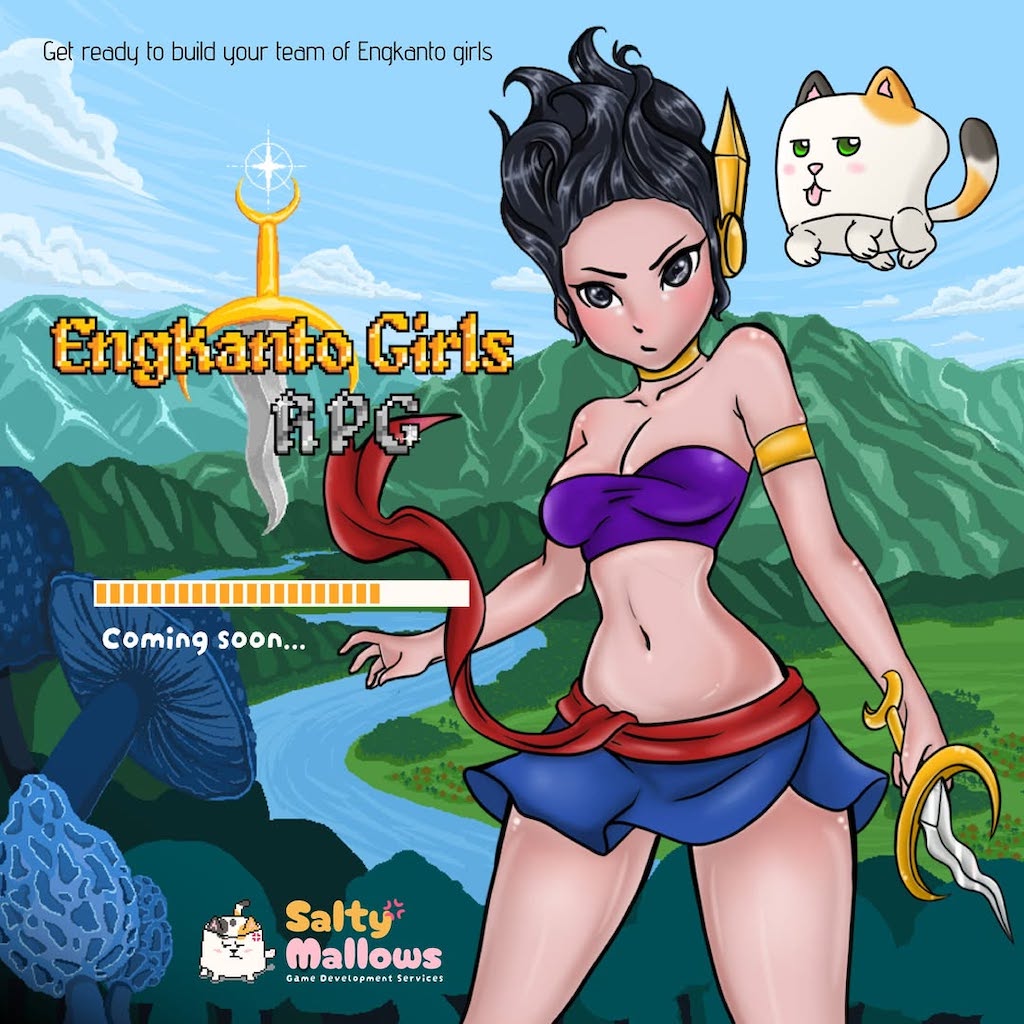
At a time when the visual novel space is saturated with familiar anime tropes and recycled character archetypes, Engkanto Girls attempts something quietly different. Drawing inspiration from Filipino folklore and blending it with light romantic visual novel conventions, the game positions itself as a cultural curiosity as much as a piece of interactive fiction. It is not an ambitious epic nor a mechanically complex title, but rather a compact, character-focused experience that leans heavily on atmosphere, charm, and cultural flavour.
What Engkanto Girls ultimately delivers is a relaxed, modestly scoped visual novel that prioritises mood and personality over narrative complexity. Its strengths are subtle rather than striking, and while it does not always fully capitalise on its thematic potential, it offers enough sincerity to feel worthwhile—particularly for players interested in folklore-inspired storytelling.
Presentation and Artistic Direction
Visually, Engkanto Girls adopts a clean, colourful anime-inspired art style that immediately establishes a lighthearted tone. Character sprites are expressive and well-defined, with clear visual identities that help distinguish each of the titular Engkanto girls. While the artwork does not reach the level of high-budget visual novels, it is consistent and competently executed, avoiding the stiffness or roughness that can plague smaller indie projects.
Backgrounds are serviceable rather than memorable, often functioning as contextual anchors rather than visual centrepieces. This is not necessarily a flaw, as the game’s focus remains firmly on character interaction rather than environmental storytelling. However, there are moments where richer background detail could have enhanced immersion, particularly when the narrative touches on its folkloric roots.
The user interface is clean and unobtrusive, making navigation straightforward even for players unfamiliar with the genre. Text is legible, menus are intuitive, and overall presentation never distracts from the storytelling. In this respect, Engkanto Girls understands its role as a narrative delivery system and executes that role competently.
Narrative and Thematic Focus
At its core, Engkanto Girls is a character-driven visual novel that places its emphasis on dialogue, light romantic tension, and cultural mythos. The game introduces players to a cast of supernatural female characters inspired by Filipino folklore, presenting them less as mythological threats and more as approachable, personable figures with distinct personalities.
The writing is generally warm and conversational, favouring gentle humour and casual exchanges over dramatic storytelling. This works in the game’s favour when establishing rapport with the characters, though it also means the overarching plot remains fairly minimal. Rather than building toward a high-stakes climax, Engkanto Girls unfolds as a series of interactions that slowly flesh out relationships and lore.
Where the game shines is in its attempt—however restrained—to weave cultural identity into its narrative. The Engkanto inspiration is not merely cosmetic; references to folklore, supernatural origins, and cultural nuance are sprinkled throughout the dialogue. That said, the game often stops short of fully exploring these ideas, opting instead to keep things accessible and light. Players hoping for deep mythological exploration may find the execution somewhat surface-level, but those looking for a relaxed introduction to the theme will appreciate its restraint.
Characters and Writing Quality
The strength of Engkanto Girls lies in its character writing. Each of the central characters is given a distinct voice and personality, allowing players to quickly form preferences. Dialogue flows naturally, with a tone that feels conversational rather than overly scripted. While some lines fall into familiar visual novel clichés, the overall writing avoids feeling lazy or overly derivative.
Romantic elements are handled with a soft touch. Rather than explicit or melodramatic scenes, the game focuses on playful banter and emotional familiarity. This approach suits the game’s relaxed pacing and makes it accessible to a wider audience, though it may feel understated to players accustomed to more intense romantic narratives.
Player choice exists but is limited in scope. Decisions influence minor dialogue variations and relationship flavour rather than radically altering the story’s direction. This reinforces the sense that Engkanto Girls is more about experiencing a specific narrative tone than shaping a highly branching storyline.
Gameplay Structure and Pacing
Mechanically, Engkanto Girls adheres closely to traditional visual novel conventions. Gameplay consists primarily of reading dialogue, making occasional choices, and progressing through the story at a steady pace. There are no mini-games, complex systems, or experimental mechanics, which keeps the experience focused but also somewhat predictable.
Pacing is one of the game’s more consistent strengths. Scenes rarely overstay their welcome, and the narrative flows smoothly from one interaction to the next. The overall length is modest, making it well-suited for short play sessions or a single extended sitting. While this brevity limits narrative depth, it also ensures the game does not become repetitive or bloated.
Replay value is present but limited. Players may wish to revisit the game to explore alternative dialogue paths or spend more time with different characters, but the lack of major branching outcomes means repeat playthroughs offer diminishing returns.
Audio and Atmosphere
Audio design in Engkanto Girls is minimal but effective. Background music is gentle and unobtrusive, reinforcing the relaxed tone without demanding attention. Tracks loop cleanly and complement the game’s mood, though there is little variety across scenes.
Sound effects are sparse, and the absence of voice acting places the burden of emotional delivery entirely on the written dialogue. Fortunately, the writing is strong enough to carry this responsibility, though voice performances could have added another layer of personality to the characters.
Final Verdict
Engkanto Girls is a modest, culturally inspired visual novel that succeeds through sincerity rather than spectacle. It does not push the boundaries of the genre, nor does it fully exploit the rich mythological foundation it draws from. However, its approachable tone, charming characters, and smooth presentation make it an enjoyable experience within its limited scope.
For players seeking a relaxed visual novel with light romance and a folkloric twist, Engkanto Girls offers a pleasant diversion. Those expecting deep narrative complexity or mechanical innovation may find it lacking, but as a compact, character-focused story, it delivers exactly what it sets out to be.