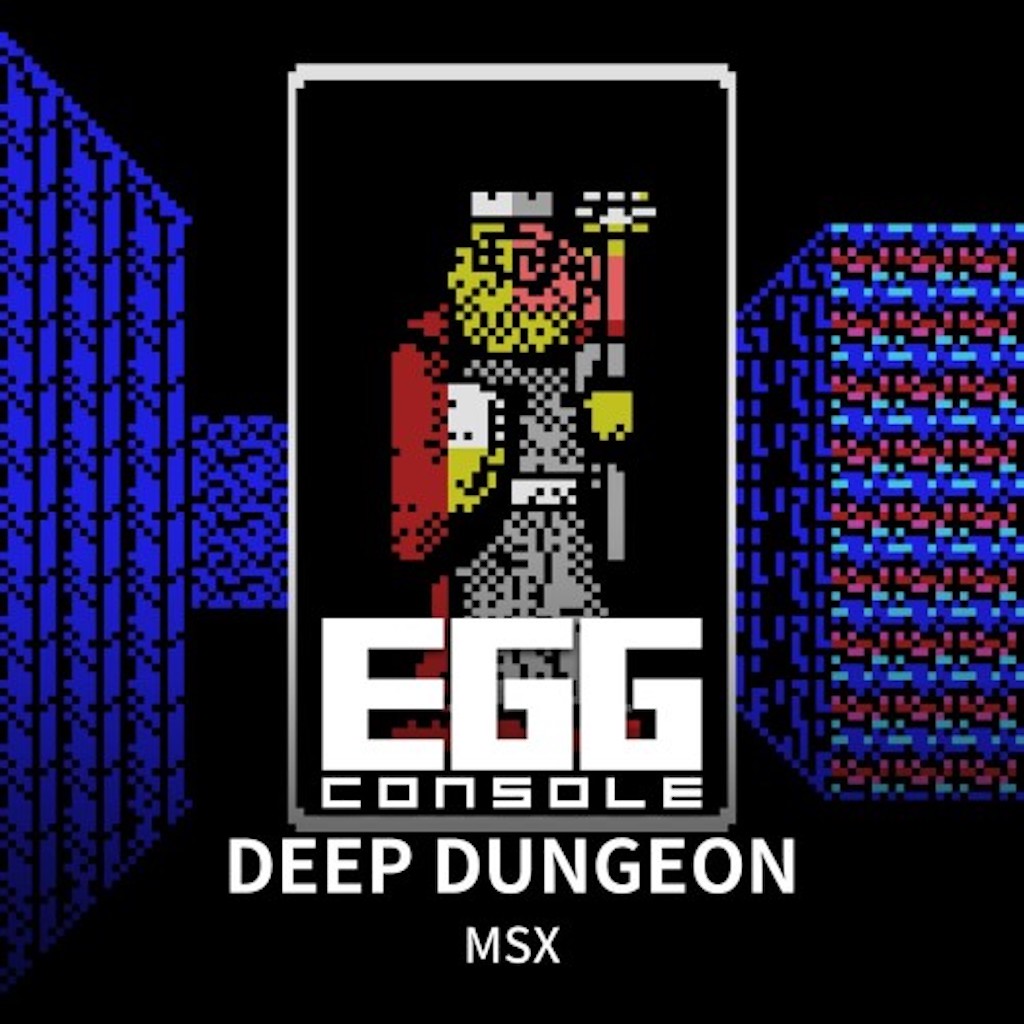
Long before we had glowing waypoints, quest markers, and auto-mapping systems, the dungeon was a place of genuine mystery. It existed partly on the television screen and partly in our imagination, built from rough sketches on graph paper and cautious notes scribbled in the margins of school notebooks. EGGCONSOLE Deep Dungeon MSX transports players directly back to that era of uncertainty. Originally developed by HummingBirdSoft and revived for modern platforms by D4 Enterprise, this 1987 dungeon crawler is less a remaster and more a preserved relic from a time when games expected players to meet them halfway. That preservation is both its greatest strength and its greatest obstacle.
Modern audiences approaching Deep Dungeon expecting streamlined retro comfort may quickly bounce off its uncompromising design. Yet for those willing to engage with its archaic rhythms, there is something undeniably compelling beneath the rough edges. Playing it feels less like revisiting an old game and more like excavating a forgotten philosophy of game design.
A Simpler Time, A Harsher One
The premise is straightforward fantasy fare. Princess Etna has been abducted, and your nameless hero is tasked with descending into a sprawling underground labyrinth to rescue her. The King provides some starting gold, a blessing, and little else. From there, you are largely left to your instincts.
There are no dramatic cutscenes or lengthy character arcs. Storytelling mostly serves as framing, pushing players deeper into the dungeon itself. In many ways, the labyrinth is the real protagonist.
What makes Deep Dungeon fascinating in 2026 is how little it explains. The game assumes patience and curiosity from the player. It trusts you to experiment, fail, and slowly learn its systems through repetition and observation. That design philosophy can feel brutal today, especially for players raised on modern RPG conveniences, but there is also an honesty to it. Nothing feels manufactured to keep your attention through constant rewards. Progress is earned slowly, cautiously, and sometimes painfully.
The Fear of Getting Lost
The first-person dungeon crawl remains the defining feature of the experience. Corridors stretch endlessly into darkness, while identical walls and twisting paths create a constant sense of disorientation. The simple, wireframe-inspired visuals of the MSX era somehow make the dungeon feel even more oppressive, leaving so much to your imagination.
Unlike modern dungeon crawlers that provide automatic mapping tools, Deep Dungeon practically demands that players create their own maps. The game does not simply encourage note-taking; it was designed around it. Every staircase, dead end, and hidden turn matters. At first, this feels exhausting. Gradually, it becomes immersive in a way modern RPGs rarely achieve.
There is genuine tension in opening a door when you are unsure whether you are even capable of finding your way back. The dungeon transforms from a collection of corridors into a mental puzzle you slowly internalise over hours of careful exploration.
Oddly enough, the absence of convenience creates a stronger sense of presence. You are not following markers. You are surviving inside a hostile maze, using memory and instinct.
Combat Built on Patience
Combat follows a traditional command-based structure, heavily inspired by early Western RPGs such as Wizardry. Encounters are entirely menu-driven, requiring players to select attacks, defend, or use items strategically.
Compared with modern JRPGs, the system is undeniably simplistic. Yet every encounter retains tension because resources remain limited and survival never feels guaranteed. Even weaker enemies can become dangerous if you are already wounded or lost deep within unfamiliar territory.
Grinding is unavoidable at times, especially in the early hours. Progression moves at a deliberate pace that may test the patience of contemporary players. Yet the slow accumulation of strength contributes to the game’s atmosphere. Victory feels meaningful precisely because the dungeon never stops feeling dangerous.
The battles themselves are not especially flashy, but they serve the larger emotional rhythm of the experience. Every fight chips away at your supplies, confidence, and sense of safety.
Preservation Over Reinvention
D4 Enterprise deserves credit for understanding exactly what the EGGCONSOLE line represents. This is preservation first and foremost. The goal is not to modernise Deep Dungeon into something more commercially accessible. Instead, the release preserves the original experience while adding a few modern tools around the edges.
The included “How to Play” guide is invaluable, particularly for players unfamiliar with older Japanese computer RPGs. Gallery features showcasing original manuals and artwork also provide important historical context.
The save state functionality is perhaps the most meaningful addition. Purists may argue that relying on save states softens the intended challenge, but modern players will likely need them. The dungeon design can be merciless, and replaying long stretches after a mistake quickly becomes exhausting without a safety net.
Still, the biggest hurdle remains the language barrier. While the EGGCONSOLE interface itself is localised, the game’s internal text remains entirely in Japanese. Menus become manageable after some trial and error, but story dialogue and certain mechanics may require external translation assistance. For some players, this limitation will be a deal-breaker. For others, it becomes part of the archaeological charm.
The Atmosphere of Isolation
Despite its technical simplicity, Deep Dungeon creates a surprisingly effective atmosphere. The sparse audio, repetitive corridors, and limited visual detail combine to form something strangely hypnotic.
There is a loneliness to the adventure that modern RPGs rarely capture. No party members chatter in your ear. No cinematic spectacle breaks the dungeon’s oppressive silence. It is just you, your map, and the growing fear that you may have wandered too far from safety.
That isolation gives the game emotional weight beyond its simple mechanics. You begin to project your own imagination onto the empty spaces. The dungeon becomes unsettling precisely because it feels so indifferent to your survival.
Even the rough edges contribute to the atmosphere. The awkward pacing, repetitive visuals, and rigid interface all reinforce the sense that this is an adventure from another era entirely.
A Relic That Demands Patience
There is no avoiding the fact that Deep Dungeon MSX feels old. Not “retro-inspired.” Old. Movement is stiff. Combat is repetitive. The interface lacks elegance. Progression can feel glacial. Without patience or historical curiosity, many players will likely abandon it within the first hour.
Yet dismissing it entirely would be unfair, as the game succeeds remarkably well at what it set out to accomplish. It captures the raw uncertainty of early dungeon crawling in a way few modern games attempt any more. Playing it today is less about chasing excitement and more about understanding the roots of the genre.
You can see fragments of future RPG ideas buried in its design. The structure, tension, and exploration systems all hint at mechanics that would later evolve into genre staples.
Final Verdict
EGGCONSOLE Deep Dungeon MSX is not an easy recommendation in the traditional sense. It is harsh, repetitive, untranslated, and unapologetically archaic. Yet within those rough edges lies an important piece of RPG history, preserved with admirable care.
For players willing to approach it as both a game and a historical artefact, there is genuine fascination here. The dungeon crawling remains tense, the atmosphere surprisingly immersive, and the sense of discovery uniquely rewarding precisely because the game refuses to guide you. This is not nostalgia polished into comfort. It is nostalgia preserved in amber, awkwardness and all. Sometimes frustrating. Sometimes fascinating. Always uncompromising.