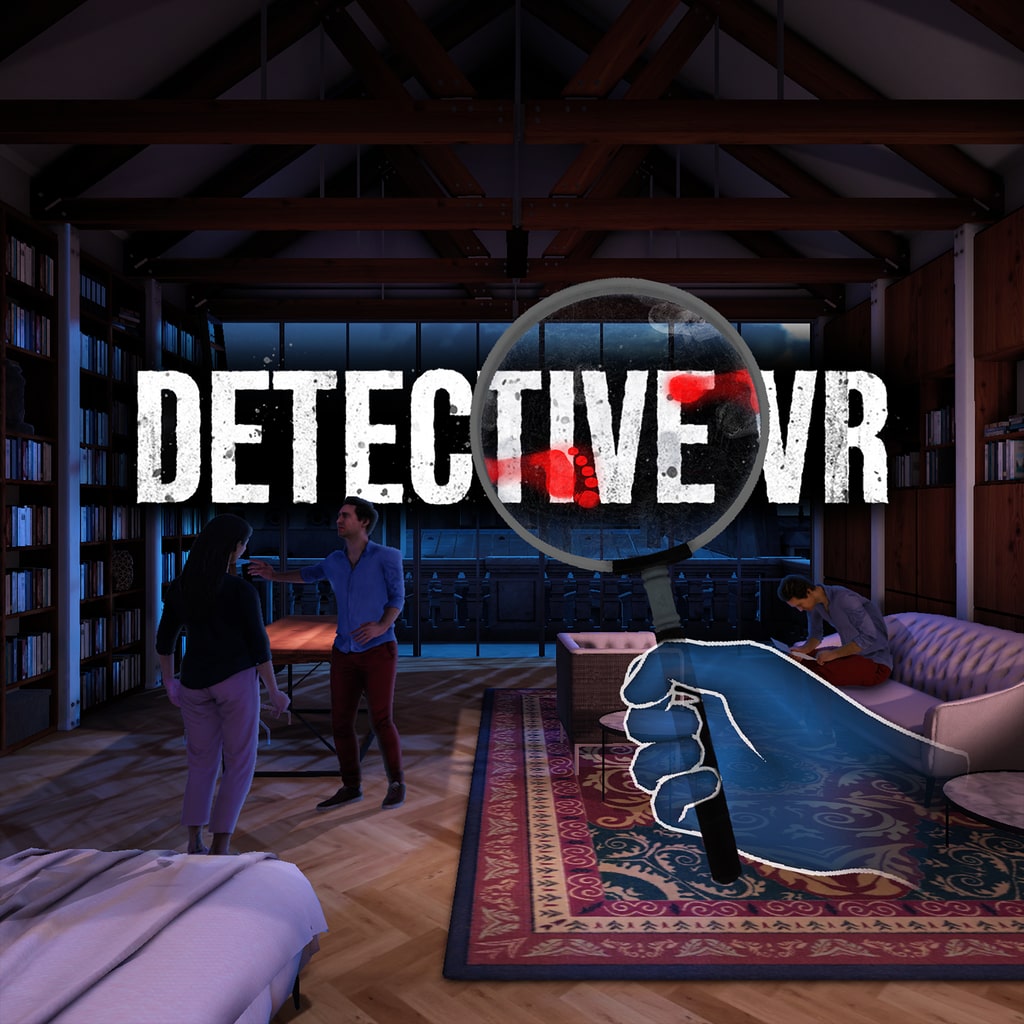
There is something wonderfully appropriate about solving a murder mystery in virtual reality. Detective stories have always asked us to look closer, question what we have been told and notice the tiny details that everyone else has missed. Detective VR takes those familiar ideas and puts them directly into your hands, allowing you to physically examine crime scenes, photograph evidence, interrogate suspects and, most intriguingly of all, manipulate time itself. It is an experience that understands the appeal of being a detective rather than simply watching one do the job.
Developed by Studio Chipo y Juan and Valem Studio, Detective VR puts you at the centre of an investigation surrounding the murder of Richard Hues, an eccentric artist whose controversial work and complicated relationships provide plenty of potential motives. There are six principal characters to investigate across eleven sequences, with around five hours of story driven gameplay to work through. It is not an enormous mystery, but the relatively compact structure works surprisingly well because the game keeps throwing new information at you rather than allowing the investigation to become bloated.
What makes Detective VR particularly interesting is that it does not simply translate a traditional detective game into VR. Instead, it uses the technology to rethink how evidence can be presented. Your physical surroundings can become part of the investigation, while the ability to rewind events lets you literally watch a crime scene unfold and search for details that might otherwise remain hidden. When everything clicks into place, there is a genuine feeling that you have solved something rather than simply selected the correct dialogue option.
Looking Beyond the Evidence
The investigation begins in fairly familiar territory. You arrive at locations, examine your surroundings and search for anything that might shed light on what happened. Photographs, fingerprints, blood patterns, objects and witness accounts all have a role to play, but Detective VR is less interested in throwing hundreds of clues at you than it is in making you question what those clues actually mean.
That distinction is important because the suspects are not exactly reliable narrators. Each character has their own version of events, and those versions do not necessarily fit together neatly. One person’s account might appear convincing until you discover a physical piece of evidence that contradicts it, forcing you to reconsider what you thought you knew. This gives the investigation a pleasing sense of uncertainty, particularly when you begin to realise that listening carefully can be just as important as searching the environment.
The interrogation sections benefit from this approach. Rather than simply exhausting a list of dialogue options, you are encouraged to confront characters with information gathered during your investigation. Finding the right contradiction at the right moment can turn an apparently straightforward conversation into something much more revealing. There is a satisfying rhythm to discovering evidence, forming a theory and then testing that theory against someone’s testimony.
Time Is Your Greatest Clue
The most interesting idea in Detective VR is undoubtedly its manipulation of time. Rather than treating a crime scene as a static location containing clues, the game allows you to rewind, pause and replay events. Suddenly, the scene becomes a moving puzzle in which people, objects and actions can all become pieces of evidence.
At first, the mechanic feels almost like having a supernatural detective ability. You can watch events unfold, rewind to an earlier moment and examine what someone was doing when you were not looking. The clever part is that the ability does not simply hand you answers. You still have to pay attention and understand what you are seeing, which means a seemingly insignificant movement can become important several minutes later.
There is a wonderful sense of discovery when you spot something hidden in the timeline. Perhaps a character moves an object, someone enters a room at an unexpected moment or an interaction happens that contradicts an earlier statement. These discoveries make you feel involved in reconstructing the crime rather than simply following a predetermined trail of clues.
Your Own Crime Lab
Virtual reality is at its best when an ordinary action suddenly feels physical and meaningful, and Detective VR gets several of these moments right. Taking photographs, examining evidence and investigating crime scenes all feel more natural when you can reach out and interact with objects yourself. Full hand tracking is supported, and while controllers remain an option, the ability to use your hands adds another layer of immediacy to the experience.
The Mixed Reality elements are arguably even more impressive. At certain points, the investigation spills into your physical surroundings, turning your real room into an extension of the detective’s workspace. Evidence can be arranged on a virtual board, with photographs, suspect information and other clues connected together to form a web of relationships. It is an excellent use of the technology because the evidence board stops being an abstract menu and starts feeling like something you are actually constructing.
There is a tactile satisfaction to picking up a photograph, examining a piece of evidence and then placing it where you think it belongs. The more connections you establish, the more the investigation begins to resemble the detective boards seen in crime dramas. It is not completely frictionless, and dense boards can occasionally become fiddly, but the concept itself is excellent.
Six Characters, Plenty of Suspicion
A murder mystery lives or dies by its characters, and thankfully Detective VR gives its relatively small cast enough personality to keep things interesting. The six central characters are brought to life through motion captured performances, helping conversations feel more like interactions between people rather than animated information dumps.
The performances also help sell the game’s central theme of uncertainty. Facial expressions, body language and changes in delivery can make you question whether somebody is nervous because they are guilty, frightened because they know something or simply uncomfortable with the situation. That ambiguity gives the investigation a human dimension that compliments the more mechanical evidence gathering.
The story does not always reach the dramatic heights that its premise suggests, but it remains engaging because there is always another question hanging over the investigation. Who is telling the truth? What are they hiding? Which details matter and which are simply distractions? Those questions provide enough momentum to keep pushing forward.
A Moody Noir World
Visually, Detective VR has a suitably atmospheric presentation. Crime scenes are generally dark and moody, with carefully controlled lighting creating an appropriately uncomfortable atmosphere. Rather than attempting to overwhelm you with visual spectacle, the game concentrates on making its locations feel like places where something has genuinely happened.
The motion captured characters are particularly important here. Seeing suspects occupy the same physical space as you makes conversations feel much more immediate than they would on a conventional screen. There are occasional moments where animations can look slightly awkward, including some minor sliding during character movements, but these issues rarely destroy the overall atmosphere.
The audio work complements the visual design nicely. A noir inspired jazz score provides much of the game’s identity, while environmental sounds and dialogue help make each investigation feel suitably tense. There are occasional inconsistencies in audio volume, particularly with recorded material, but the overall soundscape does a good job of supporting the mystery without constantly demanding your attention.
Where the Investigation Stumbles
For all its clever ideas, Detective VR is not without its rough edges. The evidence board can become a little cumbersome once you have accumulated a large number of clues, and connecting information does not always feel as intuitive as it should. There are moments when you know exactly what you want to do but spend more time wrestling with the interface than thinking about the mystery.
There is also a slight unevenness to the pacing. Some investigations move along beautifully, with each new discovery naturally leading to another question. Other sections can feel more like following instructions until the next story beat appears. Given how strong the time manipulation mechanics are, there are moments when you wish the game trusted you to experiment with them even more.
The five hour campaign is another consideration. It is long enough to tell its story without overstaying its welcome, but anyone expecting a sprawling detective epic may come away wanting more. Personally, I think the shorter structure works in its favour because the central mystery remains focused rather than becoming diluted across dozens of hours.
A Detective Game With Genuine VR Ambition
What impressed me most about Detective VR is that it understands that virtual reality should be more than simply putting a conventional game on a headset. The ability to examine scenes in three dimensions, manipulate time and construct an evidence board in Mixed Reality gives the experience its own identity. These mechanics would lose much of their impact if they were reduced to a traditional flat screen interface.
It is also refreshing to play something that rewards observation rather than reflexes. There is no need to rush around shooting enemies or completing increasingly elaborate action sequences. Instead, the satisfaction comes from noticing something, remembering something somebody said and eventually seeing how those pieces fit together.
That makes Detective VR a particularly pleasant change of pace. It is not perfect, and some of its interfaces could certainly use refinement, but there is genuine creativity here. More importantly, when you correctly identify a contradiction or uncover a hidden event by scrubbing backwards through time, the game gives you that little spark that every good detective story should deliver.
Verdict
Detective VR is an imaginative and atmospheric murder mystery that makes convincing use of virtual reality rather than treating it as a gimmick. Its combination of time manipulation, physical evidence gathering, interrogations and Mixed Reality investigation creates an experience that genuinely makes you feel like you are working a case. The story is compact, some interactions can be fiddly and the evidence board occasionally gets in its own way, but those shortcomings do little to diminish the appeal of its central ideas.
For anyone who enjoys detective games, crime dramas or simply wants to see what VR can do beyond traditional action experiences, there is plenty to enjoy here. The five hour campaign feels focused, the performances help sell the mystery and the ability to literally rewind a crime scene remains the game’s standout feature. Detective VR may not solve every problem with the detective genre, but it certainly provides a fascinating glimpse at where interactive mysteries could go next.