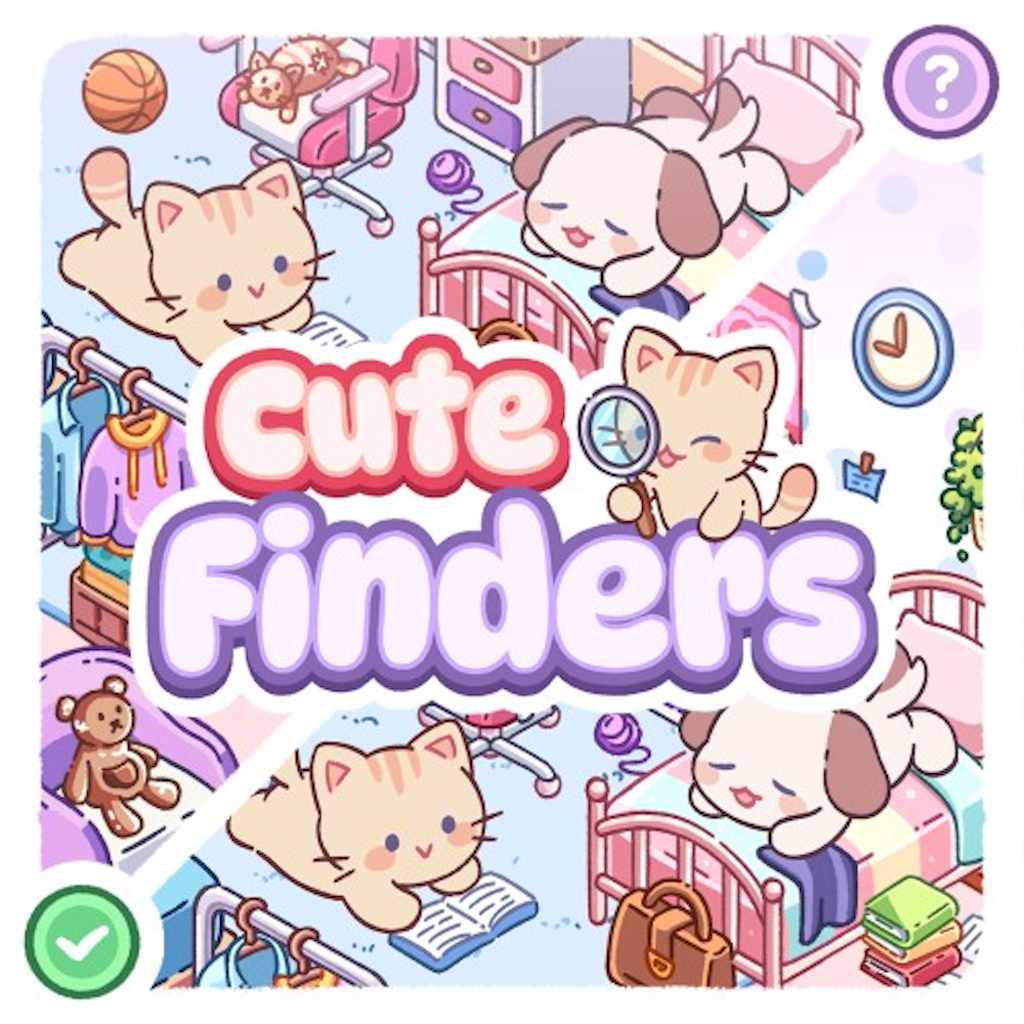
Hidden object games live and die by two things: clarity and charm. Get the first wrong and players are squinting at the screen in frustration. Get the second wrong and the whole experience feels like a checklist rather than a cosy distraction. Cute Finders understands this balance surprisingly well. What looks at first glance like a simple, budget-friendly hidden object title quickly reveals itself to be a relaxing, thoughtfully designed puzzler that leans heavily into comfort, accessibility, and cheerful presentation.
It doesn’t reinvent the genre, nor does it try to. Instead, Cute Finders focuses on doing the fundamentals right — and for the most part, it succeeds.
A World Built for Wandering Eyes
The premise is straightforward: you’re presented with busy, colourful scenes packed with objects, characters, and environmental details. Your goal is to locate a list of hidden items tucked away within the artwork. Each level presents a new scene, from cosy interiors to bustling outdoor settings, all rendered in a bright, cartoonish art style that feels immediately inviting.
The art direction is the game’s greatest strength. Every environment is packed with visual personality. Shelves overflow with knick-knacks, gardens bloom with exaggerated flora, and rooms feel lived-in rather than staged. There’s a softness to the colour palette that makes scanning the screen a pleasant activity rather than an eye-straining chore.
Importantly, objects don’t feel unfairly hidden. They are cleverly blended into the environment without ever becoming pixel-hunt nonsense. You’re challenged, but rarely frustrated.
The Satisfaction of the Search
What makes Cute Finders engaging is the rhythm of observation. Your eyes slowly learn the logic of the artwork. You begin to notice how the artists disguise shapes within other shapes. A teapot becomes part of a tree branch silhouette. A key hides within the lines of a bookshelf. The more you play, the more attuned you become to this visual language.
This creates a satisfying loop: initial overwhelm gives way to focused scanning, which gives way to small bursts of triumph as you tick items off your list.
Controls on the Switch are simple and responsive. Whether using the touchscreen in handheld mode or the analog stick and cursor while docked, the game never feels clumsy. This is essential for a hidden object title, and Cute Finders handles it gracefully.
Relaxation Over Pressure
There’s no timer breathing down your neck. No penalties for mistakes. No high-stakes scoring system. Cute Finders is built as a stress-free experience, something you can dip into for ten minutes or an hour without mental fatigue.
Hints are available if you’re stuck, but they’re never forced upon you. This reinforces the game’s laid-back philosophy: it wants you to enjoy the process, not rush through it.
The gentle background music complements this perfectly. Soft, looping tracks create a calm atmosphere that pairs beautifully with the colourful visuals. It’s easy to lose track of time while playing, slipping into a near-meditative state as you scan each scene.
Variety in Simplicity
While the core gameplay never changes dramatically, Cute Finders introduces enough variation in scene design to keep things fresh. Different environments present different visual challenges. Some scenes are densely packed and chaotic, while others are more spacious but rely on clever camouflage.
The object lists also vary in difficulty. Some items are instantly recognisable, while others require more careful scrutiny. This gentle fluctuation in challenge keeps the experience engaging without becoming exhausting.
That said, the game does stay firmly within its comfort zone. If you’re looking for puzzle mechanics layered on top of hidden object gameplay — riddles, mini-games, or narrative framing — you won’t find them here. This is a pure hidden object experience.
Aesthetic Appeal Carries the Experience
There’s a charm to Cute Finders that’s hard to quantify. The art style is cheerful without being childish, detailed without being cluttered. It feels designed to make players smile rather than impress them technically.
This makes the game especially suitable for players looking for a cosy, low-commitment experience. It’s easy to recommend to younger players, casual gamers, or anyone wanting something soothing between more demanding titles.
However, this same simplicity may limit its appeal for players seeking depth or long-term engagement. Once you’ve completed the scenes, there’s little reason to return beyond replaying for comfort.
Where It Shows Its Budget Roots
For all its charm, Cute Finders is unmistakably a budget title. There’s no overarching story, no progression system, and minimal extras. The UI is functional but basic. Menus are simple, and presentation outside the artwork itself is utilitarian.
This isn’t a dealbreaker, but it does make the experience feel lightweight. You’re here for the hidden object scenes and little else.
Longevity is another consideration. Depending on how quickly you work through levels, you may see everything the game has to offer in a handful of sessions.
Who Is Cute Finders For?
This is a game designed for relaxation. It’s perfect for winding down in the evening, playing in short bursts, or enjoying alongside a cup of tea. It’s also ideal for players who enjoy observational puzzles without the pressure or complexity of more demanding games.
If you appreciate art, calm gameplay, and the quiet satisfaction of spotting cleverly hidden details, Cute Finders delivers exactly what it promises.
If you want narrative, challenge, or mechanical depth, this may feel too slight.
Verdict
Cute Finders doesn’t try to be more than it is — a charming, well-crafted hidden object game focused on relaxation and visual delight. Its colourful artwork, intuitive design, and stress-free pacing make it an enjoyable palate cleanser between bigger titles.
It may lack depth and replay value, but what it does, it does well.