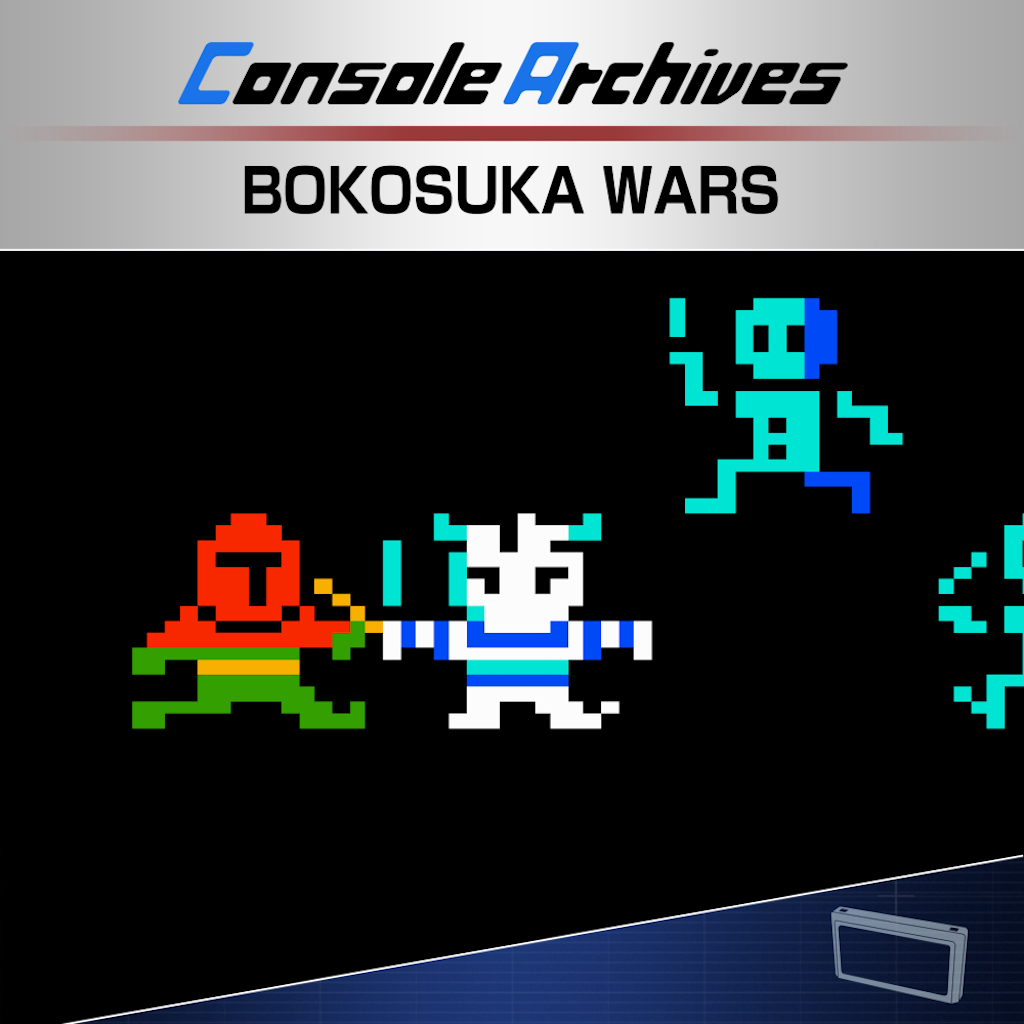
Modern players often take genre conventions for granted. Tactical RPGs, strategy games, and squad-based adventures all follow familiar rules refined over decades of development. Yet every genre has an origin point, a moment when someone attempted something completely new without knowing whether it would work. Console Archives: BOKOSUKA WARS is one such moment, frozen in time.
Originally released on home consoles in 1985 by ASCII, BOKOSUKA WARS has long occupied a curious place in gaming history. Frequently cited as one of the earliest ancestors of both tactical role-playing games and real-time strategy titles, it predates many of the mechanics that would later become industry standards. Now, thanks to Hamster Corporation’s Console Archives line, a new generation can experience this peculiar piece of gaming history on modern hardware.
The result is a package that is equal parts educational, entertaining, frustrating, and utterly baffling. BOKOSUKA WARS remains as unconventional today as it was over forty years ago. It is not always enjoyable in the traditional sense, but it is almost impossible not to admire it.
The King’s Lonely March
The story could hardly be more straightforward, yet it carries a fairy-tale charm that suits the game’s age. Players assume the role of King Suren, ruler of the Kingdom of Suren, which has fallen under the control of the evil King Ogoreth and the Basamu Empire. Using dark magic, Ogoreth has transformed Suren’s loyal soldiers into trees, rocks, and other harmless objects scattered across the land.
Armed with little more than determination and a sword, King Suren sets out to reclaim his kingdom. Along the way, he must rescue his cursed allies, rebuild his army, and march directly towards Basamu Castle to confront the tyrant responsible for the kingdom’s downfall.
There are no lengthy cutscenes, dramatic plot twists, or emotional character arcs. The narrative exists primarily to provide context for the gameplay. Yet there is something undeniably charming about its simplicity. It feels like an old fantasy tale discovered in a dusty storybook, told with sincerity and without unnecessary complication.
A Strategy Game Before Strategy Games Existed
The most fascinating aspect of BOKOSUKA WARS is how difficult it is to categorise. At first glance, it resembles a simple side-scrolling action game. Moments later, it begins to behave like a strategy title. Then it introduces RPG elements. Before long, it becomes clear that the game operates according to its own unique set of rules.
Rather than commanding units individually, players guide King Suren across a horizontally scrolling battlefield. Every allied soldier moves alongside him, creating a constantly shifting formation that can quickly spiral into chaos. As you advance, transformed allies are restored to their original forms, expanding your army and increasing your chances of survival.
Different unit types serve different purposes. Knights can free imprisoned soldiers, basic troops can disarm traps, and King Suren himself is the only character capable of destroying certain barriers. Losing the king immediately ends the game, making his survival your highest priority throughout the journey. The concept is surprisingly ambitious for its era. Unfortunately, ambition and accessibility are not always the same thing.
Chaos Rules the Battlefield
Much of BOKOSUKA WARS centres on managing disorder. Because every unit moves together, maintaining a coherent formation is extraordinarily difficult. Soldiers become separated by obstacles, trapped in narrow pathways, or intercepted by enemy patrols. Before long, your carefully assembled force can resemble a scattered collection of survivors desperately trying to find their way home.
Combat only adds to the unpredictability. When opposing units collide, battles are resolved automatically by hidden calculations and random chance. Sometimes your strongest knight effortlessly defeats multiple enemies. Other times, that same knight falls instantly to a basic foot soldier, for reasons that remain completely invisible to the player.
This randomness creates a unique tension. Every encounter carries genuine risk because certainty never exists. Yet it can also generate moments of frustration when carefully planned strategies collapse due to unfavourable luck.
Modern strategy fans may find this difficult to accept. Contemporary tactical games usually provide transparent systems and predictable outcomes. BOKOSUKA WARS offers neither. Instead, it demands adaptability, patience, and a willingness to embrace uncertainty.
Modern Features Save the Day
Had this re-release simply presented the original game without modification, it would be an incredibly difficult recommendation. Fortunately, Hamster Corporation understands the challenges of preserving older software. The emulation package includes an excellent set of quality-of-life features that dramatically improve the experience without compromising authenticity.
Save states let players preserve progress at any moment. The rewind function is particularly valuable, allowing mistakes to be undone instantly. When an important unit falls victim to an unfortunate combat roll, players can simply reverse time and try again.
Customisable controls, display options, and screen filters further enhance the package. Whether you prefer sharp, pixel-perfect visuals or a nostalgic CRT-style presentation, the options provide considerable flexibility.
These additions transform BOKOSUKA WARS from an often punishing relic into a far more approachable historical experience. Purists can ignore these tools if they wish, but their inclusion makes the game infinitely more welcoming to modern audiences.
A Window Into Gaming’s Past
Visually, BOKOSUKA WARS is unmistakably a product of the mid-1980s. Character sprites are simplistic, environments are sparse, and animation is minimal. Yet the presentation retains a clarity that remains effective. Every object serves a purpose, and important information is communicated efficiently despite the era’s technological limitations.
What truly stands out is how much imagination the game demands of its audience. Much like early fantasy novels or tabletop games, the primitive visuals encourage players to fill in the gaps themselves. The kingdom feels larger than what appears on screen because the player’s imagination completes the picture.
The soundtrack is equally memorable. The game’s iconic looping melody is catchy, energetic, and impossible to forget. Whether that is a blessing or a curse depends entirely on how long you spend playing. Long sessions can test your patience, but there is an undeniable charm in its relentlessly cheerful repetition.
More Historical Artefact Than Modern Game
The biggest challenge facing BOKOSUKA WARS is simply the passage of time. Many design choices that felt experimental in 1985 now feel awkward or unintuitive. Unit management lacks precision, combat lacks transparency, and progression often feels as dependent on luck as on skill. These elements can create barriers that modern players may struggle to overcome.
The game’s brevity also limits its appeal. Once you understand its systems, a successful run can be completed relatively quickly. There is little long-term progression or content beyond mastering the mechanics and appreciating their historical significance. For some players, that will be enough. For others, curiosity may fade long before the final confrontation with King Ogoreth.
Final Verdict
Console Archives: BOKOSUKA WARS is not an easy game to recommend in the conventional sense. It is often confusing, occasionally unfair, and undeniably archaic. Yet those same qualities are part of what makes it so fascinating.
This is gaming history preserved in playable form. It captures a moment when developers were still discovering what strategy games could become, experimenting with ideas that would eventually influence entire genres. Thanks to Hamster Corporation’s thoughtful emulation features, modern players can experience that history without enduring every frustration the original release imposed.
Those seeking a polished tactical experience should look elsewhere. Those interested in understanding where tactical RPGs and strategy games began will find something genuinely special here.