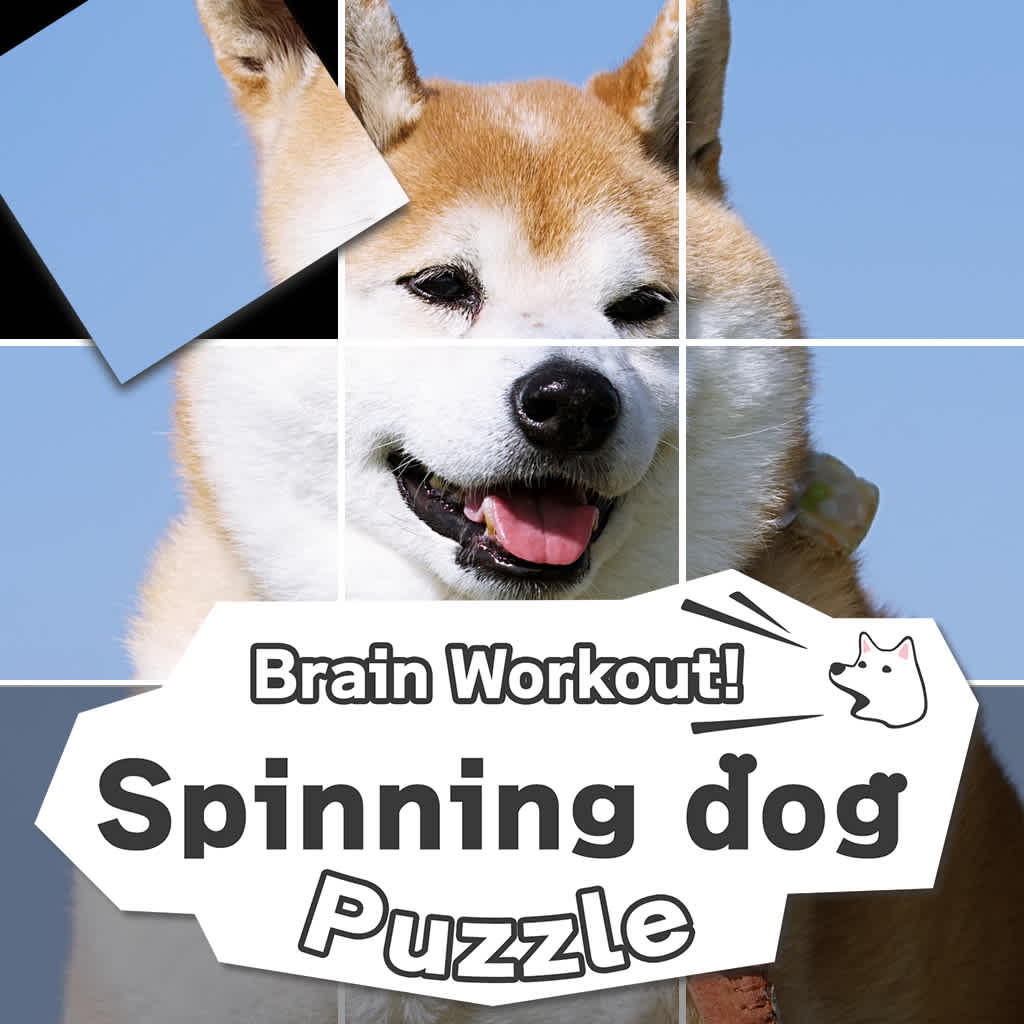
Brain Workout! Spinning Dog Puzzle arrives as a light, approachable puzzle title that leans into simplicity, charm, and steady cognitive engagement. Designed primarily for short, focused play sessions, it centres around a single core mechanic—rotating panels to correctly align images of dogs—yet manages to extract surprising depth from that limited foundation. It’s a game that understands its audience and scope, aiming not to overwhelm but to gently challenge and reward logical thinking over time.
While it never attempts to redefine the puzzle genre, Spinning Dog Puzzle succeeds by refining its idea, presenting it clearly, and supporting it with a scoring system that encourages mastery rather than mere completion. The result is a modest but well-considered experience, particularly suited to portable play.
A Simple Concept Executed with Clarity
At its heart, Brain Workout! Spinning Dog Puzzle is built around a grid of image tiles, each depicting a portion of a dog illustration. Every tile can be rotated independently, and the objective is to rotate them into their correct orientation so the full image makes visual sense. The controls are immediate and intuitive—select a tile, rotate it, and move on—making the game instantly understandable even for players with little experience in logic puzzles.
This clarity of concept is one of the game’s greatest strengths. There are no hidden mechanics, no unexpected rule changes, and no reliance on trial-and-error gimmicks. Every puzzle is transparent in its logic: if something isn’t aligned correctly, it’s visible at a glance. This ensures that failure feels like a learning moment rather than a punishment.
Presentation — Wholesome and Purposeful
Visually, the game leans heavily into a soft, friendly aesthetic. The dog illustrations are cheerful and expressive, giving each completed puzzle a sense of warmth and satisfaction. The backgrounds are deliberately understated, ensuring that the focus remains firmly on the grid and its pieces.
The interface is clean and well-structured. Buttons are clearly labelled, menus are minimal, and visual feedback is immediate. When a tile is rotated correctly, the game provides subtle confirmation cues that reinforce progress without breaking immersion. It’s a functional presentation rather than a flashy one, but that restraint works in the game’s favour.
Audio design is equally subdued. Light sound effects accompany rotations and completions, while the background music remains calm and unobtrusive. This makes the game particularly well-suited to longer sessions, as nothing in the audio design becomes fatiguing or distracting.
Puzzle Design and Mechanical Depth
Although the basic action—rotating tiles—never changes, the way puzzles are constructed evolves steadily. Early levels use small grids with forgiving layouts, allowing players to grasp the logic without pressure. As progression continues, grids grow larger and require more careful sequencing, with mistakes early in a puzzle often complicating later steps.
This creates a gentle but effective difficulty curve. Later puzzles reward planning and pattern recognition rather than reactive correction. Players begin to scan the grid holistically, identifying clusters of tiles that can be solved together and avoiding unnecessary rotations that might disrupt other sections.
Adding depth to this structure is the scoring system. Each level awards up to three “puppies” based on performance metrics such as speed and move efficiency. Simply completing a puzzle is rarely difficult, but achieving a perfect score often requires replays, optimisation, and deliberate strategy. This dual-layer design allows casual players to enjoy steady progression while offering dedicated puzzle fans something more demanding to pursue.
Hint System — Support Without Compromise
The hint system in Spinning Dog Puzzle is thoughtfully implemented. Players are allowed a limited number of hints per level, each of which resolves an entire row of tiles automatically. This provides a meaningful assist without trivialising the challenge.
Importantly, using hints affects scoring, ensuring that players are never incentivised to rely on them if they are chasing perfection. This balance makes the game accessible without undermining its integrity. Newcomers can progress without frustration, while experienced players can push themselves to solve puzzles unaided.
Progression and Structure
The game’s progression is linear and predictable, but not monotonous. Each new set of puzzles introduces slightly more complex layouts rather than entirely new mechanics. This consistency helps reinforce mastery of the core system, though it also highlights the game’s limited scope.
There are no alternate modes, time attack variants, or radically different puzzle types. Everything revolves around the same foundational mechanic. While this keeps the experience cohesive, it does limit variety, particularly for players who complete large portions of the game in a short time.
Still, the steady pacing and lack of pressure make the game ideal for dipping in and out. It’s a title that fits naturally into handheld gaming routines, offering satisfying mental engagement without demanding prolonged focus.
Accessibility and Learning Curve
Brain Workout! Spinning Dog Puzzle is accessible by design. There are no time limits forcing rapid decisions, no penalties for experimentation, and no fail states beyond restarting a level. Players are free to undo actions, reset puzzles, and think through solutions at their own pace.
The learning curve is smooth, and the absence of complex secondary systems ensures that the challenge remains purely logical. This makes the game suitable for a wide audience, including younger players, older players, or anyone seeking a low-stress cognitive workout.
Replayability and Longevity
Replay value is primarily driven by completionism. Players aiming to earn maximum scores on every puzzle will find plenty of incentive to return, refining strategies and shaving off unnecessary moves. Collecting all visual rewards and filling out progression trackers adds further motivation.
However, once all puzzles are solved and perfected, there is little to extend the experience further. The lack of procedural generation, daily challenges, or community features means that long-term engagement depends heavily on personal goals rather than evolving content.
Verdict
Brain Workout! Spinning Dog Puzzle is a small, focused, and thoughtfully designed puzzle game that succeeds by knowing exactly what it wants to be. Its strength lies in clarity, accessibility, and a scoring system that encourages deeper engagement without excluding casual players. While it lacks the variety and longevity of larger puzzle titles, it delivers a consistently satisfying experience within its modest scope.
For players looking for a relaxing, charming logic game that rewards careful thinking and incremental mastery, Spinning Dog Puzzle is an easy recommendation.