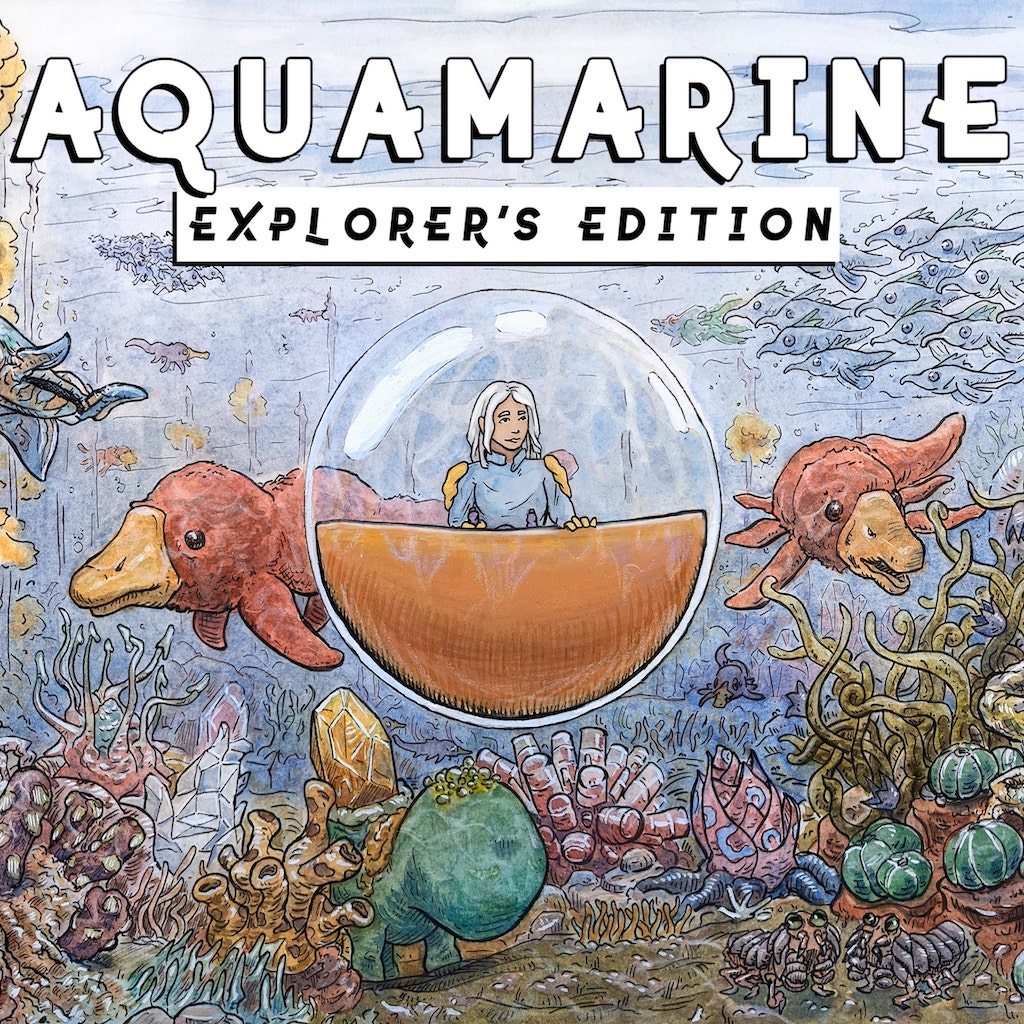
Some games demand reflexes. Others demand patience. Aquamarine: Explorer’s Edition asks for something rarer — attention.
Originally released on PC in 2022 and now arriving on consoles as its definitive edition, Moebial Studios’ atmospheric survival adventure stands apart from almost everything else in the genre. Rather than building tension through combat or resource panic, Aquamarine centres on quiet observation, strategic movement, and visual storytelling.
Described as a “playable comic book,” the comparison isn’t marketing exaggeration. Every moment feels carefully composed, every decision deliberate, and every movement through its alien ocean carries weight.
The result is a deeply contemplative experience — beautiful, unusual, and occasionally demanding in ways modern games rarely are.
Stranded in Silence
You play as The Seeker, a lone astronaut forced to abandon orbit after a mysterious signal disables their ship. Crash-landing on a small island surrounded by an endless alien sea, survival becomes a slow journey towards understanding both the planet and the circumstances that brought you there.
Narrative delivery is minimalist. Dialogue is sparse, and exposition is nearly absent. Instead, storytelling unfolds through exploration, environmental clues, and subtle discoveries scattered throughout the world.
This restraint works in the game’s favour. Rather than guiding players through a scripted narrative, Aquamarine encourages interpretation. The mystery grows organically as you uncover remnants of lost civilisations and observe the planet’s strange ecosystems.
It’s science fiction told through atmosphere rather than spectacle — closer to reflective literary sci-fi than traditional video game storytelling.
Turn-Based Survival: Every Move Matters
At first glance, Aquamarine resembles a traditional exploration game. In practice, it plays more like a strategic puzzle.
Exploration proceeds through turn-based “plunges” into the alien ocean using your amphibious survival pod. Each action — moving, scanning, harvesting resources — consumes energy and oxygen. Every decision therefore carries consequences.
Rush forward recklessly, and you risk becoming stranded without enough power to return safely.
This system turns navigation into planning rather than reaction. Players must read each screen carefully, identifying threats, safe routes, and useful resources before committing to movement.
It’s survival gameplay stripped of chaos and rebuilt around foresight.
The pacing initially feels slow, especially for players accustomed to real-time exploration games. But once the rhythm clicks, tension emerges from decision-making itself. Even small movements feel meaningful because mistakes are rarely reversible.
Survival Without Violence
Perhaps Aquamarine’s boldest design choice is its rejection of combat.
The alien ocean teems with strange and sometimes dangerous wildlife, yet fighting is never the solution. Survival depends on avoidance, understanding, and adaptation.
Creatures behave according to ecosystem logic rather than scripted hostility. Some respond to light, others to movement patterns or environmental changes. Observing these behaviours allows players to manipulate situations indirectly — by hiding behind flora, timing their movements carefully, or using environmental features for protection.
This focus on coexistence rather than domination gives the game a uniquely peaceful tension. Danger exists, but aggression is rarely the answer.
It’s survival through knowledge rather than power.
Ecosystem Study and Discovery
The world is divided into three distinct ecosystems, each with its own visual identity and biological rules.
Learning how these environments function becomes a core gameplay loop. Plants can provide fuel, concealment, or nourishment. Creatures interact in ways that can be exploited strategically once understood.
The Explorer’s Edition significantly expands these interactions through improved crafting and deeper ecosystems. Players can cultivate alien plants, craft tools, and tailor pod upgrades to suit specific environments.
Progression feels organic rather than linear. You don’t simply unlock abilities — you learn how the world works.
That sense of discovery is one of the game’s most rewarding aspects.
Art Direction: A Living Moebius Illustration
Visually, Aquamarine is extraordinary.
Heavily inspired by the psychedelic sci-fi artwork of Jean Giraud (Moebius), every screen feels like a hand-drawn panel from a vintage European comic. Fine pen-and-ink linework combines with surreal colour palettes to create environments that feel alien yet strangely serene.
The 4K presentation on PS5 and Xbox Series X enhances this dramatically. Lines remain crisp, colours luminous, and compositions striking even on large displays.
Unlike many visually ambitious games, Aquamarine avoids visual clutter. Each frame communicates information clearly while maintaining artistic elegance.
It’s less about graphical fidelity and more about visual identity — and few games achieve such cohesion.
Sound Design and Atmosphere
Audio complements the visuals perfectly.
Ambient soundscapes dominate: distant echoes, underwater currents, and subtle musical textures create a meditative atmosphere. Music appears sparingly, allowing silence to carry emotional weight.
The absence of constant audio stimulation reinforces the game’s reflective tone. Exploration feels solitary, almost introspective.
It’s a rare example of restraint enhancing immersion rather than diminishing it excitement.
Controller Support and Console Adaptation
The console version benefits from refined controller support introduced in the Explorer’s Edition update.
Navigation menus feel intuitive, movement remains precise, and inventory management avoids unnecessary friction. The slower pace of gameplay translates naturally to controllers, arguably making the experience feel more relaxed than on PC.
Performance remains stable across platforms, with smooth transitions and quick loading, maintaining immersion.
The Challenge of Patience
Despite its many strengths, Aquamarine will not appeal universally.
Its deliberate pacing demands patience and attention. Players expecting constant rewards or action-driven progression may struggle with its contemplative design.
Failure can also feel punishing when poor planning leads to lost resources or a forced retreat. The game rarely explains solutions outright, trusting players to observe carefully — a philosophy some may find refreshing, others frustrating.
But these traits are intentional. Aquamarine is designed to be experienced slowly.
Pros & Cons
Pros
- Stunning hand-drawn Moebius-inspired art style
- Unique non-combat survival mechanics
- Thoughtful turn-based exploration system
- Deep environmental storytelling
- Relaxing yet tense atmosphere
- Excellent console optimization
Cons
- Slow pacing won’t suit all players
- Minimal narrative guidance
- Occasional trial-and-error progression
- Limited traditional “action” gameplay
Final Verdict
Aquamarine: Explorer’s Edition is not merely a survival game — it’s an experience built on curiosity, observation, and quiet discovery. By rejecting combat-heavy conventions and embracing thoughtful exploration, Moebial Studios creates something rare: a game that feels meditative without becoming dull.
Its stunning art direction ensures lasting visual impact, while its turn-based survival mechanics encourage players to engage intellectually rather than react instinctively.
This isn’t a game about conquering a world. It’s about learning to exist within one.
For players willing to slow down and meet it on its own terms, Aquamarine becomes deeply absorbing — a serene yet mysterious journey through an alien ocean unlike anything else currently available on consoles.