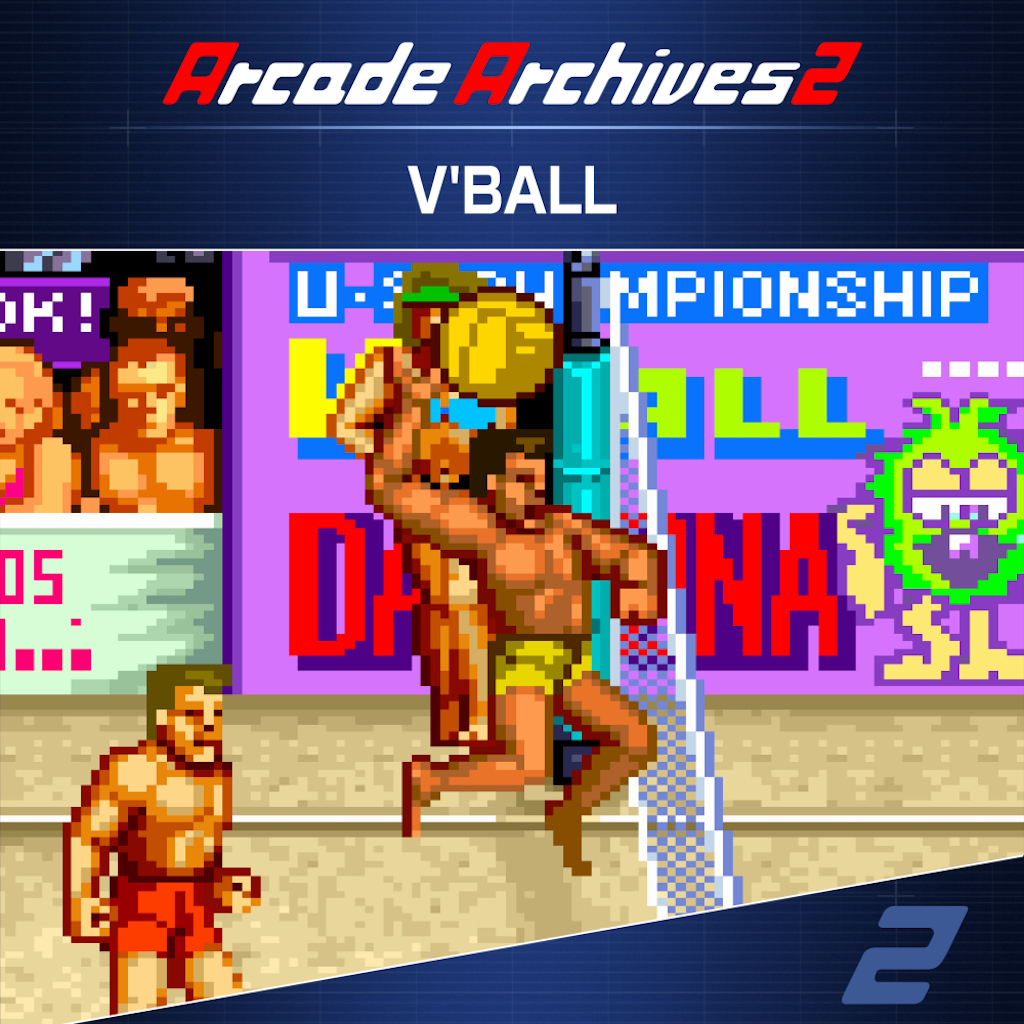
There are arcade games you remember for being technically brilliant, for being everywhere, and for simply being enormous fun. V’BALL belongs firmly in that last category. Technōs Japan’s 1988 take on beach volleyball is wonderfully uncomplicated on the surface, but beneath its bright beaches and energetic matches lies a surprisingly tactile little sports game. Arcade Archives 2 V’BALL brings that experience back with the sort of preservation features modern players have come to expect, while leaving the original personality intact. The result is a charming reminder that arcade sports games did not need complicated systems to become addictive.
Welcome To The Beach
The premise could hardly be simpler. You control a pair of young men competing in a beach volleyball tournament, with the ultimate goal of becoming champions. There are no sprawling career modes, elaborate character creation systems or endless menus standing between you and the action. You pick up the controller, step onto the sand and start trying to put a volleyball somewhere your opponents cannot reach.
That simplicity is a big part of the appeal. V’BALL feels like a game designed so that someone can understand what is happening within seconds of watching another person play. The ball comes over, you react, set it up and attempt to smash it back with enough force to leave your opponents scrambling. It is immediately readable, yet there is enough timing and positioning to make getting genuinely good at it surprisingly rewarding.
Two Against Two
The two-on-two format gives V’BALL a natural sense of teamwork. You are not simply controlling one player and chasing the ball around the court, because your partner becomes an important part of every exchange. Good positioning can set up a powerful attack, while poor positioning can leave you desperately trying to cover too much sand at once.
That makes even straightforward rallies feel surprisingly tense. A well-placed serve can put pressure on the opposing team, while a well-timed block can completely change the momentum of a point. There is something wonderfully physical about the way the game communicates these actions despite its simple controls. You can almost feel the difference between a weak return and a well-timed power spike.
Smash It
The spike is arguably where V’BALL finds its personality. Rather than simply pressing a button and watching the same attack animation play out, the game gives you a little more control over how you approach your offence. You can influence where the ball goes on serves and spikes, while rapidly tapping the controls can produce a considerably more powerful strike.
That rapid-tapping mechanic is pure arcade design. It is not elegant, and it certainly would not pass for a realistic volleyball simulation today, but it creates exactly the kind of frantic physicality that made games like this so memorable. When you know a big spike is coming and start hammering the button, there is a strange sense of excitement in the sheer ridiculousness of it. It feels like you are willing your character to hit the ball harder through sheer determination.
A Tournament Around America
V’BALL also benefits from its colourful tour of beach locations. Matches take place across a variety of American settings, giving the tournament a sense of progression even though the core gameplay remains wonderfully consistent. Daytona Beach, New York and Hawaii provide distinct backdrops, helping each stage feel like another stop on a larger sporting adventure.
The environments are hardly elaborate by modern standards, but that is not really what matters here. The bright colours, animated crowds and changing scenery give the game a sense of place without distracting from the volleyball itself. There is an almost postcard quality to the presentation, capturing a version of late 1980s beach culture that feels unmistakably tied to the era.
Arcade Difficulty
As with many games from the period, V’BALL is not always interested in making things easy for you. The computer-controlled opponents can quickly expose weaknesses in your positioning and timing, particularly as the tournament progresses. A player who simply smashes the ball repeatedly will eventually discover that the opposition is perfectly capable of returning the favour.
This is where the game’s arcade roots become apparent. V’BALL wants you to learn by playing, losing and trying again. There is no lengthy tutorial explaining every mechanic, because the expectation is that you will experiment until the rhythm begins to make sense. Once it clicks, the game becomes far more enjoyable, and what initially seemed simple reveals subtle nuances in positioning, timing and attack selection.
The Joy Of Local Multiplayer
V’BALL is arguably at its best when someone is sitting beside you. Local multiplayer gives the game an entirely different energy because human opponents are far less predictable than the computer. A friendly match can quickly turn competitive, especially when someone discovers they are particularly good at blocking your favourite attack.
That is the magic of these old arcade sports games. They are not necessarily designed around long-term progression. They are designed to create stories between players, whether that means an incredible comeback, a ridiculous rally, or the sort of defeat that immediately demands a rematch. V’BALL has that quality in abundance, and it remains one of its greatest strengths nearly four decades later.
Arcade Archives 2 Does The Rest
The original game may have been designed for an arcade cabinet, but Arcade Archives 2 makes the transition to modern hardware remarkably smooth. The usual collection of useful options is here, including difficulty adjustments, display settings, rewind functionality and multiple save slots. Being able to rewind a particularly painful mistake might feel like cheating compared with the original arcade experience, but it is an entirely welcome option when you simply want to enjoy the game without repeatedly falling into the same frustrating situation.
The addition of Time Attack Mode is another worthwhile inclusion. Rather than focusing on score, this mode asks you to clear the game as quickly as possible, offering a different reason to return once you have mastered the standard experience. The traditional Original, Hi Score and Caravan modes also provide plenty of opportunities for players who want to chase personal records or compete against the wider community.
Online rankings are particularly appropriate for a game like V’BALL. Once you have learned the mechanics and started shaving seconds or improving your scores, there is something satisfying about seeing how your performance compares with other players. Variable Refresh Rate support also helps recreate the original arcade experience more closely on compatible displays, which will matter to enthusiasts who want their retro games to feel as authentic as possible.
A Simple Game With Plenty Of Character
The biggest criticism you could reasonably make of V’BALL is that its simplicity may limit its appeal to players accustomed to modern sports games. There are no enormous rosters, detailed statistics or complicated progression systems to keep you playing for dozens of hours. Once you have seen the available locations and learned the mechanics, there is relatively little mystery left.
Yet I am not convinced that is a serious problem. V’BALL was never trying to be a comprehensive volleyball simulation. It is an arcade game, and its purpose is to get you playing quickly, make you laugh or shout at the screen, and tempt you into another match. Judged by that standard, it succeeds remarkably well.
There is also something refreshing about a game that knows exactly what it wants to be. The modern industry can sometimes mistake complexity for depth, adding system upon system when a well-designed core mechanic would have been enough. V’BALL demonstrates the opposite approach. It takes serving, passing, spiking and blocking and turns those basic ideas into something immediately enjoyable.
Final Verdict
Arcade Archives 2 V’BALL is a lovely piece of arcade history and a particularly enjoyable reminder of how inventive Technōs Japan could be beyond its better-known fighting and beat ’em up catalogue. Its controls are accessible, its matches are energetic, and the two-on-two format gives the action enough tactical flavour to remain interesting beyond the novelty of its age. The power spikes are ridiculous in exactly the right way, while the tournament structure provides enough progression to keep you moving from one beach to the next.
The modern additions make this an easy recommendation for retro enthusiasts, particularly those who appreciate having rewind, save states, display options, online rankings and Time Attack Mode available without interfering with the original experience. It may not have the depth of a modern volleyball game, but that is hardly the point. V’BALL is a compact arcade experience that understands the value of immediacy, competition and just hitting a volleyball really, really hard.
For anyone who grew up with Technōs Japan’s arcade output, this is a welcome trip back to the sand. For newcomers, it is a fascinating example of how much fun could be squeezed out of a handful of buttons and a great idea. It is simple, colourful and occasionally gloriously chaotic, but most importantly, it is still fun.