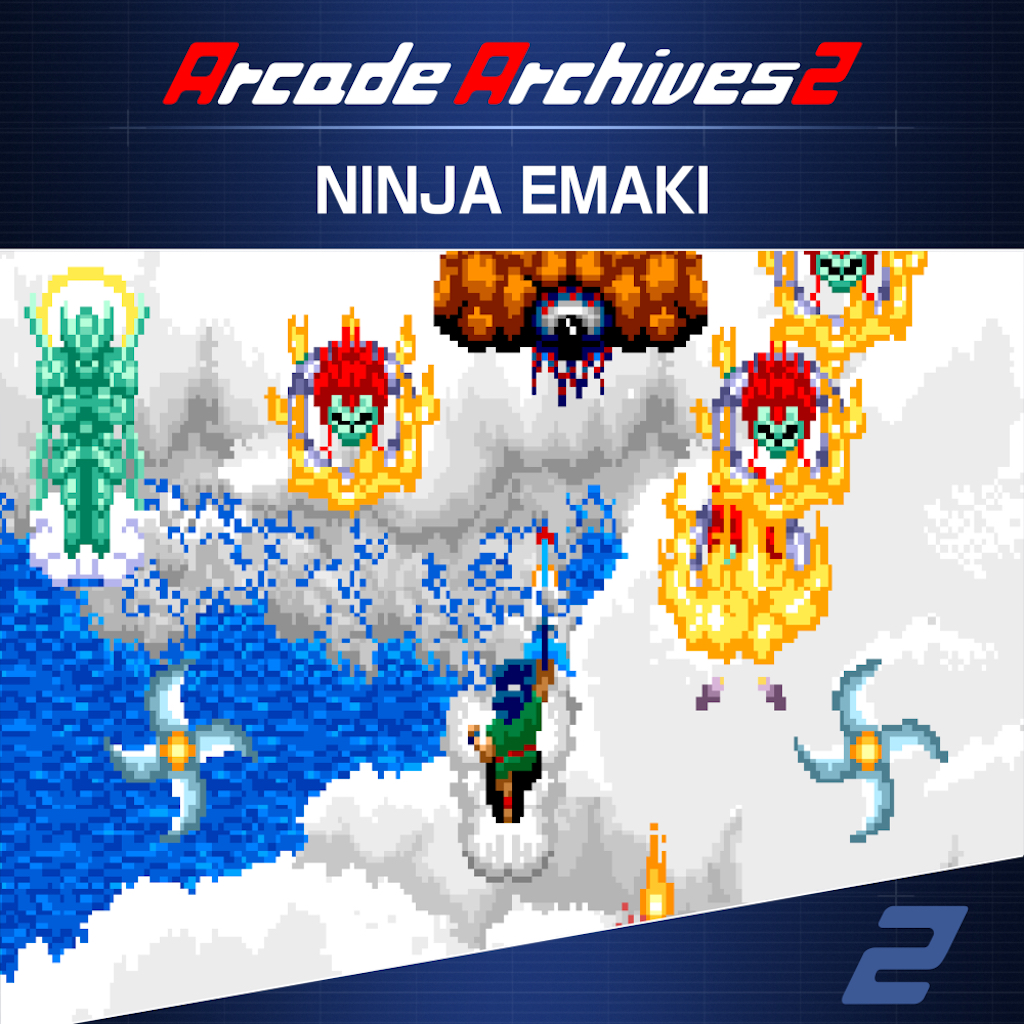
There is a particular charm to discovering an arcade game that has somehow slipped through the cracks of history. While the likes of Pac-Man, Galaga and Donkey Kong became household names, countless other games were fighting for attention in darkened arcades at the same time. Arcade Archives 2 NINJA EMAKI is one such curiosity, bringing Nichibutsu’s 1986 ninja shooter back into the light and giving modern players the chance to rediscover what might have been a forgotten favourite for an entirely different generation.
At its heart, NINJA EMAKI is a wonderfully straightforward tale of good versus evil. You take control of Shinbei, a young ninja tasked with rescuing a princess from an army of evil spirits. It is exactly the sort of setup classic arcade games excelled at, giving you just enough story to understand what you are doing before throwing you straight into danger. There is no lengthy introduction, no complicated lore to absorb, and certainly no twenty-minute tutorial explaining how to throw a shuriken.
Instead, you get a battlefield, an army of enemies, and a ninja who will need every trick available to survive. That immediacy is perhaps the most appealing thing about NINJA EMAKI. It feels like a game from a time when developers trusted players to learn by playing, failing, and trying again.
A Ninja Against the Spirit Army
The basic gameplay loop is beautifully simple. Shinbei moves through scrolling stages, battling waves of enemies, collecting scrolls and trying to stay alive long enough to reach the end of each section. Enemies can arrive from different directions, forcing you to pay attention to your surroundings rather than simply concentrating on whatever is directly in front of you.
That makes positioning surprisingly important. The temptation in an old arcade shooter is often to hold down the attack button and hope for the best, but NINJA EMAKI can be rather cruel to anyone who adopts that approach. Enemies and projectiles can appear quickly, and allowing yourself to become surrounded is often a recipe for disaster. Learning when to attack, when to move and when to simply get out of the way becomes increasingly important as the difficulty ramps up.
The controls themselves are uncomplicated, which is exactly what you want. There is a satisfying directness to controlling Shinbei, and once you begin to understand the rhythm of the stages, movement starts to feel almost instinctive. It is the sort of game where you gradually stop thinking about which button does what and start concentrating entirely on the action around you.
The Magic of the Scrolls
The real hook comes from the Ninja Magic. During your journey, you can collect scrolls that unlock eight different types of Ninja Magic. These abilities are far more than simple power-ups, because using them at the right moment can make the difference between progressing and losing another precious life.
That adds a nice little layer of strategy to an otherwise straightforward arcade experience. You might be tempted to use a powerful ability immediately when a difficult group of enemies appears, but sometimes saving it for a more dangerous section makes far more sense. The best runs are often those where you understand not only how to defeat enemies, but also when your magical abilities will have the greatest impact.
There is also something wonderfully old-school about the way these abilities are presented. They are not buried inside an elaborate skill tree or attached to an inventory system with twenty different statistics. You find a scroll, gain a new ability, and immediately understand that you have become more dangerous. It is instant gratification, and classic arcade games were very good at delivering exactly that.
A World of Pixelated Peril
Visually, NINJA EMAKI is an authentic product of 1986. Its colourful sprites and traditional Japanese settings have a distinctive personality that modern games often struggle to replicate. The presentation may look basic compared with contemporary titles, but there is a warmth to those chunky sprites and carefully constructed backgrounds that makes them surprisingly enjoyable to revisit.
The feudal Japanese setting also gives the game plenty of visual variety. Castles, forests, supernatural enemies and other traditional imagery create a world that feels larger than the technology used to create it would suggest. The designers clearly understood that you don’t need photorealism to establish a sense of place. A few well-chosen sprites, some atmospheric scenery and the right enemies can do a remarkable amount of work.
The sound is similarly rooted in its era. The soundtrack and effects have that familiar arcade quality, with simple melodies and punchy sound effects accompanying every attack and enemy defeat. It is not music you are necessarily going to listen to away from the game, but within the context of NINJA EMAKI, it works beautifully. There is something comforting about hearing those old electronic tones while desperately trying to keep a ninja alive.
Old School Does Mean Difficult
If there is one thing prospective players should understand before jumping into NINJA EMAKI, it is that this is not a particularly forgiving game. Arcade games of the mid-1980s were designed to test you, and NINJA EMAKI is certainly no exception. Enemies can overwhelm you quickly, attacks can come from unexpected directions, and learning a stage’s layout is often just as important as having fast reflexes.
That difficulty is part of the attraction, but it can also be frustrating. Modern players accustomed to frequent checkpoints and generous health systems may initially wonder why the game seems so determined to punish them. The answer is simply that this is how arcade games worked. Failure wasn’t necessarily considered a bad thing, because every defeat encouraged you to put another coin in and have another go.
Thankfully, the modern Arcade Archives 2 features make that process much more manageable. Being able to rewind mistakes and save your progress means you can enjoy the game without necessarily having to recreate the exact experience of standing in an arcade with a pocket full of coins. Purists can ignore those conveniences if they want the original challenge, while everyone else can use them to make the game considerably more approachable.
A Better Way to Revisit History
HAMSTER’s preservation work is arguably the star of the show here. The Arcade Archives series has always been about giving older games a chance to survive beyond their original hardware, and NINJA EMAKI is precisely the kind of title that benefits from that approach. Without releases like this, games that once filled arcade cabinets can become little more than footnotes in gaming history.
The display options are particularly useful for a game this old. Players can adjust the presentation to suit modern screens, while rewind, save slots and control customisation make the experience far more comfortable. There are also the familiar Hi Score Mode and Caravan Mode for those who want to take the competitive side seriously.
The addition of Time Attack Mode in Arcade Archives 2 is another welcome extra. While score chasing has always been central to arcade gaming, being able to compete purely for the fastest clear gives experienced players another reason to master the stages. Online rankings then add a modern competitive element to a game originally designed around local arcade bragging rights.
VRR support is also a nice touch for compatible hardware, helping the game retain the smoothness and responsiveness arcade enthusiasts expect. None of these features change what NINJA EMAKI is, and that is important. They simply make the original game easier to appreciate in 2026 without unnecessarily tampering with its identity.
More Than Just a Curiosity
There is inevitably a sense that NINJA EMAKI is a product of its time. It lacks the complexity, narrative depth and sheer volume of content that modern action games routinely provide. Once you have learned its stages and mastered its enemy patterns, there is not much variety beyond improving your performance.
Yet that misses the appeal of the arcade format. NINJA EMAKI isn’t trying to keep you occupied for fifty hours. It wants to give you a concentrated burst of action, challenge your reflexes and make you feel clever when you finally overcome a section that previously destroyed you. In that respect, it still works remarkably well.
There is also something satisfying about playing a game that doesn’t constantly demand your attention outside the moment-to-moment action. There are no daily rewards, no battle passes and no endless progression systems. You simply play the game, get better at it and decide whether you can beat your previous performance.
Final Verdict
Arcade Archives 2 NINJA EMAKI may not be one of the most famous arcade games ever made, but that almost makes discovering it more enjoyable. Beneath its simple presentation lies a fast, challenging and surprisingly satisfying ninja adventure that shows why arcades were so good at creating games that were easy to understand but difficult to master.
The scroll-based Ninja Magic adds just enough strategic flavour to distinguish it from a straightforward shooter, while the colourful feudal Japanese setting gives the game plenty of personality. Its difficulty can certainly feel unforgiving, particularly for players who have grown accustomed to modern conveniences, but HAMSTER’s excellent collection of quality-of-life features means you can approach the challenge on your own terms.
Most importantly, NINJA EMAKI feels like a genuine piece of arcade history rather than an old game simply being dragged onto modern hardware. It has character, charm and that wonderfully addictive quality that makes you think, “I’ll just have one more go.” For retro enthusiasts, arcade preservationists and anyone who enjoys discovering the forgotten corners of gaming history, this is a little ninja adventure worth seeking out.