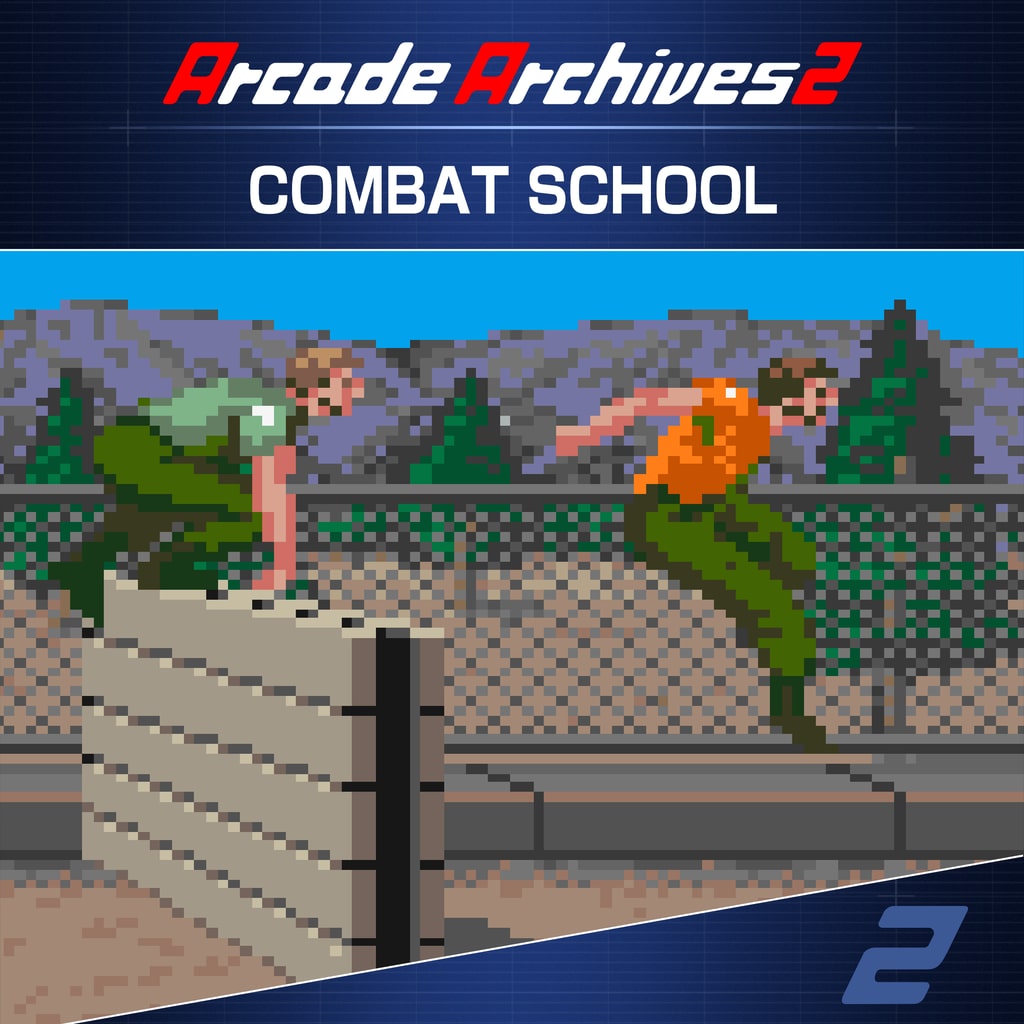
There was a time when arcade games had no interest in holding your hand. They wanted your coins, your patience and, occasionally, your pride. Few games captured that spirit quite like Combat School, Konami’s 1987 military-themed action game that threw players into an unforgiving training academy where every event demanded quick reactions, relentless determination and more than a little endurance. It was loud, competitive and unapologetically difficult, embodying the kind of arcade design that rewarded persistence as much as natural ability.
Now, thanks to Arcade Archives 2 COMBAT SCHOOL, that experience returns almost exactly as players remember it. HAMSTER’s latest preservation effort once again demonstrates why the Arcade Archives series has become one of the finest collections of classic arcade releases. Rather than reinventing the original, this version focuses on accuracy while surrounding the game with a generous selection of modern conveniences that make revisiting an ageing classic far less intimidating.
The result is a release that succeeds because it respects its source material. Combat School remains every bit as demanding today as it was nearly four decades ago, but it also reminds us why arcade gaming became such a phenomenon in the first place.
Gameplay
Unlike many action games of its era, Combat School is structured around a series of military training exercises rather than a single continuous adventure. Players begin as fresh recruits at a prestigious academy, where success depends on surviving a gauntlet of physical and combat-based challenges before earning the right to graduate.
Each event introduces its own mechanics, creating surprising variety across the campaign. One moment you’re sprinting through an obstacle course, hammering buttons at breakneck speed, and the next you’re lining up rifle shots on distant targets or wrestling with timing-based strength challenges. The constant changes prevent the experience from becoming repetitive, even though individual events are relatively brief.
That unpredictability is part of the game’s charm. Rather than asking players to master a single mechanic, Combat School continually tests different skills. Some events reward pure speed, others demand accuracy, while a few require learning subtle rhythms that are not immediately obvious. Every completed challenge feels like another hurdle overcome on the road to graduation.
Failure, meanwhile, rarely feels gentle. Miss your objectives and you’re often punished with exhausting penalty exercises before being allowed another chance. It is the kind of arcade cruelty that seems almost unimaginable today, yet it also gives every success genuine satisfaction.
An Arcade Built Around Competition
Combat School was always designed with the arcade floor in mind. Whether competing against the clock or racing another player, every event carries an infectious competitive energy that still holds up remarkably well.
Local multiplayer remains one of the game’s greatest strengths. Facing another player across the obstacle course or competing for the fastest completion time instantly transforms relatively simple mini-games into frantic contests where every mistake feels costly. Even when playing alone, the game encourages self-improvement, constantly tempting players to shave precious seconds off previous attempts.
The newly introduced Time Attack Mode fits naturally alongside the existing modes. Rather than focusing on score, it challenges players to complete the game as efficiently as possible. It feels perfectly suited to Combat School’s structure, rewarding mastery of each event and encouraging repeated playthroughs without fundamentally changing the original design.
Hi Score Mode and Caravan Mode also return, giving arcade enthusiasts even more reasons to revisit the academy. Combined with global online leaderboards, there is always another record waiting to be chased.
Modern Features That Respect The Original
One of the greatest strengths of the Arcade Archives series has always been knowing when to step back. These releases avoid unnecessary alterations, instead concentrating on preserving the original while providing optional tools that suit modern players.
Rewind functionality is perhaps the biggest quality-of-life improvement. Combat School’s difficulty can still be punishing, but the ability to reverse a costly mistake removes much of the frustration without compromising the game’s identity. Likewise, save states allow players to practise individual events without replaying the entire game each time.
Customisable controls are also surprisingly important. The original arcade cabinet relied heavily on a trackball alongside buttons, and while gamepad controls cannot perfectly replicate that tactile experience, HAMSTER has done an admirable job translating the mechanics into something that feels responsive.
Display options, multiple save slots and adjustable difficulty settings further increase accessibility, allowing newcomers to appreciate a piece of arcade history that might otherwise feel overwhelmingly harsh.
VRR support also deserves mention. Although many players may never consciously notice the difference, preserving the original arcade timing and animation smoothness contributes to the overall authenticity of the experience.
Presentation
Visually, Combat School remains unmistakably a product of the late eighties. Its chunky pixel art, exaggerated character animations and colourful military settings have a straightforward appeal that immediately transports players back to the golden age of arcade cabinets.
Character sprites are expressive despite their limitations. The drill instructor, in particular, steals the show, barking orders and dishing out punishment with exaggerated personality that borders on cartoonish. Beneath the strict military theme, a playful tone keeps the atmosphere entertaining rather than oppressive.
Each training exercise introduces distinct environments, preventing visual fatigue despite the game’s relatively short running time. The later combat mission also provides a satisfying shift in scenery, rewarding players with something noticeably different after surviving the academy.
The audio is equally memorable. Konami’s energetic soundtrack injects every event with urgency, while the sound effects deliver exactly the exaggerated impact expected from an arcade game of this vintage. Every successful hit, whistle blast and shouted command reinforces the competitive atmosphere.
A Product Of Its Time
Returning to Combat School also means accepting some design philosophies that have not aged as gracefully. Several events rely heavily on rapid button presses, once common in arcades but now physically tiring. While these challenges certainly create excitement, they may not appeal to every player, particularly during extended sessions.
The overall campaign is also fairly short by modern standards. Experienced players can reach the later stages surprisingly quickly, especially with the assistance of rewind and save states. Fortunately, replayability has always been the true objective rather than sheer length.
There is also an unavoidable sense that some mechanics were originally designed to encourage additional coin drops rather than pure enjoyment. Difficulty spikes can feel abrupt, and success sometimes feels as dependent on memorisation as on raw skill. Yet these quirks are part of the game’s historical identity, and removing them would diminish its authenticity.
Final Verdict
Arcade Archives 2 COMBAT SCHOOL succeeds because it understands exactly what it is preserving. This is not simply another retro release designed to cash in on nostalgia. It is a careful restoration of one of Konami’s more distinctive arcade experiences, presented with enough modern features to make it welcoming without sanding away its rough edges.
Combat School remains a wonderfully varied test of reflexes, timing and determination. Its collection of military-themed challenges continues to deliver short bursts of arcade excitement, while the competitive multiplayer and the newly added Time Attack Mode ensure there are plenty of reasons to keep returning long after the first graduation ceremony.
The game’s age is impossible to ignore, and some of its harsher arcade sensibilities will inevitably divide modern audiences. Even so, there is something refreshing about playing a title that wears its identity so proudly. It asks players to improve through repetition, celebrate small victories and accept failure as part of the learning process.
For arcade enthusiasts, this is another excellent addition to the Arcade Archives catalogue. For newcomers curious about a different era of game design, it offers an entertaining history lesson wrapped in one of Konami’s most memorable military adventures. Boot camp has never been particularly welcoming, but thanks to this faithful release, it remains just as rewarding as ever.