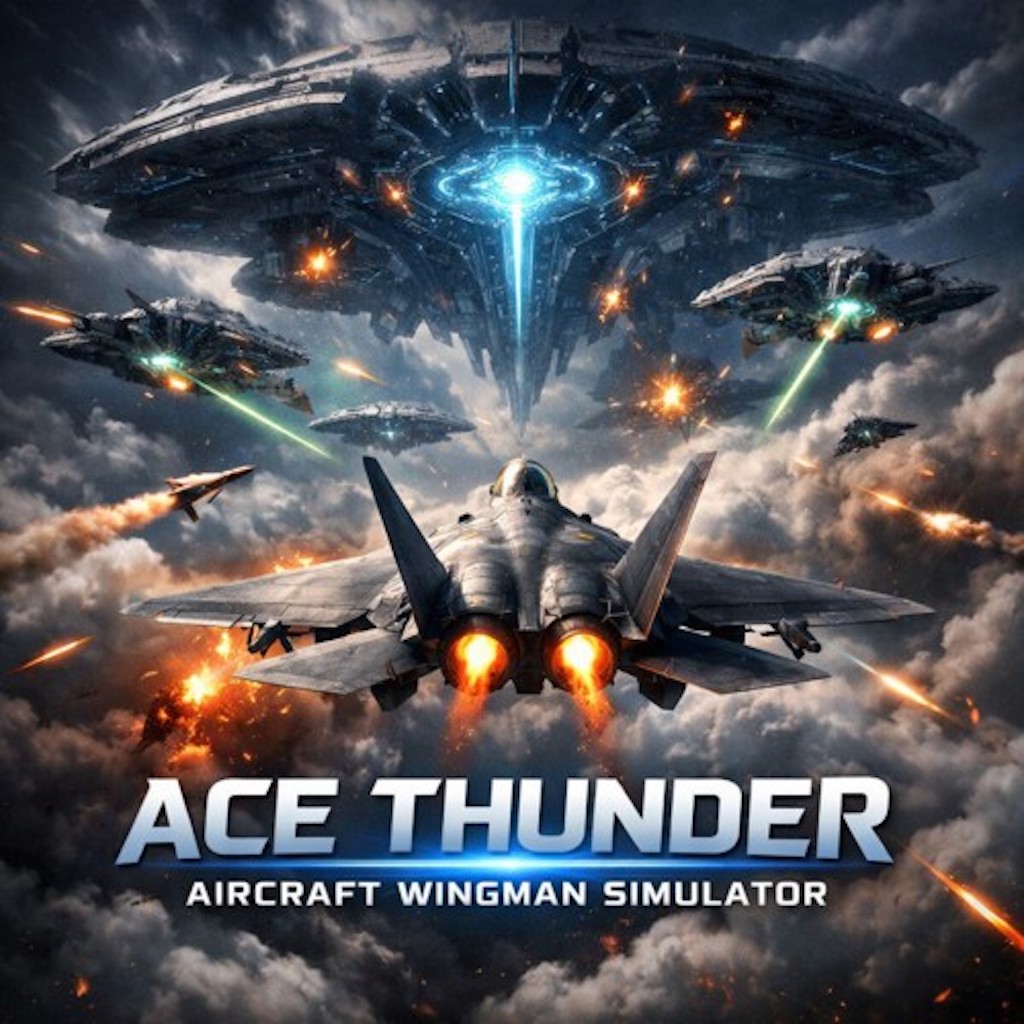
There is something timeless about climbing into the cockpit of a fighter jet and taking to the skies. Whether it is the fantasy of becoming an elite pilot, the thrill of weaving through missile fire, or the satisfaction of locking onto an enemy target and watching it erupt into flames, aerial combat games have a unique appeal. Ace Thunder: Aircraft Wingman Simulator recognises that appeal and wastes little time throwing players into the heart of an alien invasion.
Developed and published by Trio Arcade, this budget Nintendo Switch release swaps realistic military simulation for a more accessible, arcade-driven experience. Rather than focusing on fuel management, cockpit systems, and authentic flight modelling, Ace Thunder prioritises instant action. The result is a game that is easy to pick up and play, yet it struggles to sustain excitement throughout its entire campaign. While there is fun to be found among the clouds, this is ultimately a flight combat adventure that never quite reaches the heights it aspires to.
Humanity’s Last Line of Defence
The story begins with a familiar science-fiction setup. Earth is under attack by a technologically advanced alien force that has rapidly seized control of the skies. Conventional military responses have failed, leaving only a handful of elite pilots capable of mounting a meaningful resistance.
You step into the role of one of these pilots, tasked with leading a desperate counter-offensive against overwhelming extraterrestrial forces. Experimental aircraft, reverse-engineered alien technology, and increasingly dangerous missions form the backbone of the campaign.
Unfortunately, the narrative rarely evolves beyond this basic premise. Storytelling is handled almost entirely through mission briefings and radio chatter. Characters appear briefly, deliver exposition, and then disappear without leaving much of an impression. There are occasional attempts to introduce larger stakes, but the lack of meaningful character development makes it difficult to become emotionally invested.
That said, the alien-invasion backdrop does provide a welcome change from the usual military conflicts seen in many budget flight games. Battling glowing alien fighters and enormous motherships helps give Ace Thunder its own identity, even if the story itself remains largely forgettable.
Fast, Accessible Flying
The strongest aspect of Ace Thunder is its accessibility. From the moment you take off, it is clear this is not trying to compete with hardcore simulators. Controls are simple, responsive, and designed for immediate enjoyment rather than realism.
Turning, climbing, diving, and evasive manoeuvres all feel intuitive. Even players with little experience of flight games should be able to engage enemy aircraft comfortably within minutes. The game places a strong emphasis on speed and momentum, encouraging players to stay aggressive and constantly pursue targets.
Dogfights can be genuinely entertaining in the early stages of the campaign. Chasing enemy fighters through the clouds while dodging incoming missiles captures the fantasy of being an ace pilot remarkably well. Missile lock systems are easy to understand, and successfully timing a defensive flare to break an enemy lock remains satisfying throughout the adventure.
The arcade-style design also makes the game particularly well suited to handheld play. Missions are short enough to complete during brief gaming sessions, making it easy to pick up for a few minutes at a time.
Progression Through Alien Technology
To keep players engaged, Ace Thunder incorporates a progression system centred on salvaging alien materials. Every successful mission rewards currency and resources that can be invested in aircraft upgrades.
Speed, armour, weapon capacity, and other combat statistics can be enhanced through the hangar system. As your fighter evolves, it gradually becomes a more capable machine able to take on increasingly powerful threats.
Initially, this creates a satisfying sense of progression. Unlocking a stronger missile system or improving survivability provides tangible benefits in combat. The idea of integrating alien technology into human aircraft is also an enjoyable thematic touch.
The problem is that progression eventually feels like a substitute for gameplay depth. Success often depends less on improving piloting skills and more on increasing numerical stats through repeated upgrades. Rather than mastering increasingly complex combat systems, players frequently find themselves grinding missions to upgrade their aircraft enough to tackle the next challenge. As a result, the upgrade path feels functional rather than exciting.
Mission Variety That Quickly Runs Dry
One of the biggest challenges facing Ace Thunder is its mission design. On paper, there is a decent selection of objectives. Players escort bombers, defend military installations, intercept hostile fleets, and take part in larger combat operations.
The issue is that these mission types rarely differ in meaningful ways. Regardless of the objective briefing, most missions eventually boil down to locking onto targets and shooting them down until a completion screen appears.
Enemy behaviour does little to help matters. Alien fighters are aggressive enough to keep battles active, but their tactics remain predictable throughout the campaign. Encounters that initially feel intense gradually become routine as players recognise familiar attack patterns.
This repetition becomes increasingly noticeable as the campaign progresses. The core mechanics remain enjoyable, but the game struggles to introduce fresh ideas or meaningful twists that would keep the experience dynamic. By the final missions, players may find themselves wishing for more ambitious objectives, larger environmental hazards, or greater enemy variety.
A Solid Performance Above Familiar Landscapes
Visually, Ace Thunder delivers mixed results. Aircraft models are surprisingly clean and detailed, given the game’s budget origins. Human fighters and alien vessels both feature distinctive silhouettes that make threats easy to identify during high-speed combat.
The environments below are less impressive. Cities, deserts, mountains, and oceans provide some variety, but many locations feel sparse and repetitive. Long stretches of terrain can appear empty, creating the impression of flying above decorative backdrops rather than living battlefields.
Alien motherships help break up the scenery with their imposing designs. Some of the larger encounters successfully capture the scale expected of an interstellar invasion. Watching massive structures dominate the horizon can be genuinely impressive at times.
Performance is where Ace Thunder earns considerable credit. Frame rates remain stable even during larger battles packed with missiles, explosions, and multiple aircraft. On the Nintendo Switch, that level of consistency goes a long way towards making the action enjoyable.
The soundtrack complements the science-fiction setting with energetic electronic tracks that maintain a sense of urgency. While the music becomes repetitive over extended sessions, it generally supports the fast-paced action.
A Weekend Diversion Rather Than a Destination
Ace Thunder feels very much like a game designed for short-term enjoyment. It offers immediate action, accessible controls, and a straightforward progression system that rewards continued play. There is nothing inherently wrong with that approach.
The challenge is that countless flight combat games offer deeper mechanics, more memorable campaigns, and greater long-term value. Ace Thunder never quite develops the complexity needed to stand alongside those titles.
Instead, it occupies an awkward middle ground. It is more involved than a simple arcade shooter but lacks the depth expected of a full-scale flight combat simulator. The result is a game that remains entertaining for a few hours without ever becoming truly memorable.
Final Verdict
Ace Thunder: Aircraft Wingman Simulator offers accessible aerial combat within a fun science-fiction premise. Dogfights are fast, controls are responsive, and the alien-invasion setting adds a welcome layer of spectacle to the action.
Unfortunately, repetitive mission design, simplistic enemy behaviour, and a shallow progression system prevent the game from fully capitalising on its strengths. While the solid performance and approachable gameplay make it easy to recommend to casual players seeking a low-commitment action game, genre veterans will likely crave more depth. There is enjoyment to be found in Ace Thunder’s skies, but this is ultimately a journey that never quite escapes Earth’s gravity.