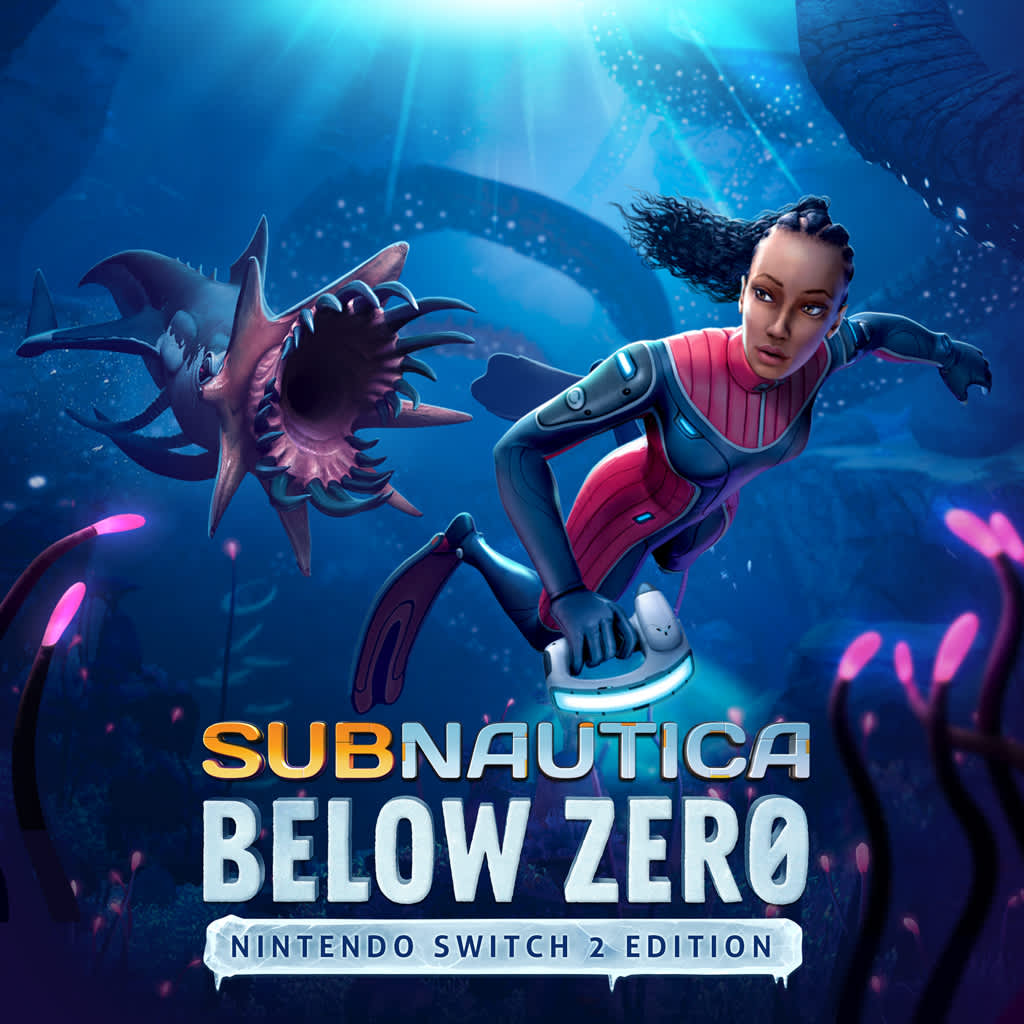
Few survival games understand atmosphere the way Subnautica: Below Zero does. While countless titles throw you into hostile environments with crafting menus and hunger meters, Below Zero does something more insidious — it makes you feel small.
On Nintendo Switch 2, that feeling finally comes without compromise.
Originally released on other platforms years ago, Subnautica: Below Zero struggled on the original Switch. Frame rate dips, long load times, and heavy pop-in undercut the immersion. The new Switch 2 Edition — surprise-launched alongside the original Subnautica — changes that narrative dramatically.
This isn’t just a resolution bump.
It’s the version the hybrid audience deserved from the start.
Performance: The Ocean Flows at 60 FPS
The most immediate and impactful upgrade is performance.
On Switch 2, Below Zero runs at a stable 60 FPS — a massive leap from the inconsistent performance of its predecessor hardware. Swimming feels fluid. Vehicle traversal no longer stutters. Combat encounters with leviathans unfold smoothly rather than chaotically.
Resolution has also been boosted significantly:
- 1440p docked
- 1080p handheld
The difference is immediately noticeable. Ice formations sparkle with detail. Bioluminescent flora glow vividly. The vast, blue-lit expanses of Twisty Bridges feel deeper and more immersive.
Draw distance improvements are especially transformative. You can now see distant predators — including the terrifying Shadow Leviathan — far earlier than before. This changes navigation strategies entirely. What was once a surprise attack can now be a calculated risk.
And perhaps most importantly: load times have been dramatically reduced. Jumping between large biomes or loading into Planet 4546B after the intro sequence now happens in seconds rather than minutes.
The ocean feels uninterrupted.
A More Personal Story
Unlike the original Subnautica, Below Zero places a stronger emphasis on narrative.
You play as Robin Ayou, a voiced protagonist investigating the mysterious disappearance of her sister. The story unfolds through abandoned research stations, scattered logs, and environmental storytelling.
The arctic region of Planet 4546B feels less isolated than the first game’s crash-landing scenario — but more emotionally focused. Robin’s search for answers adds urgency beyond simple survival.
The narrative threads — corporate secrets, alien artifacts, grief, and closure — are woven more directly into gameplay.
Some players may prefer the quieter, lonelier tone of the original game. But Below Zero’s story-driven approach works especially well on a portable system. It feels like a serialized sci-fi mystery you can pick up and continue anywhere.
Arctic Biomes and Survival Evolution
The sub-zero setting introduces new mechanics and environmental pressures.
Beyond managing hunger and oxygen, you must contend with freezing temperatures while exploring above-ground regions like the Glacial Basin. Crafting a cold suit or seeking warmth from Thermal Lilies becomes essential.
Below the surface, new biomes offer visual and mechanical variety:
- Twisty Bridges — glowing arches teeming with life
- Crystal Caverns — shimmering depths haunted by leviathans
- Thermal Vents — volatile underwater heat sources
- Glacial Basin — icy terrain navigated via the Snowfox hoverbike
The modular Seatruck remains one of the sequel’s best additions — a customizable submarine that can be upgraded for cargo, research, or defense.
On Switch 2, the enhanced clarity makes biome transitions more striking. Crystal Caverns in particular benefit from the improved lighting and resolution.
Joy-Con 2 Integration
The Switch 2 Edition also incorporates Joy-Con 2 haptics and motion functionality.
Subtle haptic feedback enhances immersion while swimming or using tools like the Scanner and Habitat Builder. Motion controls allow for more precise aiming when interacting with objects, though they remain optional.
It’s not a revolutionary change — but it adds tactile depth that aligns well with the game’s immersive design.
Alien Life and Lingering Terror
One of Below Zero’s defining strengths remains its creature design.
Peaceful Titan Holefish drift gracefully through open waters. Playful Pengwings waddle along icy shores. And then there’s the Shadow Leviathan — an elongated nightmare lurking in the Crystal Caverns.
Improved draw distance fundamentally alters predator encounters. Seeing a leviathan coil in the distance triggers a different kind of tension than sudden ambush.
You have time to choose:
- Turn back?
- Proceed cautiously?
- Or dive straight into danger?
The ocean feels more readable — but no less terrifying.
Habitat Building and Resource Loop
Base construction remains central to survival.
Gather resources. Craft tools. Expand habitats. Install power sources. Establish safe zones.
The faster load times and smoother performance on Switch 2 make returning to large bases far less cumbersome. Habitat-building no longer feels like a technical compromise.
Resource management retains its addictive loop. The moment-to-moment rhythm of scavenging, crafting, and venturing deeper remains intact.
Where It Excels
Strengths:
- Massive performance leap (stable 60 FPS)
- Significant resolution boost
- Dramatically reduced load times
- Improved draw distance enhances tension
- Engaging narrative with voiced protagonist
- Excellent biome diversity
This version feels fully realized.
Where It Falters
Weaknesses:
- Story-driven tone may not match original’s isolation
- Above-ground exploration can feel slower than underwater segments
- Occasional UI density in handheld mode
But these are design traits, not technical flaws.
Final Verdict
Subnautica: Below Zero – Nintendo Switch 2 Edition is more than a port upgrade. It’s a redemption.
Where the original Switch version struggled under hardware limitations, this edition finally delivers the smooth, immersive survival experience the game demands.
Stable 60 FPS transforms exploration. Enhanced resolution sharpens environmental beauty. Faster loading keeps immersion intact. And improved draw distance subtly rebalances predator encounters in fascinating ways.
Narratively, it offers a more personal, emotionally grounded journey than its predecessor — one that trades pure isolation for investigative intrigue.
For existing Switch owners, the free Upgrade Pack makes this an easy recommendation.
For newcomers, it stands as one of the finest atmospheric survival experiences available on Nintendo hardware.
The ocean has never looked clearer.
And it has never felt deeper.