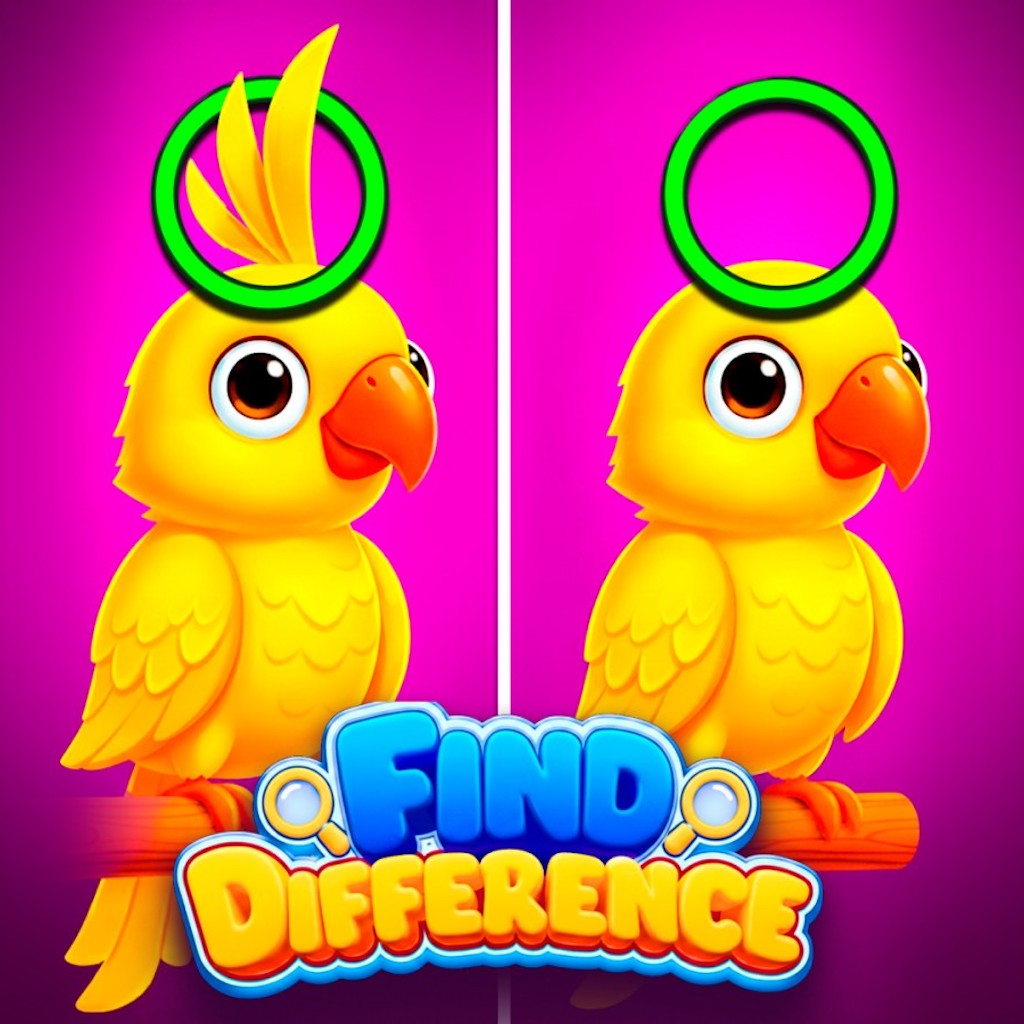
In a gaming landscape increasingly obsessed with spectacle, scale, and complexity, there’s something quietly defiant about games that choose simplicity instead. Find Difference belongs to a long-standing tradition of observational puzzle games, asking players to slow down, pay attention, and engage their minds rather than their reflexes. The premise is instantly familiar: two nearly identical images are placed side by side, and your task is to spot the differences between them. It’s a concept that needs no tutorial and no narrative justification — and yet, in the digital space, it lives or dies by the quality of its execution.
Find Difference is not a game that reinvents its genre. Instead, it attempts to refine and modernise a classic formula through volume, visual clarity, and accessibility. The result is an experience that is comfortable, sometimes absorbing, and occasionally limited by its own restraint.
A Familiar Formula, Faithfully Executed
From the moment you start Find Difference, the game makes its intentions clear. There are no elaborate menus, no cinematic intros, and no lore to unpack. You are presented with a pair of images and a simple objective: identify all the discrepancies between them. Click or tap the correct area, and the difference is marked. Find them all, and you move on to the next challenge.
This clarity is one of the game’s greatest strengths. There’s no barrier to entry whatsoever. Players of any age or gaming background can understand what’s required within seconds, making Find Difference one of the most accessible puzzle experiences available. It’s equally at home being played in short bursts or longer, more focused sessions.
The game gradually increases in complexity by introducing images with greater detail, subtler differences, and more visual noise. Early puzzles might include obvious changes in colour or missing objects, while later challenges require careful scrutiny of shadows, textures, and tiny environmental alterations. This gradual escalation ensures that players feel a sense of progression without ever being overwhelmed.
Visual Design: The Backbone of the Experience
Because Find Difference relies entirely on visual observation, presentation is absolutely critical — and for the most part, the game delivers. The images are clean, colourful, and varied, covering a broad range of themes such as landscapes, interiors, city scenes, and whimsical illustrations. This variety helps prevent visual fatigue and keeps the experience feeling fresh across dozens of puzzles.
Image clarity is consistently strong. Details are sharp enough to reward careful inspection, and differences are usually logical rather than cheap or arbitrary. When you miss a discrepancy, it often feels like a lapse in attention rather than an unfair trick — a key distinction that separates satisfying puzzle design from frustrating guesswork.
However, the visual quality does occasionally fluctuate. Some images feel richly detailed and thoughtfully composed, while others are more basic and less engaging. This inconsistency doesn’t ruin the experience, but it does highlight the importance of strong art direction in a genre where visuals are the gameplay.
Difficulty and Pacing: Relaxed, Sometimes Too Much So
Find Difference adopts a largely relaxed approach to difficulty. Most puzzles are untimed, allowing players to take as long as they like to examine each image. This design choice aligns perfectly with the game’s calm, low-pressure philosophy and makes it ideal for casual play.
Optional hints are available for players who get stuck, preventing frustration and ensuring steady progress. Importantly, using hints doesn’t feel like failure; it’s framed as a supportive tool rather than a crutch. This makes the game approachable for younger players and those who prefer stress-free experiences.
That said, players seeking a more demanding challenge may find the experience too forgiving. The lack of time pressure, scoring systems, or escalating penalties means that tension is minimal. While some later puzzles are genuinely tricky, the game rarely pushes players to their limits. A more robust challenge mode or optional difficulty modifiers could have added longevity and depth for puzzle veterans.
Interface and Usability: Simple and Effective
The user interface in Find Difference is refreshingly straightforward. Navigation is intuitive, controls are responsive, and the screen remains uncluttered at all times. This simplicity ensures that nothing distracts from the act of observation, which is exactly how a game of this nature should function.
Feedback is immediate and clear. Correct selections are acknowledged with subtle visual and audio cues, while incorrect clicks are gently indicated without harsh penalties. This reinforces the game’s relaxed tone and encourages experimentation rather than punishment.
One minor drawback is the lack of advanced customization options. Players can’t significantly alter visual settings, hint behaviour, or input sensitivity, which may limit comfort for some users. Still, for the majority of players, the default settings are more than sufficient.
Content Volume and Replay Value
One of Find Difference’s biggest selling points is the sheer number of puzzles on offer. There’s a generous selection of image pairs, ensuring that the game remains engaging over multiple sessions. This volume makes it particularly appealing as a “pick-up-and-play” title — something you can return to between larger gaming commitments.
However, replay value is more limited. Once you’ve solved a puzzle, its challenge is largely gone. Unlike logic puzzles with multiple solutions or procedural variation, Find Difference relies on fixed answers. Revisiting completed levels offers little incentive beyond relaxation or completionism.
A daily challenge system, rotating image sets, or randomized differences could have extended replayability significantly. As it stands, the game’s longevity depends almost entirely on how much you enjoy the core activity of visual comparison.
Who Is Find Difference For?
Find Difference is ideally suited for players who enjoy calm, observational puzzles and value accessibility over complexity. It’s a perfect fit for casual gamers, younger players, or anyone looking for a soothing experience that engages the brain without demanding intense focus or skill mastery.
It’s also well-suited as a secondary game — something to unwind with after more demanding titles, or to enjoy in short, satisfying bursts. Players seeking narrative depth, evolving mechanics, or competitive challenge will likely find the experience too lightweight.
Final Verdict
Find Difference succeeds by doing exactly what it sets out to do: delivering a clean, accessible, and visually driven puzzle experience that rewards attention and patience. Its intuitive mechanics, varied imagery, and generous content make it an easy recommendation for casual players and fans of classic puzzle formats.
While it doesn’t push boundaries or introduce meaningful innovation, it doesn’t need to. Its strengths lie in comfort, clarity, and consistency. The lack of advanced challenge modes or long-term replay incentives prevents it from standing out in a crowded market, but as a relaxed puzzle game, it delivers dependable enjoyment.