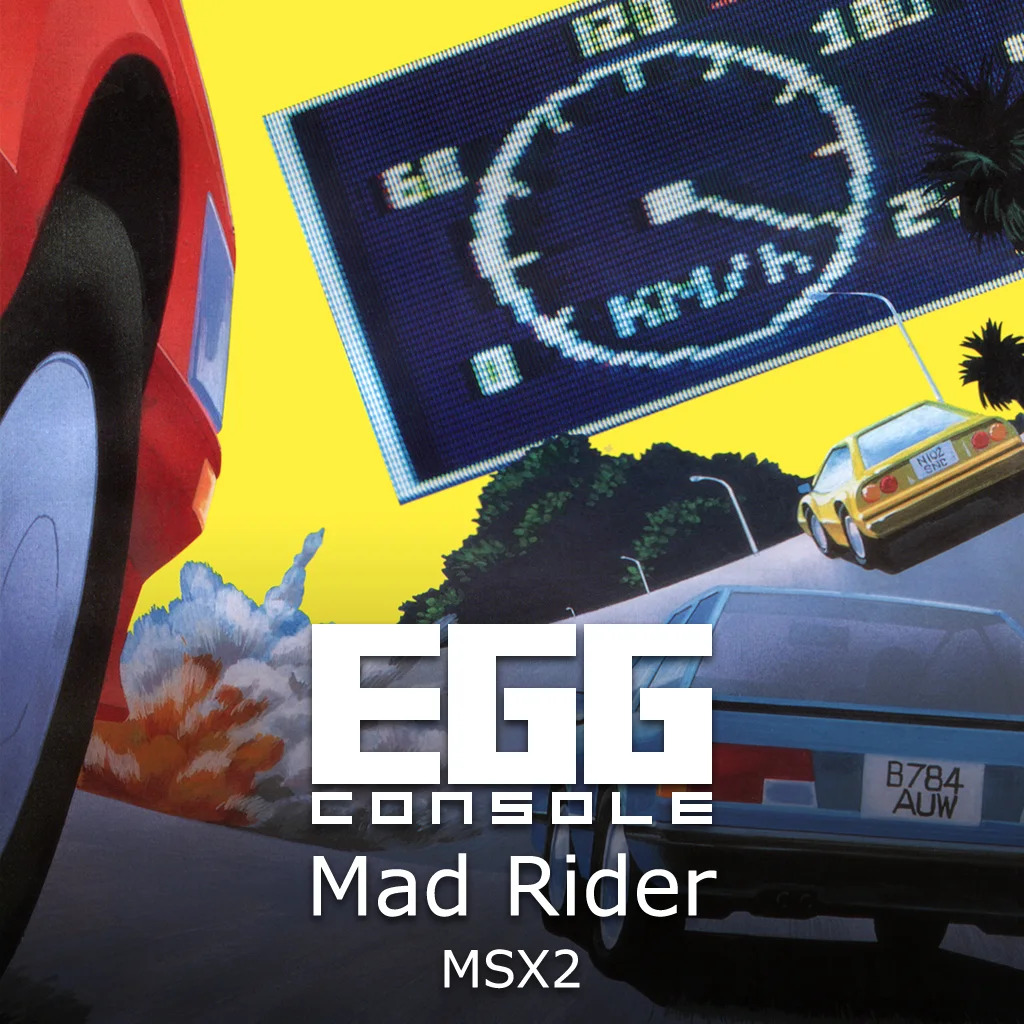
There’s a unique joy in titles that wear their retro inspiration proudly on their sleeve. EGGCONSOLE Mad Rider MSX2 taps into that sentiment with gusto: a side-scrolling motorcycle racer heavily inspired by classic 80s and 90s MSX2 era games. It’s the kind of game that celebrates chunky pixels, energetic chiptunes, and instantly memorable stages, while mixing in enough contemporary freshness to avoid feeling like a straight rehash.
This edition isn’t just a nostalgic throwback; it’s a lovingly built homage — one that offers both the visceral thrill of old-school speed and a satisfying modern learning curve. At its best, Mad Rider MSX2 captures the visceral thrill of late-night arcade sessions; at its worst, it occasionally stumbles into repetition. Still, what you get overall is a racetrack worth riding again and again.
Premise and Core Mechanics
Mad Rider MSX2 places you in control of a high-speed motorcycle navigating linear, obstacle-strewn courses where precision, timing, and split-second decisions rule the road. There’s no sprawling open world here — instead, it’s about rhythm, memorisation, and pushing limits within carefully constructed lanes.
Movement and Controls
The control scheme is simple but responsive. Acceleration is automatic (true to its arcade roots), and your inputs focus on balance, jumping, and leaning to adjust trajectory mid-air. Steering is tight, and even slight directional changes have meaningful effects on landings and speed retention.
This simplicity is deceptive. While controls are easy to pick up, mastery requires:
- Precision timing on jumps
- Split-second balance adjustments
- Risk assessment — fast routes vs safer paths
As you grind through consecutive levels, you’ll find that the game rewards memorisation and consistency as much as raw reaction skills.
Stage Design: Crafting Momentum and Challenge
One of Mad Rider MSX2’s greatest strengths is its stage design. Courses are crafted with intentional flow, rhythm, and escalation. Early stages are forgiving, giving you spacious landing zones and slower pacing that help you learn the mechanics. But as you advance, track layouts become tighter, obstacles multiply, and the margin for error shrinks.
Classic hurdles include:
- Gaps that require perfectly judged jumps
- Inclines and declines that affect momentum
- Moving hazards that can force mid-air corrections
- Narrow platforms where balance is everything
What’s impressive is how courses feel alive. They aren’t just pixel layouts; they’re rhythmic sequences — a bit like timing patterns in rhythm games — where memorising obstacle timing can be as useful as reaction speed.
Each level’s pacing reinforces this feeling. You rarely feel stuck in a static space; every field, bridge, or plateau pushes you forward — whether it’s towards a well-placed checkpoint or a cascading sequence that’ll test your mastery.
Difficulty Curve and Learning Reward
Mad Rider MSX2 doesn’t mince words: it’s challenging. But that challenge feels fair because it’s rooted in pattern recognition and controlled repetition — the two pillars of skill growth in classic arcade design.
The learning curve is well-constructed:
- Easy at first, introducing obstacles in isolation.
- Gradually more complex, combining patterns into longer sequences.
- Later stages deliver precision tests that demand both memory and skill.
That said, players expecting a relaxed motorcycle romp might find the difficulty jarring. This isn’t Trials level simulation, but it isn’t a casual ride either. Players who enjoy overcoming spikes, learning layouts by heart, and rewarding repetition will thrive — those who prefer gentle progression might feel a bit overwhelmed.
Checkpoints are generous enough to avoid frustration, but the real satisfaction comes from clearing long stretches without dying, a classic arcade joy that few modern racers fully capture.
Visual and Audio Presentation
As a retro-inspired racer, Mad Rider MSX2 leans into nostalgic aesthetic cues. It embraces pixel art with intent:
- Visual Style: Bold, recognisable sprites, vibrant colour palettes, and parallax backgrounds conjure a distinct MSX2-era feel without sacrificing clarity on modern screens.
- Animation: Bike movement, environmental hazards, and background elements all move with a tactile punch that feels just right — not too frenetic, not too static.
- Track Variance: Themes shift between industrial zones, desert plateaus, neon cityscapes, and more — each with its own visual identity that complements gameplay.
Audio Landscape
The soundtrack is an absolute highlight. Chiptune-heavy tracks thrum with energy and seamlessly sync with the urgency of each stage. Sound effects — engine revs, jumps, collisions — are crisp and punchy. They might be simple, but they carry weight, reinforcing every high-speed dash and every clattering fall with satisfying feedback.
The audio doesn’t just accompany gameplay — it amplifies it, making daring runs feel even more exhilarating.
Replayability and Incentives
Given its arcade DNA, Mad Rider MSX2 naturally lends itself to replayability. Once you’ve beaten the main roster of stages, there’s a strong urge to go back and shave seconds off personal bests or clear sections with fewer mistakes.
Modes that encourage replay include:
- Time attack challenges
- High-score leaderboards
- Optional routes that reward risky manoeuvres
Despite the linear structure, the game cleverly layers optional mastery paths over core completion goals. This makes it feel bigger than the sum of its stages, especially for completionists and speed-runners.
Accessibility and Learning Curve
Accessibility is a mixed bag here. On one hand, the controls are intuitive and easy to grasp. On the other, the skill ceiling is high, and there’s little in the way of optional tutorials once you get past the basics.
Some players might crave more assist modes — slower speeds, generous hitboxes, or gradual ramp for beginners. The lack of these could limit the game’s appeal beyond its core audience of retro enthusiasts and hardcore racers.
Still, Mad Rider MSX2 lets you hone your skills organically. There’s an unmistakable satisfaction in climbing from “I almost got it” to “I own this track” — exactly the reward loop that the genre excels at.
Where It Could Improve
No game is perfect, and Mad Rider MSX2 has a few rough edges:
- Steep Difficulty: While rewarding for dedicated players, the spike in later stages can feel unforgiving for casual racers.
- Limited Modern Features: No split-screen multiplayer or robust online leaderboards feels like a missed opportunity in 2026.
- Narrative Minimalism: For those who enjoy a story or hub world between stages, the retro focus may feel bare.
None of these are deal-breakers, but they do shape who the game will most appeal to.
Final Verdict
Pros:
- Stylish pixel art and dynamic visual themes
- Tight, satisfying control and responsive physics
- Energetic chiptune soundtrack that elevates the experience
- Deep replay value through mastery and time challenges
- Faithful retro design with modern polish
Cons:
- Difficulty may alienate casual players
- Missing some modern features like online leaderboards
- Narrative and contextual elements are minimal
Summary:
EGGCONSOLE Mad Rider MSX2 is a standout throwback racer that delivers both nostalgia and tangible gameplay thrills. Its commitment to retro aesthetics doesn’t dilute the core design — instead, it enhances it, blending old-school charm with modern execution. While its challenge won’t suit all players, those who embrace its rhythm of risk and reward will find a finely tuned ride with plenty of depth.
Whether you’re here for the pixel artistry, the punchy audio, or the rush of clearing a brutally clever jump sequence, Mad Rider MSX2 earns its place among the more compelling indie racers of the year.