
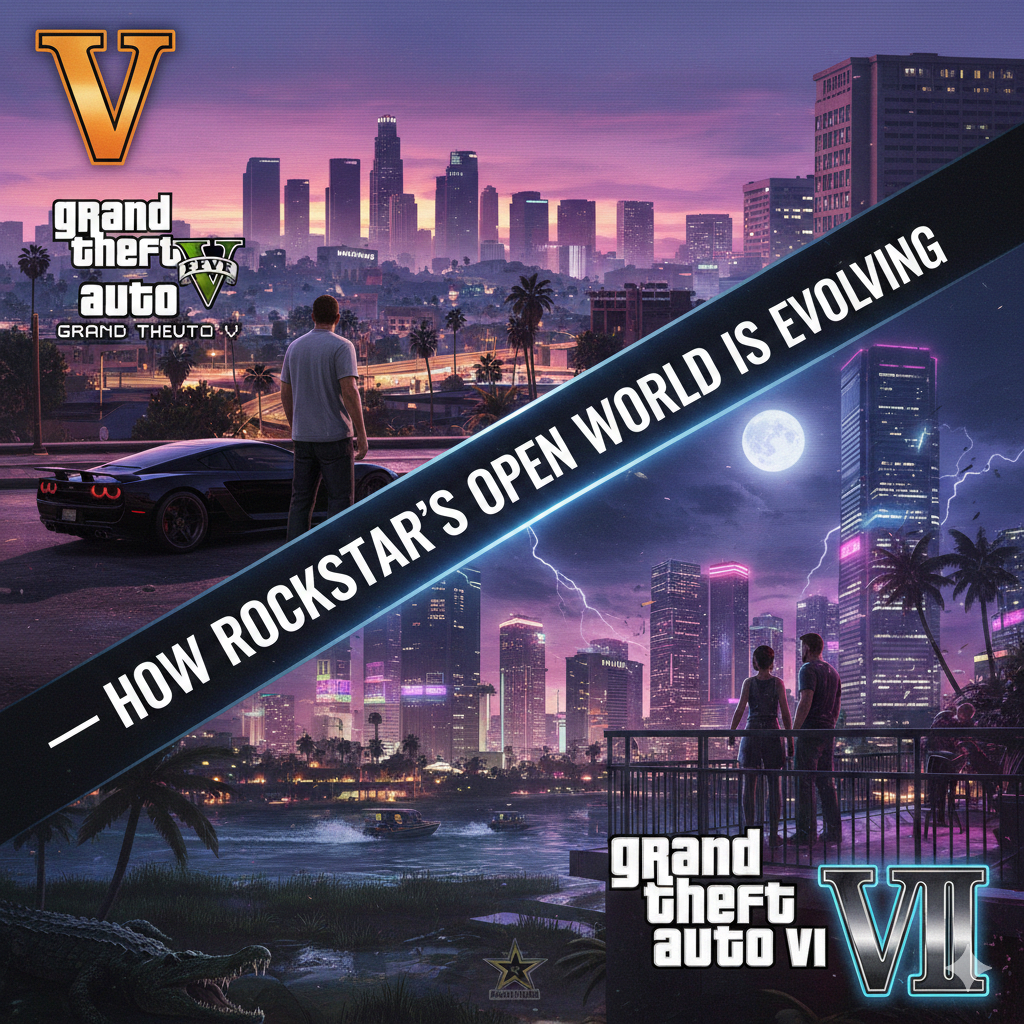
When Grand Theft Auto V launched in 2013, it redefined open-world design, delivering an unprecedented level of scale, freedom, and cultural satire. Over the years, it has remained a benchmark for the genre, supported by multiple re-releases and the enduring success of GTA Online.
Now, more than a decade later, Grand Theft Auto VI is preparing to usher the franchise into a new era. Rather than simply expanding on GTA V’s foundations, Rockstar appears focused on deeper immersion, stronger character relationships, and a world that reacts more meaningfully to player actions. For a closer look at Vice City’s return, the game’s dual-protagonist structure, and Rockstar’s ambitions for the next generation, be sure to read our full Grand Theft Auto VI preview.
Setting: Los Santos vs Vice City
GTA V — A Satirical Playground
Los Santos was designed as a caricature of Southern California excess. It thrived on exaggeration: celebrity culture, wealth disparity, and media absurdity were presented through bold satire and exaggerated archetypes. The world was vast, varied, and intentionally playful, encouraging reckless exploration and emergent chaos.
Its map design prioritised openness. Wide roads, expansive deserts, and long sightlines supported fast driving and large-scale mayhem. Interiors were limited, but the city itself felt like a playground built for freedom.
GTA VI — A Living Ecosystem
Vice City in GTA VI appears to be a fundamentally different approach. Rather than acting purely as a backdrop for chaos, the city feels denser, more vertical, and more reactive. Crowds are thicker, NPC behaviour is more nuanced, and environments appear layered with activity.
Where Los Santos invited spectacle, Vice City seems designed for immersion. The emphasis is less on size alone and more on believability — a city that reacts to the player rather than simply tolerating them. This marks a clear shift in Rockstar’s priorities.
Protagonists: Trio vs Duo
GTA V — Variety Through Contrast
GTA V’s three protagonists — Michael, Franklin, and Trevor — were a bold narrative experiment. Each represented a different aspect of the American crime fantasy: disillusioned wealth, ambition, and unchecked chaos. Switching between them allowed Rockstar to explore multiple tones and playstyles.
However, this structure often came at the cost of emotional depth. Character arcs were compelling but fragmented, and relationships between protagonists sometimes felt secondary to the spectacle of missions.
GTA VI — Intimacy and Partnership
GTA VI’s dual-protagonist approach appears more focused. Lucia and her partner are framed not as contrasts, but as a unit — a shared journey inspired by loyalty, survival, and desperation. This allows for deeper emotional storytelling and more cohesive character development.
Rather than juggling perspectives, GTA VI seems poised to explore relationship dynamics, potentially allowing gameplay systems and narrative outcomes to evolve based on how players approach missions together.
This marks a tonal shift from GTA V’s satire-heavy ensemble to something more personal and grounded.
Gameplay Philosophy: Chaos vs Consequence
GTA V — Freedom First
GTA V prioritised freedom above all else. Players could cause destruction with minimal long-term consequence, and the game actively encouraged experimentation. Law enforcement was predictable, systems were forgiving, and failure was rarely punishing.
This design made GTA V endlessly replayable, but it also meant the world often felt indifferent to player actions outside scripted missions.
GTA VI — A Reactive World
GTA VI appears to lean toward consequence-driven systems. NPCs react dynamically, crimes feel more visible, and the world seems aware of player behaviour. Social media integration, witnesses recording events, and evolving law enforcement responses suggest a more systemic approach.
Rather than reducing freedom, this could enhance immersion — turning every decision into a calculated risk rather than a disposable action. It’s a philosophy Rockstar previously explored in Red Dead Redemption 2, now adapted for GTA’s modern urban chaos.
Combat and Movement
GTA V — Accessible and Arcade-Like
Gunplay in GTA V was functional but rarely exceptional. It favoured accessibility over realism, supporting fast-paced encounters that matched the game’s chaotic tone. Movement was responsive but light, allowing players to sprint, dive, and shoot with ease.
GTA VI — Weight and Precision
Early footage suggests GTA VI adopts a more grounded approach. Movement appears heavier, animations more deliberate, and combat encounters more tactical. This shift could slow the pace slightly, but it adds tension and meaning to firefights.
If successful, this evolution could bridge the gap between GTA’s arcade roots and Rockstar’s growing interest in realism.
Satire: Then vs Now
GTA V — Media and Celebrity Culture
GTA V skewered reality TV, Hollywood, and corporate excess — themes that felt timely in the early 2010s. Its satire was broad, loud, and intentionally unsubtle.
GTA VI — The Social Media Era
GTA VI enters a world dominated by social media, influencers, and viral outrage. Rather than traditional media satire, Rockstar appears to be targeting online performativity, digital identity, and modern attention economies.
This evolution feels necessary. Repeating GTA V’s satire would risk irrelevance, while GTA VI’s focus on livestreaming culture and public perception positions it squarely in the present day.
Online Ambitions
GTA V — A Phenomenon Born Post-Launch
GTA Online grew into a juggernaut, but it wasn’t fully realised at launch. Over time, it became increasingly grind-heavy and monetised, sometimes overshadowing the single-player experience.
GTA VI — Designed for Longevity
While details remain scarce, GTA VI’s online component is expected to be more integrated and structured from the start. Many fans hope Rockstar has learned from GTA Online’s excesses, delivering a more balanced, player-driven experience.
Technical Leap
GTA V was constrained by the hardware of its time, even across multiple re-releases. GTA VI, built exclusively for modern consoles, appears unconstrained — featuring denser crowds, improved physics, advanced lighting, and unprecedented environmental detail.
This isn’t just an upgrade — it’s a generational reset.
Final Comparison Thoughts
Grand Theft Auto V remains a landmark achievement — a chaotic, endlessly entertaining sandbox that defined open-world gaming for over a decade. Grand Theft Auto VI doesn’t seek to replace that legacy; it seeks to evolve it.
Where GTA V embraced spectacle, GTA VI leans toward immersion. Where GTA V celebrated chaos, GTA VI explores consequence. Where GTA V spread its focus wide, GTA VI appears to narrow it for emotional impact.
If Rockstar succeeds, GTA VI won’t just be “the next GTA” — it will be a reflection of how both gaming and society have changed since GTA V first rewrote the rules.












[…] For an in-depth look at how GTA VI compares to Grand Theft Auto V on key pillars — including world design, character structure, and narrative philosophy — check out our full comparison piece: Grand Theft Auto VI vs Grand Theft Auto V — How Rockstar’s Open World Is Evolving. […]