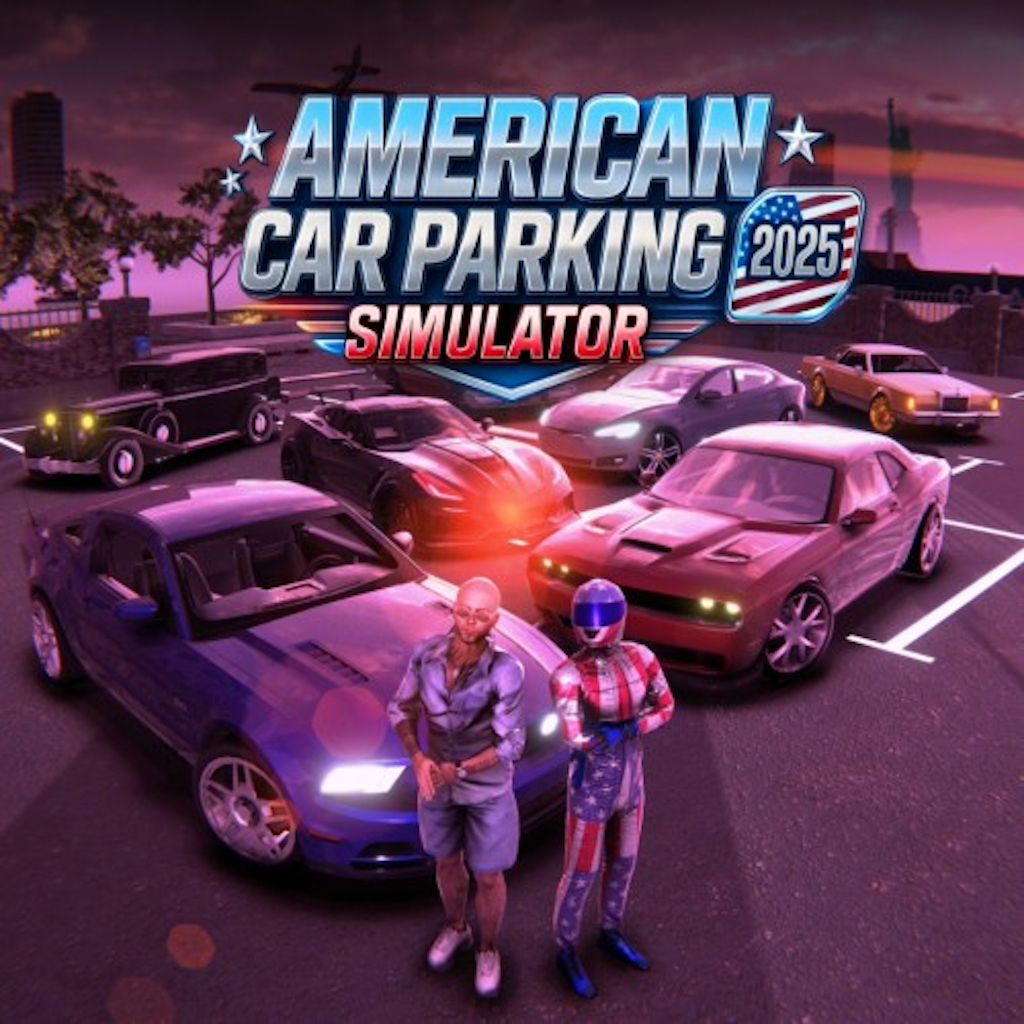
American Car Parking Simulator 2025 is exactly what it sounds like: an earnest—and occasionally unexpectedly soothing—simulation grounded in the deceptively simple task of navigating cars into designated spots with precision and spatial awareness. What begins as a novelty becomes something of a meditative exercise, especially for players who enjoy systems that reward patience, control, and consistency. At its best, the game channels the quiet satisfaction of a perfectly executed parallel parking job after a dozen failed attempts. At its worst, it exposes the limits of its core concept as a long-term play experience.
The title’s premise is uncomplicated: master a series of increasingly complex parking challenges across a range of vehicles and environments that echo the diversity of American landscapes. From suburban lots and urban garages to scenic roadside overlooks, the game strives to marry thematic variety with a central test of driving precision. It’s not a title built on high-stakes drama, but it doesn’t need to be. Its tension comes from competence, and the pleasure comes from clarity.
Parking as Gameplay — Precision Over Spectacle
The defining mechanic of American Car Parking Simulator 2025 is its commitment to realism within its central task. This isn’t a racing title with occasional parking minigames. The parking itself is the game: approach speed, steering input, angle, spatial judgement, and brake control all contribute to whether an attempt will be clean or chaotic.
Initial levels ease players in with generous boundaries, forgiving physics, and clear markers. Here, the game’s approachability is evident. Controls are intuitive, and camera perspectives offer helpful framing options. Newcomers can quickly grasp the core challenge: align the car, throttle into position, and stop within the designated zone.
As the campaign unfolds, however, the task subtly deepens. Precision demands grow tighter, spaces narrower, and environmental elements—curbs, cones, adjacent vehicles, time limits—begin layering additional constraints. The game stages these elements thoughtfully, typically introducing one new wrinkle at a time so that each mechanic can be internalised before it is compounded.
This methodical pacing serves the simulation well. Players who enjoy repeated attempts, incremental mastery, and incremental improvement will find a compelling loop wherein each success feels genuinely earned. It’s a game that respects the satisfaction of competence.
Controls and Handling — Economy and Elegance
One of the title’s greatest technical achievements is its control and handling model. Steering input is weighty but predictable; acceleration and braking feel tuned to a believable range rather than exaggerated arcade responses. This level of fidelity matters: if parking feels sloppy or disconnected from input, the entire premise collapses. Fortunately, American Car Parking Simulator 2025 avoids that pitfall.
The game offers multiple camera perspectives—overhead, chase, side, and free camera—that players can switch between on the fly. Each has situational value: overhead helps with spatial awareness, chase improves directional cues, and free camera lets you eyeball the approach more intuitively. This flexibility is particularly helpful in tighter spaces where depth perception matters.
Some players may initially find the physics engine demanding, especially if they approach with expectations shaped by casual driving games. But once the learning curve is mastered, minor corrections and controlled adjustments feel satisfying rather than frustrating. The result is a control framework that doesn’t oversimplify real-world skill, yet doesn’t alienate players through undue complexity.
Challenge and Level Design — Structured but at Times Repetitive
Structurally, the game unfolds as a series of discrete parking scenarios across themed environments. Suburban residential parking spots, downtown city garages, airport lots, and parking challenges on scenic overlooks each offer unique visual context. These environmental shifts provide visual variety—and occasionally mechanical novelty—but rarely do they fundamentally alter the under-the-hood challenge.
This design choice keeps the game focused, but it also exposes its limitations. Once players have internalised the core mechanic of spatial alignment and controlled braking, later levels are more about incremental refinement rather than new experiences. Environments change, but the tasks remain comfortably familiar.
Some levels introduce time pressures that add mild tension, though they rarely transform the nature of the challenge. Likewise, obstacles such as cones, barriers, or adjacent parked cars introduce marginal complexity without fundamentally expanding the game’s thematic scope. The result is a reliable but narrowly scoped progression: it consistently tests skill, but rarely surprises.
Presentation — Functional with Thematic Flourish
Visual presentation in American Car Parking Simulator 2025 is clean and purposeful, prioritising clarity over spectacle. Parking lines, indicators, boundaries, and vehicle outlines are always readable—an essential requirement for a game where spatial judgement is central. Vehicles are modelled with enough detail to differentiate them, though they don’t ascend to high-fidelity realism.
Environmental backdrops add thematic flavour without distracting from the task at hand. Subtle touches—urban skyline elements, roadside diners, distant mountains, and parked traffic in the background—imbue stages with identity while avoiding visual noise that might interfere with gameplay. Color palettes are pleasant and varied, an appreciated choice for a game that many players will revisit in short sessions.
Audio design reinforces the tactile feel. Engine noise, throttle response, braking feedback, and environmental ambience layer together without ever becoming intrusive. Music is mellow, unobtrusive, and designed to sustain concentration rather than dictate mood. It’s a thoughtful choice for a game predicated on focus.
Accessibility and Learning Curve
From the outset, the game is welcoming. Tutorials explain essential mechanics without overcomplication, and early levels are forgiving to accommodate iterative learning. This is one of the game’s core strengths: it understands that patience and gradual mastery should feel rewarding, not punitive.
Thereafter, the difficulty curve is measured. Scenarios steadily increase in precision demands, but rarely jump in a way that feels abrupt. This pacing complements the game’s identity as a simulator grounded in realistic skill. For players who prefer predictable challenge escalation and clarity of goals, the game consistently provides.
That said, accessibility options are modest. Assist features—such as trajectory indicators, braking aids, or optional spatial guides—are limited or toggled off by default. Players who rely on visual aids may find this limiting, though it does preserve challenge integrity for purists.
Replayability and Longevity
Here lies the greatest tension in a game built around a single mechanic: American Car Parking Simulator 2025 excels in satisfying its central loop, but that same loop may not sustain extended play for all audiences. For enthusiasts of precision, iterative improvement, and skill refinement, replay value is grounded in personal performance: perfecting runs, trimming time, and mastering tight spaces.
For others, the core appeal can wane once the novelty of precise parking settles into routine. There are no sprawling narrative arcs, emergent scenarios, or sandbox elements that radically reshape play over time. Challenges are finite and structured, and once most scenarios are completed, the motivation to replay hinges on self-imposed goals rather than in-game incentives.
This doesn’t diminish the quality of the experience for those who enjoy its niche, but it does delineate the game’s audience.
Verdict
American Car Parking Simulator 2025 is an unexpectedly competent and satisfying precision simulator rooted in focus, patience, and spatial awareness. Its mechanics are sound, its pacing is measured, and the core loop delivers justification for repeated engagement—particularly for players who enjoy mastery through incremental progress.
However, its narrow scope and limited variety prevent it from being more than a specialised experience. Players seeking varied gameplay loops, emergent systems, or narrative context may find the simulator’s confines too narrow. Those who appreciate meticulous control challenges and the calming satisfaction of a perfectly executed manoeuvre will find genuine enjoyment here.