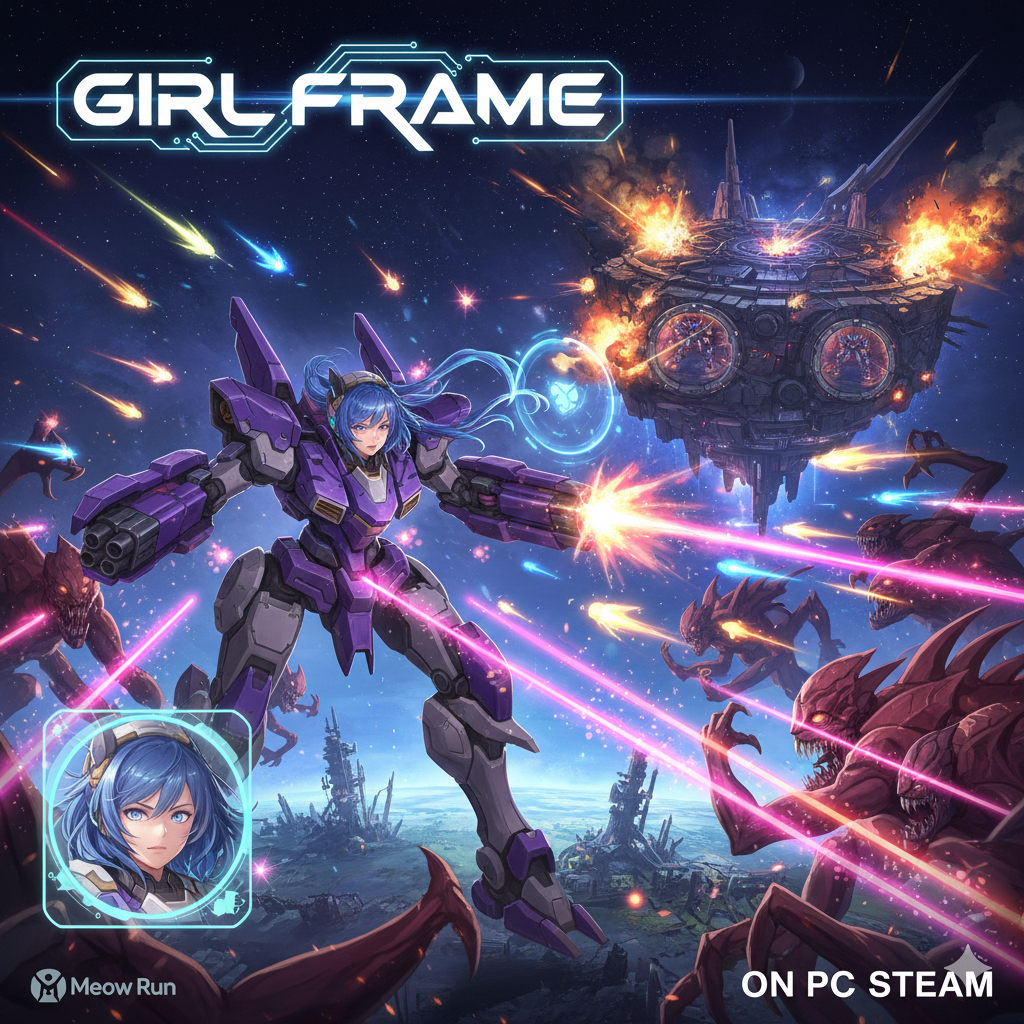
In a gaming landscape increasingly dominated by high-intensity action and mechanically dense systems, Girl Frame takes a markedly different approach. This PC title positions itself at the intersection of photography, visual storytelling, and light puzzle interaction, offering an experience that is deliberately introspective and understated. Rather than demanding fast reflexes or strategic mastery, Girl Frame asks players to slow down, observe carefully, and engage with composition, framing, and subtle environmental cues.
It is a game built around mood, perception, and presence. While that design philosophy will not appeal to everyone, Girl Frame succeeds in delivering a cohesive, emotionally restrained experience that rewards patience and attentiveness. For players who appreciate experimental indie design and games that prioritise atmosphere over action, this is a quietly compelling offering.
Concept and Core Identity
At its core, Girl Frame is about perspective. Players step into a world where progress is achieved not through combat or traditional objectives, but through observation and framing. The primary interaction revolves around a camera mechanic, encouraging players to explore environments, locate points of interest, and capture images that meet specific visual or thematic criteria.
This mechanic serves both as the game’s progression system and its narrative language. Rather than delivering story through dialogue-heavy cutscenes or text dumps, Girl Frame relies on implication, environmental storytelling, and visual symbolism. The act of framing an image becomes a metaphor for understanding the world and the characters within it.
The game’s identity is firmly rooted in this idea. It does not attempt to broaden its scope with unnecessary systems or genre blending. Instead, it commits fully to its central mechanic, for better and for worse.
Visual Presentation and Art Direction
Visually, Girl Frame is its strongest asset. The art direction leans into soft lighting, carefully composed scenes, and a muted colour palette that reinforces the game’s reflective tone. Environments are intentionally sparse, but every object feels placed with purpose. Empty space is used effectively, drawing attention to subtle movement, lighting shifts, and environmental details that might otherwise go unnoticed.
Character design is minimalist yet expressive. Facial animations and body language convey emotion without exaggeration, reinforcing the game’s quiet atmosphere. The titular “frame” concept is reinforced through environmental geometry, windows, doorways, reflections, and shadows — all of which subtly guide the player toward potential photographic opportunities.
The camera interface itself is clean and unobtrusive. Grid overlays, focus indicators, and exposure controls are easy to understand, even for players with no prior interest in photography. Importantly, the game avoids overcomplicating this system, ensuring that creativity is encouraged rather than constrained by technical barriers.
Gameplay Mechanics and Interaction
Gameplay in Girl Frame is intentionally simple. Exploration is slow-paced, and movement is deliberately restrained to keep the focus on observation rather than traversal. Players wander through interconnected spaces, searching for visual moments that satisfy the game’s objectives.
These objectives vary slightly across chapters. Sometimes the goal is to capture a specific subject from the correct angle; other times, players must align environmental elements in a particular way, using framing to reveal hidden meanings or trigger progression. In some sequences, taking the “wrong” photo provides subtle feedback, encouraging experimentation rather than outright failure.
This design fosters a relaxed relationship between player and game. There are no timers, no fail states in the traditional sense, and no pressure to optimise performance. Instead, Girl Frame invites players to engage at their own pace, making it particularly well-suited to short, reflective play sessions.
However, the simplicity of these mechanics also introduces limitations. After several hours, the core loop begins to feel repetitive. While new environments and thematic variations are introduced, the fundamental interaction remains unchanged. Players seeking evolving mechanics or escalating challenge may find the experience lacking in variety.
Narrative and Thematic Elements
Narratively, Girl Frame is deliberately abstract. The story is conveyed through visual cues, environmental shifts, and symbolic imagery rather than explicit exposition. Themes of identity, perception, and emotional distance recur throughout the experience, often communicated through repeated motifs and subtle environmental changes.
This approach will resonate strongly with players who enjoy interpretive storytelling and ambiguity. The game trusts its audience to draw their own conclusions, resisting the urge to explain or resolve every narrative thread. In doing so, it creates space for personal interpretation, which can make the experience feel intimate and resonant.
That said, the lack of narrative clarity may frustrate players who prefer more concrete storytelling. Without clear character arcs or defined plot progression, the emotional payoff relies heavily on player engagement and personal reflection rather than scripted moments.
Sound Design and Atmosphere
Sound design plays a crucial role in reinforcing Girl Frame’s mood. Ambient audio dominates the soundscape, with soft environmental noises, distant echoes, and subtle musical cues guiding emotional tone without drawing attention to themselves. Music is used sparingly, often fading in during key moments before retreating into silence.
This restraint is effective. Silence becomes a tool, heightening awareness and encouraging players to focus on visual composition. The shutter sound of the camera is particularly well-designed, providing a satisfying sense of finality to each captured moment.
Voice acting is minimal or entirely absent, depending on interpretation, further emphasising the game’s reliance on visual storytelling. This choice reinforces immersion, though it also contributes to the game’s emotionally distant tone.
Pacing and Structure
Girl Frame is relatively short, with most players likely to complete it in a handful of hours. Its pacing is steady and deliberate, with chapters flowing naturally into one another. There are no abrupt difficulty spikes or mechanical surprises, which makes the experience consistent but occasionally predictable.
Checkpoints are generous, and backtracking is minimal. The game respects the player’s time, rarely forcing repetition or unnecessary traversal. This structure supports its meditative tone, ensuring that frustration never undermines atmosphere.
Replay value is limited, however. Once puzzles are solved and narrative beats experienced, there is little incentive to revisit the game beyond appreciating its visuals again. Additional modes, such as a free photography mode or alternate framing challenges, could have significantly extended longevity.
Accessibility and Approachability
From an accessibility standpoint, Girl Frame is welcoming. Controls are straightforward, input requirements are minimal, and there are no reflex-based challenges. Players of all skill levels can engage with the game without feeling overwhelmed.
However, accessibility options beyond basic control remapping are limited. Visual filters, text scaling, or additional guidance systems would broaden the game’s reach and improve inclusivity.
Critiques and Limitations
The most significant limitation of Girl Frame is its narrow mechanical scope. While the camera-based gameplay is well-implemented, it is not deep enough to sustain long-term engagement on its own. Players looking for challenge, progression systems, or mechanical evolution may feel underserved.
Additionally, the abstract narrative approach, while artistically consistent, may alienate players who prefer clear storytelling and character development.
Final Verdict
Girl Frame is a carefully crafted, visually striking experience that prioritises atmosphere, reflection, and creative observation over traditional gameplay complexity. It succeeds in delivering a cohesive artistic vision and offers moments of quiet beauty that linger long after the screen fades to black.
While its limited mechanical depth and short length prevent it from achieving broader appeal, it remains a worthwhile experience for players who value mood-driven design and experimental storytelling.