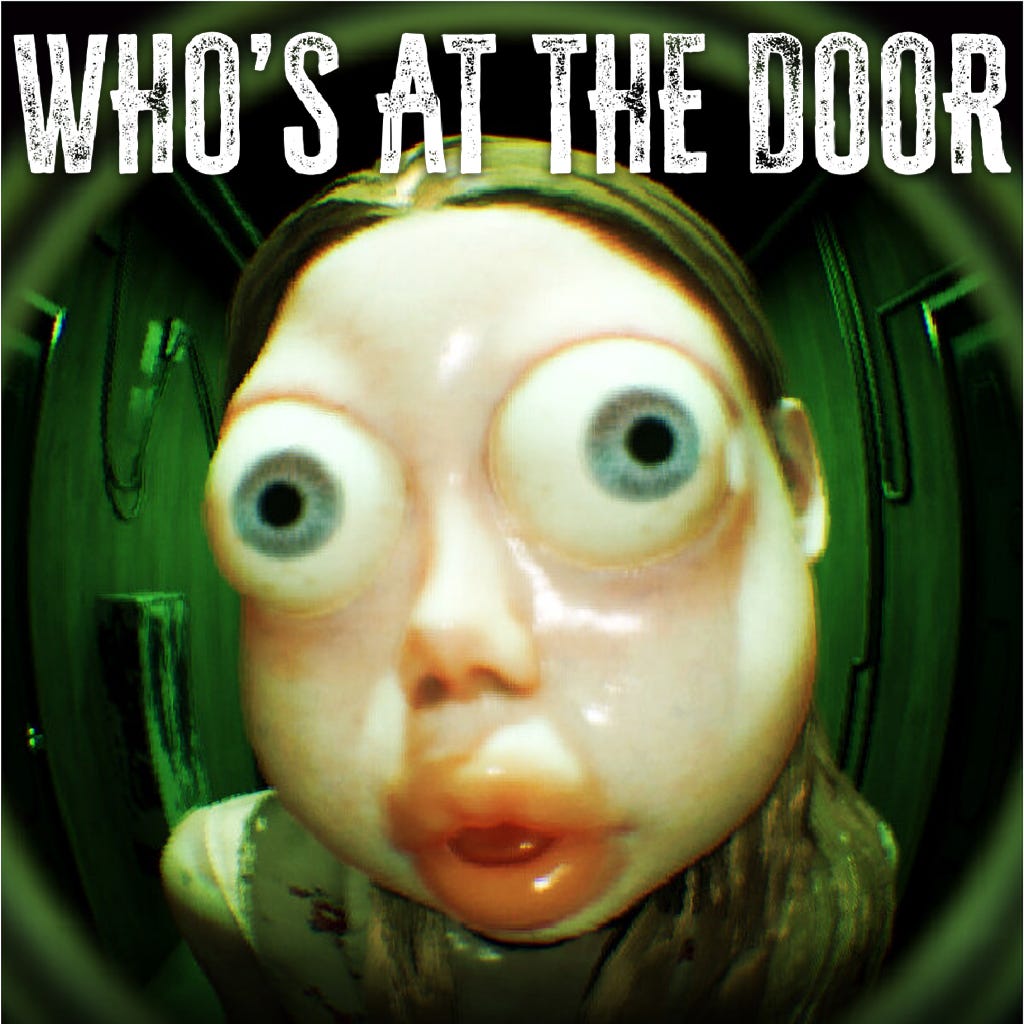
Who’s at the Door? is a short-form psychological horror experience that thrives on unease rather than spectacle. Built around repetition, paranoia, and subtle environmental shifts, it places the player in a confined domestic space and asks a deceptively simple question: do you open the door, or do you wait? From that premise, the game constructs a tense, oppressive atmosphere where nothing feels entirely safe, and certainty is always just out of reach.
Rather than leaning on jump scares or explicit violence, Who’s at the Door? draws inspiration from analogue horror and looping narrative design. It’s a game that understands the power of suggestion, using restraint and ambiguity to keep players second-guessing their own perceptions. The result is a compact but effective horror title that leaves a lingering impression long after its brief runtime ends.
Gameplay and Structure
At a mechanical level, Who’s at the Door? is intentionally minimal. You are confined to a small interior space—your home—and the core loop revolves around observation, routine, and decision-making. Each “cycle” or loop presents subtle variations in the environment, audio cues, or events occurring outside the door. Your task is not spelled out explicitly; instead, you are expected to learn through repetition, trial, and error.
This design choice is central to the game’s identity. Progress is less about traditional objectives and more about recognising patterns, noticing inconsistencies, and deciding when something feels wrong. The door itself becomes a focal point of dread. Opening it at the wrong time can have consequences, while refusing to open it may also push the experience in an unexpected direction.
The controls are simple and responsive, keeping friction low so the player’s attention remains on the environment. Interaction is limited, but purposeful. Every action feels deliberate, reinforcing the sense that even small choices matter.
Atmosphere and Tension
Atmosphere is where Who’s at the Door? truly excels. The confined setting creates a claustrophobic sense of isolation, while sound design does much of the heavy lifting. Distant knocks, muffled voices, subtle ambient noise, and moments of near-silence all work together to heighten tension. The game frequently allows discomfort to build without resolution, which is often more unsettling than overt scares.
Lighting and environmental detail are used sparingly but effectively. Minor changes—a shifted object, altered lighting, or an unfamiliar sound—are enough to destabilise the player. Because the game trains you to pay attention to small details, even the slightest deviation can trigger anxiety. This constant state of vigilance is key to the experience, making each loop feel heavier than the last.
Importantly, the game respects the player’s intelligence. It rarely explains itself, choosing instead to let unease emerge naturally through implication and repetition.
Visual Presentation
Visually, Who’s at the Door? adopts a grounded, realistic style that supports its psychological focus. The environment is intentionally ordinary: a familiar domestic space that feels safe at first glance. This normality is what makes the horror effective. There are no elaborate monster designs or grotesque visuals; instead, the fear comes from the sense that something is off, even if you can’t immediately articulate why.
The restrained use of visual effects ensures that when something unusual does occur, it stands out sharply. The game avoids visual clutter, keeping the player’s attention locked on the space and the door itself. This clarity of presentation reinforces the tension rather than distracting from it.
Narrative and Interpretation
Narrative in Who’s at the Door? is abstract and open to interpretation. Rather than presenting a clear story, the game offers fragments—suggestions of events, implications of past actions, and possible meanings behind the figure (or presence) at the door. This ambiguity will appeal strongly to players who enjoy piecing together meaning rather than being given explicit answers.
Themes of paranoia, guilt, fear of intrusion, and the unknown are woven throughout the experience. The lack of concrete exposition encourages discussion and reflection, making the game feel larger than its runtime might suggest. Multiple endings or outcomes further reinforce this interpretive approach, rewarding players who experiment with different choices and behaviours.
Pacing and Replayability
As a short horror experience, pacing is tight and deliberate. The game does not overstay its welcome, which works in its favour. Each loop adds pressure, and the gradual escalation of tension ensures that the experience remains engaging from start to finish.
Replayability comes primarily from curiosity and completion. Players interested in uncovering all possible outcomes or fully understanding the game’s internal logic will find reason to revisit it. However, those seeking mechanical variety or long-term progression may find replay value limited once the core patterns are understood.
Strengths and Limitations
The greatest strength of Who’s at the Door? lies in its restraint. By focusing on mood, sound design, and psychological discomfort, it delivers a horror experience that feels thoughtful and controlled. It proves that fear doesn’t require constant escalation or visual excess.
That said, the same minimalism that defines the game may not appeal to everyone. Players expecting traditional horror mechanics, frequent scares, or explicit storytelling may find the experience too subtle or ambiguous. The confined setting and repetitive structure are intentional, but they can feel limiting if you’re not aligned with the game’s design philosophy.
Final Verdict
Who’s at the Door? is a compact, unsettling psychological horror game that succeeds through atmosphere, tension, and intelligent restraint. It’s not designed to shock or overwhelm, but to quietly burrow under the player’s skin and stay there. For fans of slow-burn horror, analogue-style unease, and interpretation-driven narratives, it offers a memorable and effective experience.
It may be brief, and it may not be for everyone, but for the right audience, Who’s at the Door? delivers exactly what it sets out to do.