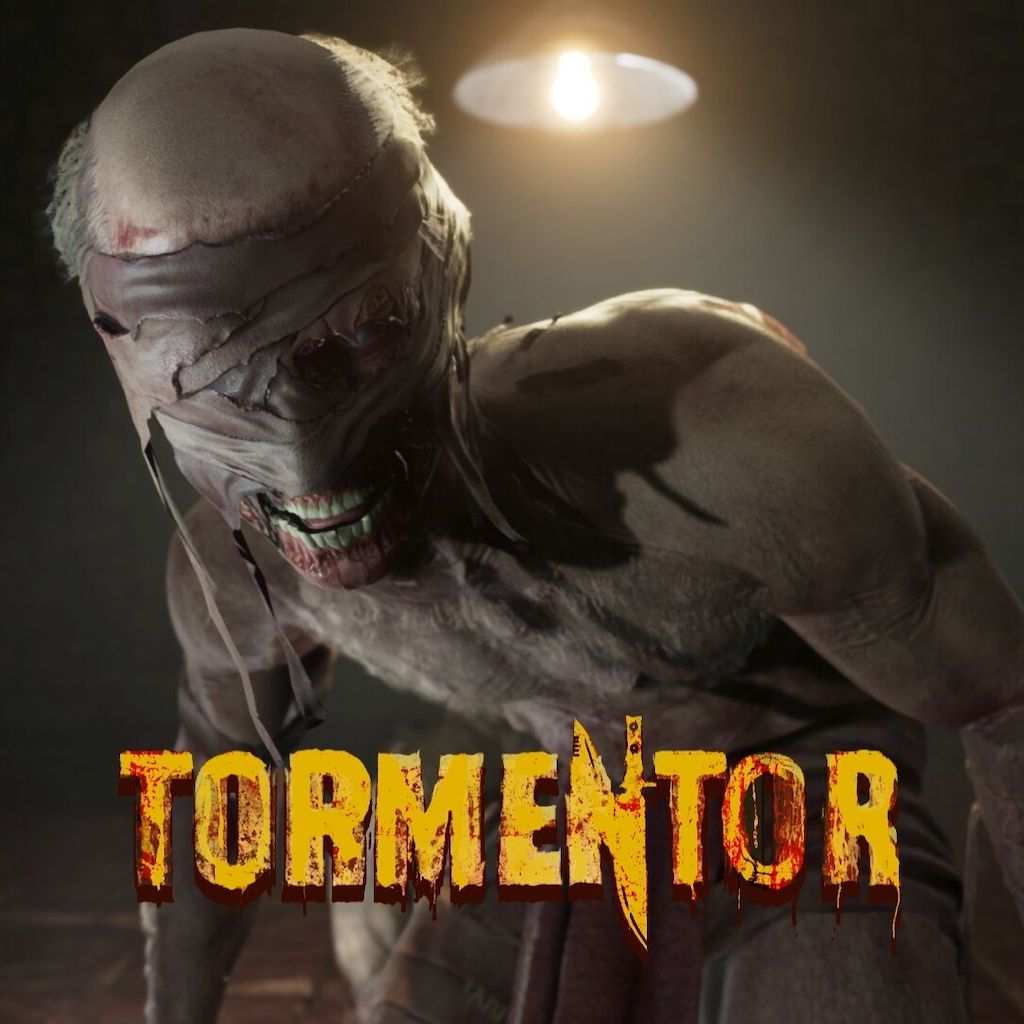
At first glance, TORMENTOR presents itself as another bleak, minimalist horror experience, the kind that thrives on oppressive atmosphere rather than spectacle. Spend more than a few minutes with it, however, and it becomes clear that this is not simply a game about fear—it is a sustained exercise in discomfort, control deprivation, and psychological endurance. TORMENTOR does not want to scare you in the conventional sense. It wants to wear you down.
This is a game that leans heavily into mood, pacing, and mental pressure. It is not interested in empowering the player or providing cathartic release. Instead, it builds an experience that feels deliberately hostile, forcing you to confront vulnerability, isolation, and uncertainty at nearly every turn.
Atmosphere and World Design
The greatest strength of TORMENTOR lies in its atmosphere. From the opening moments, the game establishes a suffocating tone that rarely lets up. Environments are sparse, dimly lit, and often deliberately indistinct. Corridors bleed into rooms, rooms into cell-like spaces, and before long the player begins to feel lost—not just spatially, but emotionally.
The visual design favours muted colours, heavy shadows, and unsettling geometry. There is a sense that the world itself is decaying or warping under unseen pressure. Walls feel too close. Ceilings feel too low. Even larger spaces are framed in ways that deny comfort, using awkward angles and limited sightlines to keep players perpetually on edge.
Crucially, TORMENTOR avoids relying on cheap jump scares. When sudden moments do occur, they feel earned rather than mechanical. More often, the game unsettles through suggestion—distant sounds, flickering lights, half-seen shapes that may or may not be real. The result is a lingering unease that persists even during moments of relative quiet.
Sound Design: The Invisible Enemy
If visuals set the stage, sound design is what truly drives TORMENTOR’s horror. Audio cues are sparse but razor-sharp, used with restraint and purpose. Footsteps echo unnaturally. Breathing sounds feel too close for comfort. Environmental noises—creaks, metallic groans, distorted hums—create the constant impression that something is moving just beyond perception.
The absence of music for long stretches is particularly effective. Silence becomes a weapon, amplifying every minor sound and making the player hyper-aware of their surroundings. When music does appear, it is often low, droning, and dissonant, less a melody and more an auditory manifestation of dread.
This careful audio design ensures that fear in TORMENTOR is rarely visual alone. Often, what you hear is more disturbing than anything you see, encouraging the imagination to fill in gaps in deeply uncomfortable ways.
Gameplay: Powerlessness as Design Philosophy
TORMENTOR’s gameplay is built around intentional limitation. Controls are responsive, but movement often feels weighty and deliberate, reinforcing the sense that the player is not in full control of their situation. There is no power fantasy here—no arsenal of weapons, no reliable means of defence.
Instead, the game focuses on exploration, observation, and survival through avoidance. Puzzles are environmental rather than abstract, requiring players to read the space around them rather than rely on explicit instructions. Objectives are often implied rather than stated outright, encouraging careful attention to detail.
This approach will not appeal to everyone. TORMENTOR frequently withholds information, and moments of progress can feel ambiguous. However, this ambiguity is a deliberate choice. The game wants players to feel uncertain, second-guessing their decisions and questioning whether they are moving forward or deeper into danger.
Psychological Horror Over Physical Threat
What sets TORMENTOR apart from many genre peers is its commitment to psychological horror. Threats are rarely straightforward. Enemies, when present, feel less like traditional antagonists and more like manifestations of fear, guilt, or obsession. The line between reality and hallucination is often blurred, and the game never fully clarifies which is which.
Narrative elements are fragmented and subtle. Storytelling occurs through environmental details, cryptic imagery, and unsettling implications rather than explicit exposition. Players are left to piece together meaning from scraps, which enhances immersion while also reinforcing themes of confusion and mental instability.
This narrative ambiguity may frustrate players seeking clear answers, but it aligns perfectly with the game’s tone. TORMENTOR is less concerned with telling a coherent story and more interested in making the player feel trapped within one.
Pacing and Tension Management
Pacing is deliberate and, at times, punishing. TORMENTOR is not a fast game, nor does it attempt to be. Progress is slow, methodical, and frequently interrupted by moments of hesitation or fear-induced paralysis. This slow burn will test patience, particularly for players accustomed to more action-driven horror experiences.
That said, the game understands when to apply pressure. Periods of quiet exploration are often followed by sudden shifts in tone, forcing players to adapt quickly. These transitions are handled carefully, ensuring that tension escalates without becoming exhausting.
The result is an experience that feels relentless but controlled, constantly walking the line between suspense and suffocation.
Technical Performance and Presentation
From a technical standpoint, TORMENTOR is largely solid. Performance remains stable, with few distractions that pull the player out of the experience. Visual fidelity is not cutting-edge, but it does not need to be. The art direction carries the experience, using style and atmosphere rather than raw graphical power.
Minor issues may arise—occasional visual oddities or slightly awkward animations—but they rarely detract from the overall impact. In some cases, imperfections even enhance the unsettling tone, adding to the sense that the world itself is unstable.
Final Verdict
TORMENTOR is not an easy game to recommend universally, but it is a compelling one for the right audience. It is slow, oppressive, and unapologetically uncomfortable. It asks players to embrace uncertainty, vulnerability, and prolonged tension without the promise of relief.
For fans of psychological horror, minimalist storytelling, and atmosphere-driven experiences, TORMENTOR offers a deeply unsettling journey that lingers long after the screen fades to black. It may not shock in traditional ways, but it excels at getting under the skin and staying there.
This is horror not as spectacle, but as endurance—and for those willing to endure, TORMENTOR delivers an experience that is as disturbing as it is memorable.