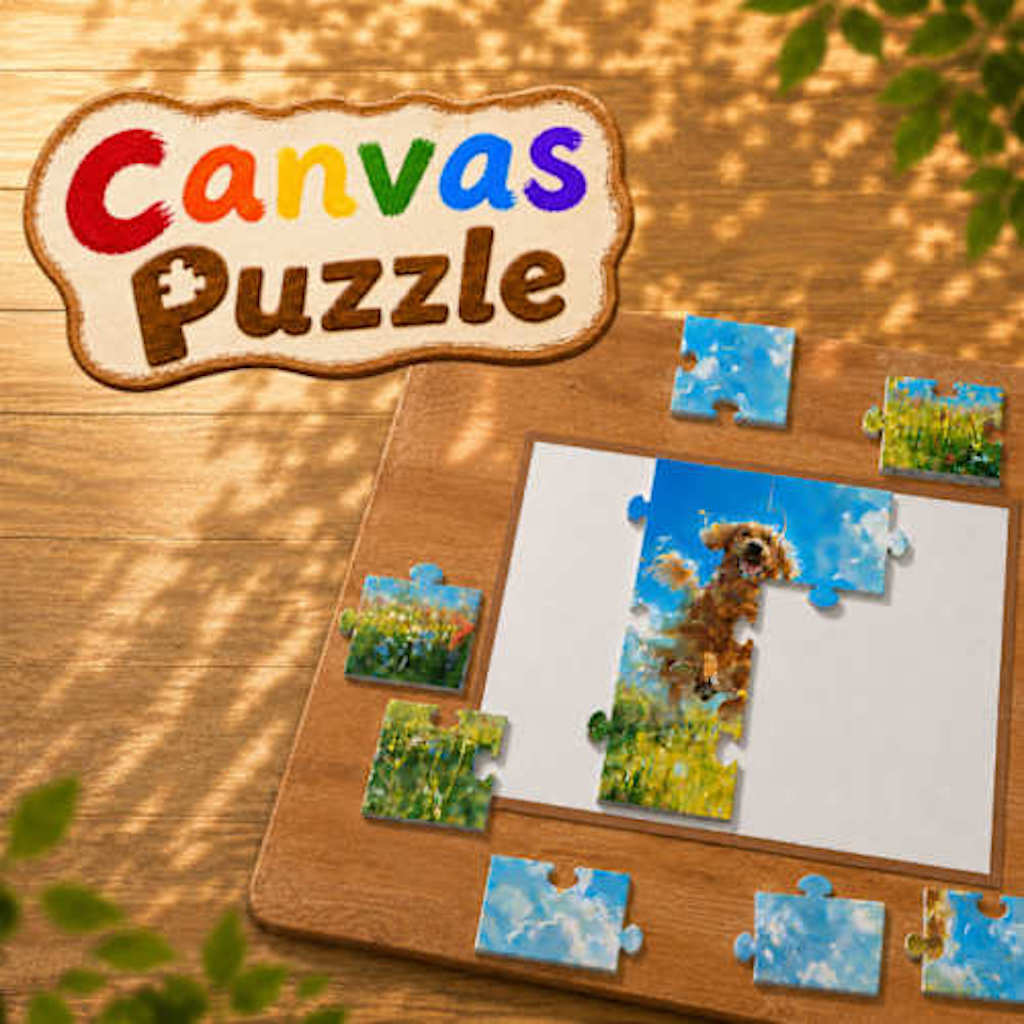
There is something wonderfully comforting about sitting down with a jigsaw puzzle, spreading the pieces across a table and watching a picture gradually take shape. It is a simple pleasure that can be enjoyed alone, shared with family or turned into a friendly competition between friends. Canvas Puzzle, developed and published by Hamgames, takes that familiar pastime and adds a creative twist, allowing players to draw their own pictures before transforming them into fully playable jigsaw puzzles. It is an inviting idea that gives the game a little more personality than a traditional digital puzzler, blending creativity, relaxation and the satisfaction of piecing together a finished image.
Available on Nintendo Switch, Canvas Puzzle is clearly designed with accessibility and togetherness in mind. Its colourful collection of drawing tools, charming 3D puzzle pieces and flexible difficulty settings make it approachable for players of different ages and abilities, while local multiplayer lets up to four people enjoy the experience together. Whether you are creating a colourful masterpiece, solving a picture of a peaceful landscape or helping a younger player find the right piece, the game encourages a slower, more thoughtful kind of entertainment. It is not interested in overwhelming players with complicated mechanics or punishing time limits. Instead, it offers a gentle space in which imagination and patience are rewarded, and that is precisely where its appeal lies.
A Canvas for Your Imagination
The most distinctive feature of Canvas Puzzle is its ability to turn players into artists before inviting them to become puzzle solvers. Rather than limiting the experience to a gallery of predetermined images, the game offers a selection of drawing tools, including pens, watercolours, crayons and stamps, allowing players to create their own artwork from scratch. Once the picture is finished, it can be transformed into a jigsaw puzzle, giving the creative process a satisfying second life. It is a clever concept that makes every drawing feel a little more meaningful, particularly when the finished image can be shared and enjoyed by others.
The drawing tools provide an accessible introduction to digital creativity, encouraging experimentation without demanding any particular artistic ability. Players can produce something carefully planned or simply let their imagination run wild, with the freedom to create pictures that are personal, silly, colourful or entirely abstract. For younger players, this is a particularly appealing way to explore creativity, as there is no pressure to produce something perfect. A drawing does not need to resemble a professional illustration to become an enjoyable puzzle, and the opportunity to turn even the simplest doodle into a playable activity gives the game a genuine sense of charm.
There is also something rather lovely about the idea of solving a picture that you have created yourself. Recognising familiar shapes, colours and details as the image gradually comes together can make the experience feel more rewarding than completing a standard puzzle. A picture drawn by a child, for example, might become a treasured little creation that the family can revisit and solve together. This personal connection is what gives Canvas Puzzle its strongest identity, turning a familiar pastime into something that feels more individual and expressive.
Of course, the drawing system is not intended to rival dedicated digital art software, and players looking for advanced creative tools may find it relatively basic. Its purpose is to make drawing enjoyable and accessible, rather than to provide a comprehensive artistic workstation. That simplicity works in the game’s favour, keeping the focus on creativity as part of a wider puzzle experience. It is less about producing a masterpiece and more about enjoying the process of making something that is entirely your own.
Piecing Together a Relaxing Experience
Alongside custom artwork, Canvas Puzzle offers a gallery of built-in images covering familiar subjects such as scenery, animals, food and landscapes. This provides plenty of options for players who would rather get straight into solving puzzles without spending time creating their own pictures. The range of imagery helps keep the experience varied, offering a mixture of appealing scenes that suit the game’s gentle atmosphere. Whether you prefer a peaceful natural setting, an adorable animal or something a little more colourful, there is a selection of pictures to explore.
The puzzles themselves are presented in 3D, giving the pieces a more tactile appearance than the flat images often associated with digital jigsaw games. There is a satisfying sense of handling individual pieces as they are moved into position, while watching the image gradually emerge provides the familiar pleasure that makes jigsaws so enjoyable. The presentation is inviting without being unnecessarily elaborate, allowing the artwork and the process of solving the puzzle to remain the main attraction. It is a style that suits the game’s relaxed personality, creating an experience that feels welcoming from the outset.
Players can choose between 12 and 84 pieces, allowing the difficulty to be adjusted according to their confidence, patience or available time. Smaller puzzles are ideal for younger players or anyone looking for a quick and uncomplicated activity, while larger arrangements provide a little more challenge for those who want to spend longer with a particular image. The option to enable or disable piece rotation is another welcome addition, as rotating pieces can introduce an extra layer of difficulty for anyone who enjoys a more demanding experience. These settings make the game flexible enough to accommodate different skill levels, although dedicated jigsaw enthusiasts may wish for more substantial challenges.
The maximum of 84 pieces is perhaps the most noticeable limitation of the puzzle system. For casual players and families, it is a perfectly reasonable number, offering enough complexity to make completing an image satisfying without becoming frustrating. However, experienced jigsaw fans who enjoy working through hundreds or even thousands of pieces may find the available options rather modest. A broader selection of piece counts would have helped the game appeal to a wider audience, particularly those who enjoy settling down for a lengthy puzzle session. Even so, the chosen range fits the game’s intended audience and its emphasis on accessible, low-pressure entertainment.
A Game Best Shared
While Canvas Puzzle is perfectly enjoyable as a solo experience, its local multiplayer support is one of its most appealing features. With up to four players able to participate, the game offers a simple way for families and friends to spend time together without complicated controls or extensive gaming experience. Jigsaw puzzles are naturally suited to cooperation, as different players can focus on separate sections of an image, exchange pieces and help one another when progress slows. The inclusion of multiplayer gives the game a social dimension that feels entirely appropriate for its creative and relaxed approach.
There is a particular appeal in the idea of drawing a picture together before turning it into a puzzle that everyone can solve. A family might create a shared piece of artwork, with each person contributing their own details, then enjoy the satisfaction of rebuilding the image as a group. It is the sort of activity that can encourage conversation and cooperation without making the game itself feel like a test of skill. Younger players can take part alongside adults, and the adjustable difficulty means the experience can be adapted to suit the people playing.
The absence of intense competition is also a welcome part of the game’s appeal. Rather than focusing on winning or losing, Canvas Puzzle places the emphasis on the shared experience of creating and completing something. That makes it a suitable choice for players who prefer a more peaceful alternative to fast-paced multiplayer games. It may not deliver the excitement of a competitive party title, but it offers a gentler kind of social entertainment that could prove especially enjoyable during family gaming sessions.
Collecting, Unlocking and Making It Your Own
Completing puzzles earns players coins, which can be exchanged for additional pictures, stamps and tables. This creates a straightforward progression system that gives players a reason to keep exploring the available content, even after they have completed their favourite images. Unlockable pictures expand the selection of puzzles, while new stamps offer further creative possibilities for those who enjoy designing their own artwork. Tables provide an additional way to customise the environment, adding a little personality to the space where the puzzles are assembled.
The rewards are simple, but they suit the game’s overall philosophy. There is no need for an elaborate economy or a complicated progression tree when the main attraction is the pleasure of drawing and solving puzzles. Earning coins through regular play provides a gentle incentive to keep going, while unlocking new items can make returning to the game feel worthwhile. It is a system that complements the experience rather than distracting from it, although players who prefer more substantial rewards may find the progression somewhat limited.
The ability to unlock new creative items is particularly useful because it feeds back into the game’s strongest feature. New stamps and pictures provide more opportunities to experiment, while the additional customisation helps players make the experience feel a little more personal. The system encourages continued engagement without introducing unnecessary pressure, allowing players to progress at their own pace. It may not be a particularly deep reward structure, but it gives the game a welcome sense of continuity.
A Gentle Visual and Audio Escape
The overall presentation of Canvas Puzzle is designed to create a soothing atmosphere, and that approach is central to its identity. The 3D puzzle pieces make solving each image feel tangible, while the colourful artwork gives the game a cheerful, inviting appearance. There is no need for elaborate visual effects or dramatic set pieces when the appeal lies in watching a picture gradually take shape. The presentation keeps things clear and approachable, ensuring players can concentrate on the puzzles rather than be distracted by unnecessary visual clutter.
The relaxed atmosphere also makes the game particularly suitable for shorter sessions. Players can complete a small puzzle during a spare moment or spend longer creating artwork and working through a larger image. There is a pleasing lack of urgency, giving players the freedom to stop and return whenever they wish without feeling they have fallen behind. This makes Canvas Puzzle a welcome alternative to games that demand constant attention or reward only rapid reactions.
Its gentle approach will not appeal to everyone, of course. Players who thrive on challenging mechanics, competitive pressure or complex progression systems may find the experience too subdued. The game is deliberately uncomplicated, and while that is one of its strengths, it also places a natural limit on its appeal. Those who enjoy peaceful puzzle games, however, will likely appreciate the opportunity to unwind with something that is as much about the journey as the finished picture.
Final Verdict
Canvas Puzzle is a charming and accessible take on the digital jigsaw genre, made more interesting by its imaginative draw-your-own puzzle feature and focus on shared creativity. The ability to turn personal artwork into playable puzzles gives the experience a distinctive identity, while the built-in gallery, adjustable piece counts and optional rotation provide plenty of flexibility for casual players. Its local multiplayer support is another major strength, making it an appealing choice for families and friends who want to enjoy a relaxed gaming experience together.
The limitations are clear. The modest maximum of 84 pieces means that dedicated jigsaw enthusiasts may find the challenge somewhat limited, while the straightforward drawing tools and uncomplicated progression system are unlikely to satisfy players seeking a deeper creative experience. Nevertheless, these shortcomings do little to undermine what the game is trying to achieve. It is designed to be welcoming, enjoyable and easy to share, and it succeeds in those areas.
Ultimately, Canvas Puzzle is a lovely little game that finds its greatest strength in the connection between creativity and play. It offers a place to draw without pressure, solve puzzles at a comfortable pace and share the experience with people around you. It may not be the most challenging jigsaw game available, but its personal touch and family-friendly design make it an enjoyable addition to the casual puzzle genre.