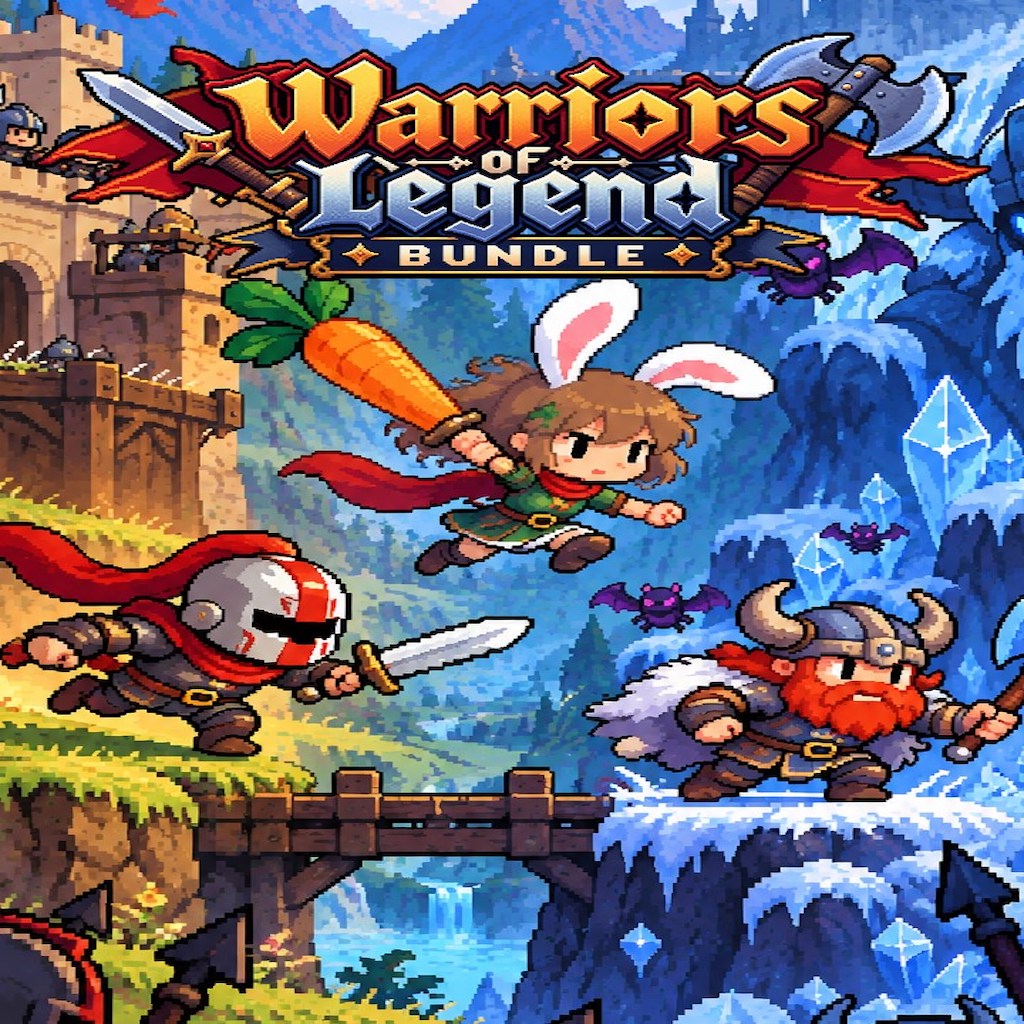
There is something appealing about a game bundle that knows exactly what it is offering. Warriors of Legend Bundle does not arrive pretending to be the next great revolution in 2D action games. Instead, Synnergy Circle Games has gathered three compact fantasy adventures, each with its own hero, setting and central gameplay idea, and packaged them into one affordable collection. The result is a distinctly old-school assortment that feels as though it has been pulled from a time when games were happy to throw a warrior, a handful of enemies and a mysterious kingdom onto the screen and simply let you get on with it.
Released for Xbox Series X|S, Xbox One and Windows, the bundle contains Carrot Crusade – Mimika’s Reckoning, Bastion Break and Shards of Mistfrost. While all three share the same broad 2D action-platforming DNA, they are different enough mechanically to stop the collection from feeling like precisely the same game three times over. One gives us a rabbit warrior armed with a rather unusual carrot-based arsenal, another puts a lone knight against an entire empire, while the third hands a Viking-inspired warrior an axe that becomes both weapon and tool.
There is no shortage of imagination here, even if the execution remains firmly within budget indie territory. These are small adventures rather than epic campaigns, and that distinction is important when considering what Warriors of Legend Bundle is actually offering. If you approach it expecting a lavish fantasy trilogy, you are likely to come away disappointed, but if you fancy three uncomplicated action games that can be picked up, played and completed without demanding dozens of hours, there is considerably more to enjoy.
Mimika’s Carrot-Fuelled Crusade
Of the three games, Carrot Crusade – Mimika’s Reckoning perhaps makes the most immediately memorable first impression. Mimika is a half-human, half-rabbit warrior on a mission to recover seven Rainbow Carrots, mystical relics capable of restoring life and balance to a world where nature’s magic is fading. It is an enjoyably bizarre premise, and the decision to equip Mimika with a Carrot Blade and enchanted Carrot Arrows certainly gives the adventure a personality that many low-budget platformers desperately lack.
The basic platforming and combat are straightforward, with Mimika leaping through dangerous environments, cutting down corrupted creatures and dealing with traps and guardians. There is nothing especially revolutionary about the underlying mechanics, but the experience has a pleasing simplicity. You see an enemy, work out how to approach it, attack, move on and keep exploring. Sometimes that uncomplicated structure is exactly what you want from a game like this, particularly when you have only half an hour to spare.
The Rainbow Carrots provide a useful sense of purpose as you work your way through the adventure, while the mixture of corrupted beasts, environmental hazards and ancient traps gives the journey some welcome variety. The presentation is undeniably basic, though, and there are moments when the game’s budgetary limitations become difficult to ignore. Environments can feel sparse, enemy encounters lack the complexity found in more polished action platformers, and the overall adventure is over before Mimika has really had the opportunity to become a fully developed character.
Even so, there is a certain charm to it. The carrot weaponry is silly in exactly the right way, and Mimika herself gives the game a little identity. In a collection where the other protagonists are considerably more traditional warriors, she is the one who sticks in the memory.
One Knight Against an Empire
Bastion Break takes a more traditional approach to fantasy action. The Empire of Valedorn is sweeping across the continent. Aurelia is next, and no conventional army can stop the invasion. Enter Kael Draven, a legendary knight who decides that the sensible response to an entire empire is to charge alone into enemy territory.
It is the sort of wonderfully straightforward setup that immediately tells you what kind of game you are playing. Kael is not negotiating peace treaties or recruiting a resistance movement. He is going to hit things with a sword.
The gameplay revolves around fast 2D combat and platforming as Kael cuts through enemy soldiers, storms fortified positions and takes on elite commanders. Compared with Carrot Crusade, there is a greater emphasis on sustained combat, with enemy groups creating more opportunities to chain attacks and react quickly. It never reaches the complexity or precision of the genre’s heavy hitters, but the basic action is satisfying enough when you are simply looking for something uncomplicated.
The strongest aspect of Bastion Break is arguably its momentum. The game wants you moving forward, fighting through enemy lines rather than spending huge amounts of time worrying about inventories, statistics or elaborate progression systems. That focus makes it particularly easy to dip into for a quick session.
The downside is that the simplicity can eventually become repetitive. Enemy behaviour is fairly basic, and once you have become comfortable with the combat rhythm, there are fewer surprises than you might hope for. The environments also lack the visual richness that would help each stage feel like a truly distinct part of Kael’s desperate campaign.
Still, there is something satisfying about the sheer directness of it. Sometimes being told to grab a sword and go dismantle an empire one soldier at a time is enough.
Into the Frozen World of Mistfrost
Shards of Mistfrost is perhaps the most mechanically interesting of the three, giving its protagonist, Hrok Thorgril, an axe that does considerably more than simply hurt enemies. The Giants of Calamity are attempting to cover the world in eternal winter using mysterious Winter Crystals, and Hrok must destroy the crystals and defeat the giants before the frozen apocalypse becomes permanent.
The axe is the star of the show. Hrok can throw it at enemies and obstacles, using positioning and timing to clear hazards and progress through the environment. Crucially, the axe must eventually return to Hrok, creating a simple but effective rhythm that makes positioning more important than simply charging towards anything that moves.
This mechanic works particularly well within the retro-inspired 2D structure. Throw the axe too early and you may find yourself without your weapon when an enemy approaches. Throw it in the wrong direction and you may need to wait for its return before making your next move. That adds just enough thought to the action to make the game feel more distinctive than a conventional sword-swinging platformer.
The Norse mythology influence also gives Shards of Mistfrost a strong visual and thematic identity. Giants, winter crystals and a warrior carrying a mighty axe naturally lend themselves to a familiar fantasy atmosphere, although once again the relatively simple presentation means that the ambition is sometimes greater than the available resources.
Of the three games, this is the one where the central gameplay gimmick feels most integrated into the level design. It encourages you to think about where you stand, when you throw and how you navigate the space around you. It is still a relatively lightweight adventure, but there is a satisfying rhythm to mastering the axe.
Three Games, Three Different Flavours
The biggest advantage of the Warriors of Legend Bundle is undoubtedly its variety. Had Synnergy Circle Games packaged three games that played almost identically, the collection would have struggled to justify itself. Instead, while the foundations are similar, each adventure has a slightly different flavour.
Carrot Crusade brings the eccentricity, Bastion Break delivers straightforward sword-swinging action, and Shards of Mistfrost introduces the more unusual axe mechanic. None of them are particularly deep, but they provide enough variation that moving from one to another feels worthwhile.
That variety also makes the bundle particularly easy to recommend to players who enjoy short indie adventures. You can play a few levels of one game, switch to another when you fancy something different, and come back later without having to remember an enormous amount of story or complicated systems. It is uncomplicated gaming in a very literal sense.
There is also appeal for achievement hunters. With three separate games included, there are plenty of opportunities to work through their objectives and steadily build up your Gamerscore. The relatively short campaigns and straightforward gameplay make the collection particularly accessible for players who enjoy completing smaller games alongside larger releases.
Budget Adventure Has Its Limits
Of course, the Warriors of Legend Bundle is not without its limitations. The biggest issue is that all three games feel unmistakably budget in their presentation. Pixel art and retro aesthetics can be extremely effective when used with confidence, but here the relatively basic visual assets, simple environments and limited enemy variety can make the games feel less polished than their concepts deserve.
Combat is similarly uncomplicated. There is fun to be had in all three games, but players looking for deep character progression, sophisticated enemy behaviour or highly technical combat will probably find the experience rather thin. The campaigns are also short, so the collection offers variety rather than an enormous amount of content.
That is not necessarily a criticism in itself. There is nothing wrong with a game being short, especially when its price reflects that fact. The problem only arises if you expect each title to develop into something substantially more ambitious as you play. These are lightweight adventures, and they remain so from beginning to end.
There is something refreshing about that, though. Modern games can sometimes bury simple fun beneath layers of systems, currencies, crafting mechanics and progression trees. Warriors of Legend Bundle largely avoids that temptation. You pick a warrior, learn the controls and start fighting.
A Charming Little Fantasy Collection
What ultimately makes Warriors of Legend Bundle work is that it never feels like it is trying to be something it isn’t. These are three modest indie adventures built around simple ideas, and while none of them reaches the heights of the genre’s finest examples, each brings enough personality to make the journey worthwhile.
Mimika’s carrot-powered crusade is the most eccentric, Kael’s one-man war provides the most traditional action, and Hrok’s axe gives Shards of Mistfrost the most interesting mechanical hook. Together, they create a collection that is more varied than its budget presentation might initially suggest.
There is a certain comfort in games like this. They do not demand your entire weekend. They do not expect you to learn an enormous skill tree or spend hours managing equipment. They simply put a character on the screen, give you a reason to move forward, and let you start swinging, slashing, throwing and jumping.
For players who appreciate compact indie adventures, retro-inspired action, and the satisfaction of steadily clearing smaller games from their backlog, there is plenty here to enjoy. Those seeking a major fantasy epic should look elsewhere, but that was never really what Warriors of Legend Bundle set out to be.
Instead, this is a modest collection with a decent heart. It has rough edges, repetitive moments, and plenty of evidence of its limited budget, but there is also imagination behind these three adventures. Sometimes that is enough to turn a simple collection of games into something worth spending an evening with.