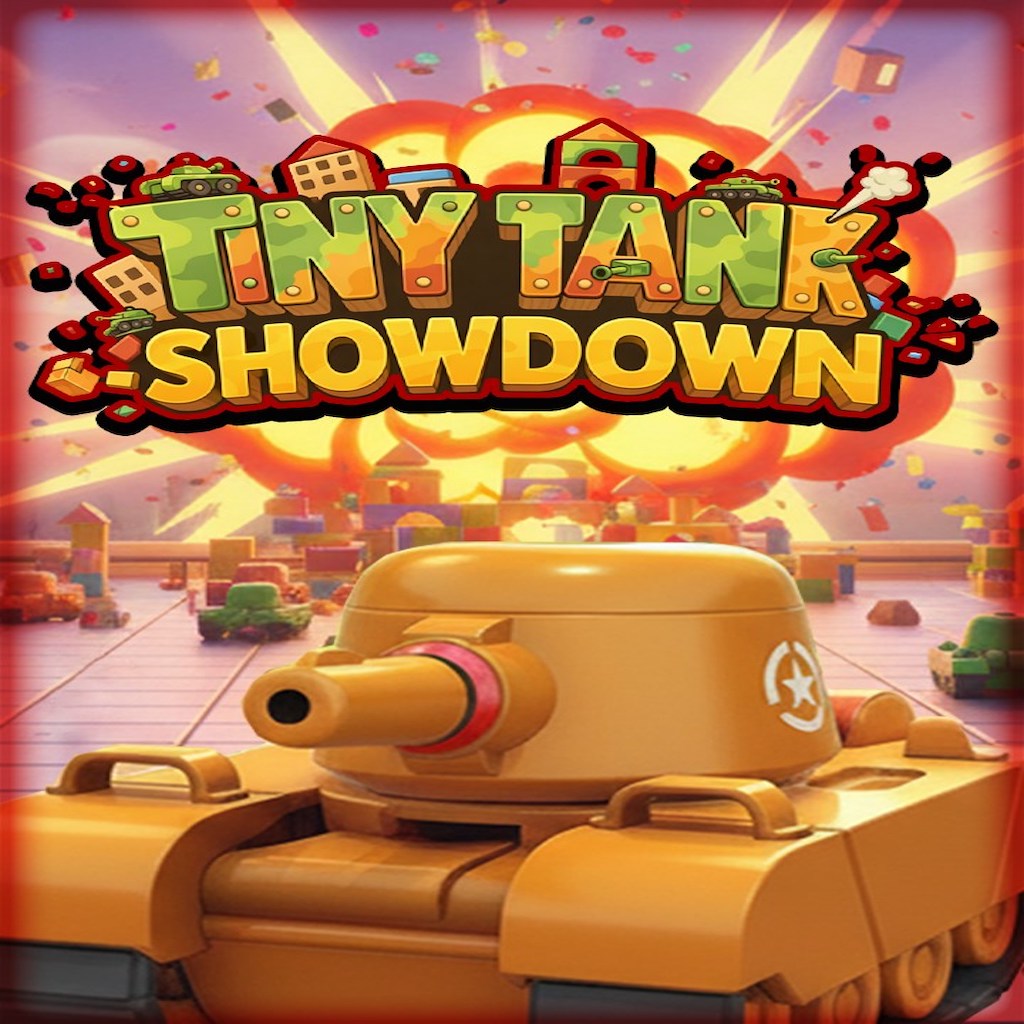
There is something wonderfully satisfying about driving a tiny tank around a small arena and blowing another tiny tank into oblivion. Perhaps it is the ridiculousness of the situation, perhaps it is nostalgia, or perhaps there is simply something inherently enjoyable about pointing a cannon at something and pulling the trigger. Whatever the reason, Tiny Tanks Showdown understands that sometimes you don’t need a complicated premise to have a good time. You just need a tank, some bullets, a handful of friends and an arena that is about to become considerably less peaceful.
Developed and published by EpiXR Games, Tiny Tanks Showdown is a fast-paced top-down arcade shooter built around quick battles, increasingly dangerous enemies and the simple pleasure of surviving one more wave. It takes the classic miniature tank formula and gives it a modern multiplayer twist, allowing you to tackle the campaign alone, work through it cooperatively with another player, or turn your friends into enemies in four-player VS matches. It is deliberately uncomplicated, and while that simplicity prevents it from becoming a particularly deep experience, it also gives the game an immediacy that is difficult to dislike.
This is not a game that wants you to read a 40-page manual before you can enjoy yourself. It wants you to pick up the controller, start moving and discover very quickly whether you’ve got the reflexes to survive.
Small Tanks, Big Trouble
The basic concept behind Tiny Tanks Showdown is almost wonderfully old-fashioned. You control a miniature tank from a top-down perspective, move around an arena and try to destroy enemy tanks before they destroy you. The controls are straightforward, the objectives are obvious, and there is very little standing between you and the action.
That accessibility is one of the game’s greatest strengths. You don’t need to understand a complicated upgrade tree or spend hours learning dozens of abilities. You simply move, aim, fire and try not to get shot. Within a few minutes, you’ll have a reasonable understanding of what you’re doing, and from there the game becomes a test of how quickly you can improve your reactions and positioning.
Of course, the simplicity doesn’t mean the action is always easy. Enemy tanks become faster, smarter and more dangerous as you progress through the campaign, and suddenly those early battles where you could happily drive around, firing at anything that moved, feel like a distant memory. Later encounters demand considerably more awareness, particularly when enemy fire begins filling the arena.
That gradual escalation is important because it gives the campaign a sense of progression, even though the game doesn’t rely heavily on elaborate character development or RPG mechanics. Your tank may not transform into some unstoppable super-machine, but your skills should improve as you learn how the enemies move and how best to exploit the environment.
Dodging Bullets and Bouncing Shots
The shooting itself is satisfying, but one of the more entertaining aspects of Tiny Tanks Showdown is its emphasis on ricochets. Shots can ricochet around the environment, allowing you to attack enemies from angles that aren’t immediately obvious. It adds a little tactical thinking to what could otherwise be a straightforward shoot-and-dodge affair.
There is something particularly satisfying about lining up a shot, watching it bounce off a wall and then slam into an enemy that thought it was safely out of sight. These moments are when the game feels most rewarding, because you’re not simply reacting to what is happening. You’re anticipating how the battlefield will behave and using it to your advantage.
The same environment can also become your biggest problem. A ricocheting projectile doesn’t care whether it belongs to you or your opponent, and crowded arenas can quickly become dangerous places. Learning when to take a shot and when to keep moving becomes increasingly important as the difficulty rises.
That creates a nice little rhythm. Fire, move, assess the situation, fire again, and hope the next projectile isn’t heading straight back towards you. It is simple arcade design, but when everything is moving quickly, it can become surprisingly tense.
Going It Alone
The single-player campaign provides the game’s main progression and serves as a useful introduction to its mechanics. Playing alone lets you learn enemy patterns, experiment with movement, and gradually improve your aim without having to worry about another human player getting in your way.
There is a certain satisfaction in working through the campaign and seeing how far your skills have developed. Early enemies can seem almost harmless, but as the game introduces tougher opposition, you quickly discover that simply holding down the fire button won’t get you to the end. Movement becomes just as important as shooting.
The campaign is also where the game’s straightforward nature becomes most apparent. There isn’t a particularly elaborate story pushing you forward, and the progression doesn’t offer a wide range of upgrades or character development. You’re essentially there to defeat increasingly challenging groups of tanks and eventually take on their leader.
For some players, that will be more than enough. For others, particularly those looking for a substantial solo adventure, it may feel a little thin. Tiny Tanks Showdown is much more interested in the quality of the moment-to-moment action than in giving you a grand reason to care about what happens next.
Bringing a Friend Along
The co-op mode is where the game starts to make considerably more sense as a social experience. The campaign can be completed with two players, allowing you and a friend to work together against the enemy forces. There is something inherently amusing about two tiny tanks rolling into battle together, especially when everything starts going wrong.
Co-op play also changes how you approach encounters. One player can draw enemy fire while the other attempts to flank an opponent, or you can simply charge in together and hope your combined firepower solves the problem. Communication can make a difference, but there is also plenty of room for the sort of glorious chaos that tends to happen when two friends are sharing a screen.
It is not a revolutionary co-op system, but it doesn’t need to be. Sometimes the best multiplayer experiences are those that can be explained in a sentence. Destroy the enemy tanks, don’t get destroyed yourself, and try not to laugh when your mate accidentally drives directly into a barrage of bullets.
Friends Make the Best Targets
If cooperation isn’t your thing, VS Mode lets up to four players settle their differences by turning the battlefield into a miniature war zone. This is arguably where the game’s simple mechanics have the greatest potential.
Four human players introduce a level of unpredictability that AI opponents simply cannot replicate. You know the person sitting next to you is actively trying to outmanoeuvre you, and every successful ricochet becomes something worth celebrating. Equally, every ridiculous death becomes ammunition for the next argument.
Tiny Tanks Showdown is ideally suited to this sort of local multiplayer because the controls are easy to understand. You can hand a controller to someone who has never played before and have them participating almost immediately. There is no long tutorial to get through and no complicated character build to explain.
That makes it an appealing party game, particularly for players who grew up with classic arena combat experiences. There is a clear nostalgic thread running through the whole thing, recalling the uncomplicated joy of games such as Combat while adding enough modern polish to make the formula accessible today.
The Limits of Tiny Warfare
The biggest weakness is also the most obvious. Tiny Tanks Showdown is quite a narrow experience. The basic gameplay is enjoyable, but there isn’t an enormous amount of variety.
The arenas can begin to feel repetitive, particularly during longer sessions, and the lack of a deeper progression system means there isn’t much to work towards beyond getting further, getting better and achieving higher scores. For a game built around arcade action, that isn’t necessarily a disaster, but it does limit the longevity.
I would have liked to see more variety in the arenas, perhaps environmental hazards that change how battles play out or additional tank abilities that encourage different approaches. More substantial unlocks or challenges could also have provided an incentive to keep returning after the initial novelty has worn off.
The good news is that the game doesn’t pretend to be something it isn’t. It is a lightweight arcade shooter, and judging it by the standards of a sprawling modern campaign would be missing the point. The question is whether the simple formula remains entertaining once you’ve played enough of it, and for the right audience, I suspect it will.
Final Thoughts
Tiny Tanks Showdown wears its simplicity proudly. There is no complicated narrative, no sprawling progression system, and no attempt to turn miniature tank warfare into something it isn’t. Instead, EpiXR Games has focused on the basics and built a pleasant little arcade shooter around them.
The movement is snappy, the shooting is satisfying, and the ricochet mechanics provide just enough tactical thought to make the combat more interesting than simply pointing and firing. The campaign offers a useful solo challenge, while the two-player co-op mode gives you a reason to invite a friend along. Then there is the four-player VS mode, which is arguably the game’s greatest opportunity to produce memorable moments.
Its limitations are equally clear. The environments can become repetitive, the progression is fairly light, and players searching for complex upgrades or a substantial story will find little here to satisfy them. The campaign feels more like an extended arcade challenge than a fully developed adventure, and once you’ve mastered the basic mechanics, there isn’t an enormous amount of additional depth waiting to be discovered. But sometimes that is exactly what you want.
Tiny Tanks Showdown feels like the sort of game you can fire up without making a commitment. You can play for ten minutes, have a few frantic battles, laugh at an unfortunate ricochet, and move on with your day. Or you can grab three friends and turn the evening into a miniature tank war where nobody is quite willing to admit the last victory was pure luck.
It won’t reinvent the arcade shooter, but it doesn’t need to. Tiny Tanks Showdown understands the timeless appeal of simple controls, quick matches, and watching your opponent explode. For anyone looking for a cheerful little throwback to the days when multiplayer gaming was often about who could survive the longest and who could blame the controller when they lost, there is plenty to enjoy here.