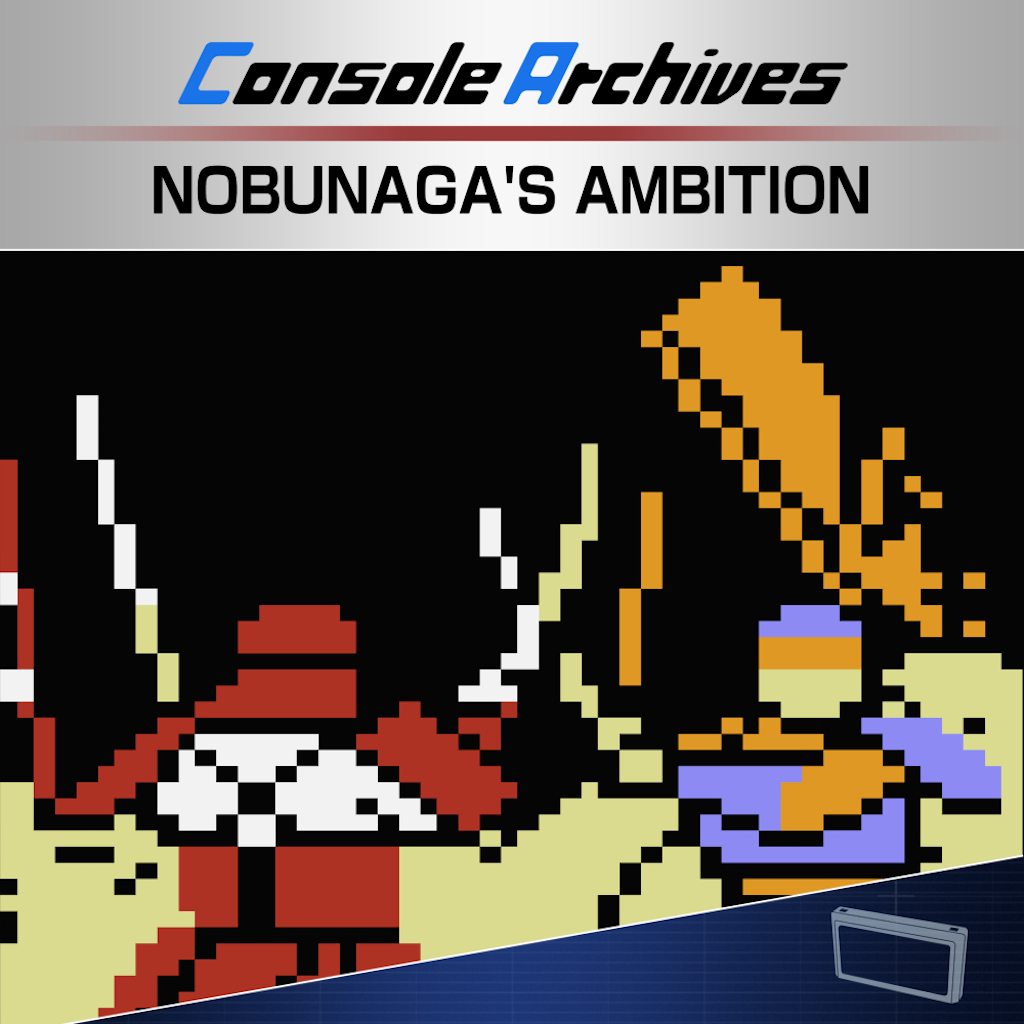
There is something rather wonderful about booting up an old strategy game and finding it has absolutely no interest in holding your hand. Modern grand strategy games can sometimes throw so many menus, tutorials, objectives and pop-ups at you that the actual business of ruling an empire can be buried beneath layers of interface. Console Archives NOBUNAGA’S AMBITION II comes from a very different school of thought. Released by KOEI in 1990 for an 8-bit home console, this is a game that expects you to sit down, pay attention and learn how its world works before you can hope to conquer it.
Set during Japan’s turbulent Sengoku period, NOBUNAGA’S AMBITION II places you in control of a daimyo with one enormous task ahead of them: unify Japan. That sounds straightforward enough until you realise that your kingdom is not simply a collection of soldiers waiting for orders. You have agriculture to manage, officers to keep happy, resources to balance, territories to develop and rival warlords who would quite happily see your ambitions come to an abrupt end. It is a remarkably broad simulation, considering the hardware it was originally designed to run on.
The result is a strategy game that can feel intimidating at first, but increasingly rewarding once its systems begin to make sense. There is a certain satisfaction in looking at a seemingly hopeless situation and gradually working out how to turn it around. NOBUNAGA’S AMBITION II doesn’t hand you victories. You have to earn them.
The Sengoku Period Becomes Your Chessboard
The real attraction here is the scale of the strategic challenge. The game features 38 fiefs across regions including Kanto and Chubu, giving you an enormous political and military playground to work with. You can choose from a substantial selection of historical warlords, each bringing different circumstances and opportunities to the campaign. With approximately 400 historical samurai represented, there is also considerable personality behind the numbers.
Your officers aren’t simply interchangeable pieces on a board. Their individual abilities and characteristics can have a meaningful impact on how efficiently your territories operate and how successful your military campaigns are. Recruiting the right people, assigning them appropriately, and maintaining their loyalty are therefore important parts of the experience. Ignore your retainers for too long, and your carefully constructed empire can begin to develop cracks from within.
This creates a fascinating balance between the personal and the political. You might have an excellent opportunity to expand into neighbouring territory, only to realise that your own domain isn’t ready for another war. Perhaps your army needs supplies, your economy needs attention, or one of your officers needs rewarding before they decide that another daimyo offers a more attractive career opportunity. It is these little decisions that make NOBUNAGA’S AMBITION II feel like more than simply a game about moving armies around a map.
Build Before You Conquer
One of the biggest mistakes a newcomer can make is assuming that military strength is everything. It isn’t. Your fiefs need careful management if you are going to build an empire capable of sustaining warfare, and that means paying attention to agriculture, commerce and the resources available to you.
Developing your territories provides the foundation for everything else. A strong economy gives you more options, while sufficient food and supplies help keep your forces functioning when campaigns drag on. There is a satisfying sense of cause and effect here, because your decisions in one season can have consequences several turns later.
The seasonal structure also gives the game a satisfying rhythm. You aren’t simply issuing commands and watching numbers increase. You are constantly assessing the condition of your territory, deciding where limited resources should go and thinking about what you might need several turns down the road. It encourages patience, which becomes particularly important when your ultimate goal is to unify an entire country.
Warfare With More Than One Trick
When diplomacy and economic development inevitably give way to warfare, NOBUNAGA’S AMBITION II introduces its expanded hex-based combat system. Battles take place on a grid where positioning, movement and tactical decisions matter, adding another layer of strategy to the larger campaign.
The inclusion of both open and siege battles is particularly welcome. Fighting in the field presents a different challenge from attempting to overcome a fortified castle, and understanding the distinction between the two is important when planning an invasion. You cannot simply throw every available soldier towards the enemy and expect the numbers to do all the work.
There is something satisfyingly methodical about these encounters. The battles don’t attempt to recreate warfare through flashy animations or cinematic spectacle. Instead, they make you think about positioning and the situation in front of you. It is closer to moving pieces across a strategic board than to participating in an action game, and that is entirely appropriate for a title of this vintage.
A Lot of Game in a Very Old Package
The sheer volume of content in NOBUNAGA’S AMBITION II is impressive. Multiple scenarios offer different starting points and circumstances, so the experience can vary considerably depending on which warlord you select. A powerful daimyo might provide a relatively secure start but attract the attention of neighbouring rivals, while a weaker position can turn the opening turns into a desperate struggle for survival.
This replayability is one of the game’s greatest strengths. Once you understand the basic systems, you naturally start wondering how another campaign might play out. What happens if you choose a different warlord? Could you expand in another direction? Could you rely more on diplomacy rather than military conquest? Could you turn a comparatively weak starting position into an eventual victory?
These questions are what keep a grand strategy game alive long after its first campaign. NOBUNAGA’S AMBITION II has plenty of them.
Retro Presentation With Modern Conveniences
Visually, there is no hiding the game’s 8-bit origins. The pixel art, menus and character portraits are firmly rooted in the 1990s, and anyone expecting a modern grand strategy interface will need to adjust their expectations. Yet there is an understated charm to the presentation, particularly when viewed as a piece of gaming history.
Both the English and Japanese versions are included, a particularly nice touch for preservation. The original presentation remains intact, while the Console Archives framework provides modern conveniences such as customisable controls, screen settings and the ability to save and load at any point.
These additions make a meaningful difference. Older strategy games could be demanding enough without the added worry of losing hours of progress because real life suddenly demanded your attention. Being able to save whenever you need to makes the experience much more approachable without changing the underlying game.
The rewind feature is another useful addition for anyone learning the ropes. When an unfortunate tactical decision goes spectacularly wrong, being able to step backwards gives newcomers an opportunity to understand what happened rather than simply staring at a defeat screen. For experienced players, however, there is still plenty of room to play the game in a more traditional fashion.
A Game That Rewards Patience
Perhaps the greatest compliment I can pay NOBUNAGA’S AMBITION II is that it still feels like a proper strategy game. It isn’t interested in constant rewards or in making you feel powerful every few minutes. Instead, it asks you to think, plan, and occasionally accept that your brilliant idea was, in fact, an absolutely terrible one.
That can be frustrating, particularly in the early hours. The menus aren’t always intuitive, and there are plenty of systems newcomers will need to understand before they can play confidently. But once the mechanics begin to click, the experience becomes surprisingly absorbing.
There is also something refreshing about the pace. Modern games can make everything feel urgent, whereas NOBUNAGA’S AMBITION II gives you time to consider your options. You can spend a turn developing your territory, another managing your officers, and another preparing for the next stage of your campaign. It makes success feel like the result of planning rather than simply reacting quickly.
Final Verdict
Console Archives NOBUNAGA’S AMBITION II is a fascinating piece of strategy history that remains impressively deep more than three decades after its original release. Its 38 fiefs, hundreds of historical officers, multiple scenarios and expanded tactical battles provide a wealth of strategic material, while the economic and political systems ensure that conquest is never simply a matter of having the biggest army.
There is undoubtedly a learning curve, and the 8-bit interface can feel daunting compared with the polished menus of modern strategy games. The pace is also deliberately slow, demanding patience from anyone accustomed to immediate action and constant rewards. Yet once you settle into its rhythm, there is undeniable satisfaction in watching your modest domain grow into something capable of challenging the most powerful warlords in Japan.
HAMSTER’s Console Archives presentation does exactly what it should, preserving the original experience while adding sensible conveniences that make it far easier to enjoy today. Save functionality, custom controls and screen options don’t dilute the experience. They simply remove some of the practical barriers that come with playing a game originally designed for another era.
For fans of historical strategy, retro gaming, or anyone curious about the foundations of the genre, NOBUNAGA’S AMBITION II is a fascinating reminder that deep strategy didn’t require modern hardware. Sometimes all you need is a map, a handful of ambitious warlords and enough patience to turn a small fief into an empire.