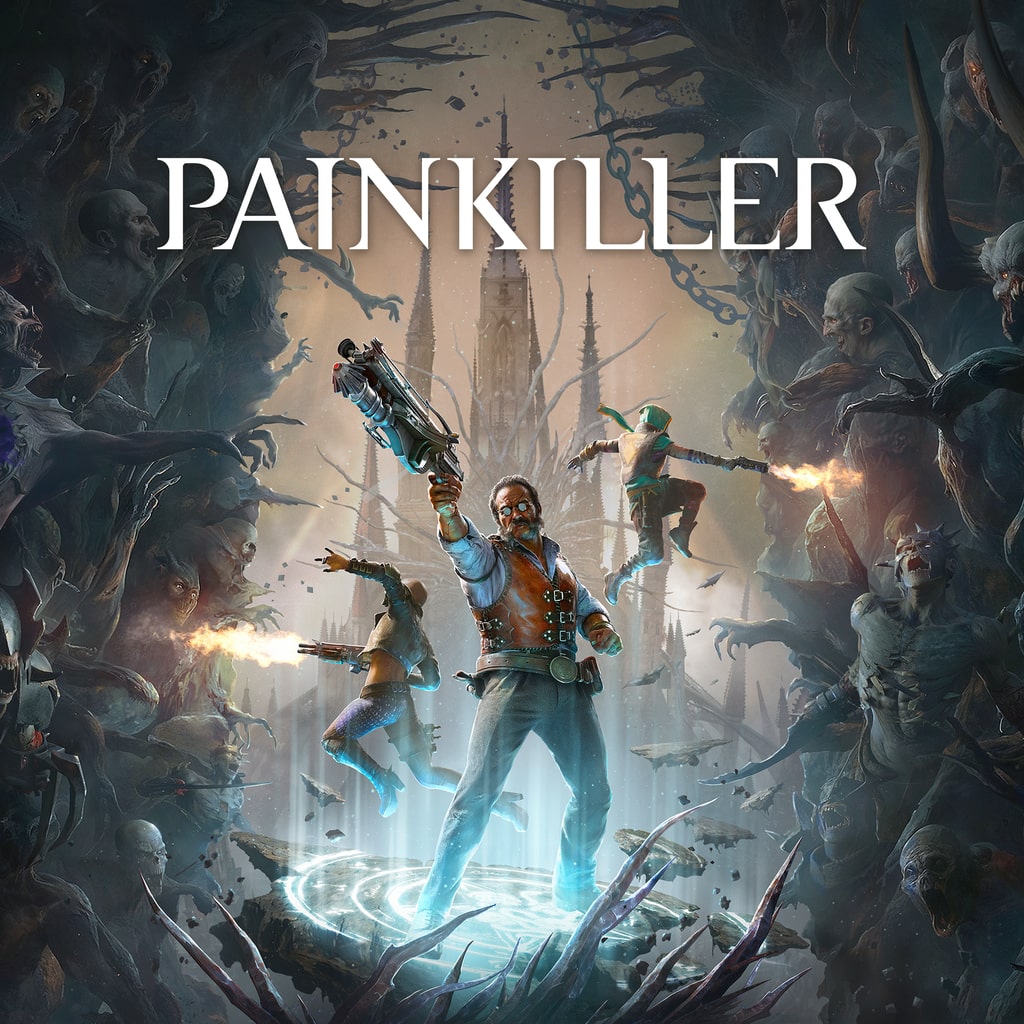
There’s something deeply satisfying about a game that doesn’t pretend to be more than it is. Painkiller knows exactly what it wants to be: a brutally fast, unapologetically old-school first-person shooter that trades subtlety for spectacle. It’s loud, violent, and relentless — a throwback to a time when all you needed to know was how many monsters you could blast into dust before your ammo ran dry. Two decades later, it still feels like an adrenaline shot straight to the heart of the genre.
A Descent into Chaos
The setup is simple, and it’s supposed to be. You play as Daniel Garner, a man killed in a car accident who finds himself trapped in Purgatory. Heaven and Hell are at war, and the celestial powers have chosen Daniel as their reluctant hitman. To earn redemption, he must tear through the legions of Hell and defeat the Four Generals of Lucifer’s army. It’s a premise that sounds like a mix between Doom and Paradise Lost, but in execution, it’s pure arcade action — the story exists only to get you from one slaughterhouse to the next.
And that’s perfectly fine. Painkiller isn’t trying to be deep; it’s trying to be fun. It’s a reminder that you don’t always need a complex narrative to justify shooting hundreds of monsters in the face.
Gameplay: Pure Mayhem
From the first level, Painkiller makes its philosophy clear. Every stage is an arena filled with waves of enemies, each more twisted than the last — zombies in armor, skeleton knights, demonic clowns, and screaming ghosts that swarm in terrifying packs. You enter an area, the doors slam shut, and the music kicks into overdrive. What follows is chaos — a ballet of bullets, explosions, and flying limbs.
The weapon design is easily one of the game’s strongest points. Each gun is lovingly over-the-top, from the spinning Painkiller blade (which doubles as a close-range grinder and ranged saw) to the shotgun that doubles as a freezing cannon. The stake gun — which fires wooden stakes that pin enemies to walls — remains one of the most satisfying weapons ever created in an FPS. It’s absurd, grotesque, and completely delightful.
Combat feels kinetic and punchy. Movement speed is blistering, and enemies come in overwhelming numbers, forcing you to constantly strafe, jump, and circle-strafe again like it’s 1999. There’s no cover system, no reloading, and no modern FPS baggage — just you, your weapons, and hundreds of creatures trying to rip you apart. The simplicity is refreshing, and it never gets old.
The AI isn’t particularly clever, but that’s part of the fun. Enemies come at you in waves, screaming and clawing, creating a sense of sheer chaos that keeps you moving. Every encounter feels like an arena match — a test of reflexes and spatial awareness rather than tactical finesse. In a world of carefully scripted shooters, Painkiller’s raw unpredictability feels exhilarating.
Level Design and Atmosphere
If there’s one area where Painkiller consistently surprises, it’s the environments. Each of the 24 levels feels distinct and meticulously designed to amplify atmosphere and spectacle. One moment you’re fighting through a fog-covered graveyard, the next you’re battling demons in a gothic cathedral, and then you’re sprinting across a collapsing bridge while fire rains from the sky.
The art direction leans heavily into the macabre. Massive cathedrals, war-torn battlefields, and haunted castles ooze gothic charm. There’s a bleak, almost dreamlike quality to the settings that elevates Painkiller beyond mindless shooting. The mood evokes classic horror imagery — rusted metal, crumbling stone, and the echoes of unseen horrors lurking in the dark.
The level variety also keeps the pacing brisk. Each stage offers new enemy types, visual themes, and often a gigantic boss fight that feels ripped straight from heavy metal album art. These bosses — towering monstrosities that require both quick reflexes and environmental awareness — are highlights of the experience. They’re massive, intimidating, and spectacularly over-designed in all the right ways.
Sound and Music
Painkiller’s audio design deserves a standing ovation. The sound of the weapons — from the mechanical clatter of the stake gun to the thunderous boom of the shotgun — hits with bone-rattling impact. Enemy screams echo through the halls, and every level drips with eerie ambient noise that keeps you uneasy.
Then there’s the soundtrack. When combat starts, the game kicks into pounding metal riffs that perfectly complement the carnage. It’s not subtle, but that’s the point — the soundtrack is the pulse of Painkiller. It energizes every fight and makes you feel unstoppable. It’s one of the most defining aspects of the game’s identity, and it still holds up as one of the most iconic metal-infused soundtracks in FPS history.
Modern Eyes, Classic Soul
Playing Painkiller today feels like discovering a lost relic of the genre’s purest era. Its focus on fast-paced combat and arcade simplicity is almost alien in a time dominated by tactical shooters and cinematic storytelling. Sure, the game shows its age — the physics can get janky, the story is barely present, and enemy behavior sometimes borders on comical — but those quirks are part of its charm. It’s the kind of game that doesn’t care about polish as long as it delivers fun by the bucketload.
The core campaign can be finished in around ten hours, but its replay value is surprisingly high. Each level has optional objectives that unlock “Tarot Cards,” special power-ups that can drastically change your play style. Mastering levels for faster times and higher kill counts adds an addictive challenge for completionists.
Final Verdict
Painkiller is pure, unfiltered FPS joy — a chaotic, blood-soaked rollercoaster that reminds us why the genre was so thrilling in the first place. It’s a game that doesn’t waste your time with fluff or filler; it just hands you a stack of overpowered weapons and unleashes you on an army of hellspawn. The combination of gothic aesthetics, insane weaponry, and nonstop momentum makes it an enduring cult classic.
Yes, it’s rough around the edges. The story is thin, the AI isn’t going to win any awards, and the graphics — though stylish — show their age. But none of that matters when the action feels this good. Painkiller understands that sometimes all you need from a shooter is the rush of movement, the roar of metal music, and the thrill of turning demons into confetti.
A glorious throwback to the golden age of shooters — fast, ferocious, and unapologetically fun.