Some games ask you to save the world. Others ask you to conquer it, rebuild it, or simply survive long enough to see the credits roll. 1998: The Toll Keeper Story asks something considerably more uncomfortable: what would you do if survival depended on the choices you made while simply trying to get through another day? Developed by GameChanger Studio and published by PT Gudang Gim Global, this narrative work simulation takes the familiar idea of checking documents and enforcing rules and places it within one of the most frightening periods of Indonesia’s modern history. The result is a small, deeply human game about motherhood, poverty, political unrest, and the uncomfortable compromises ordinary people are sometimes forced to make.
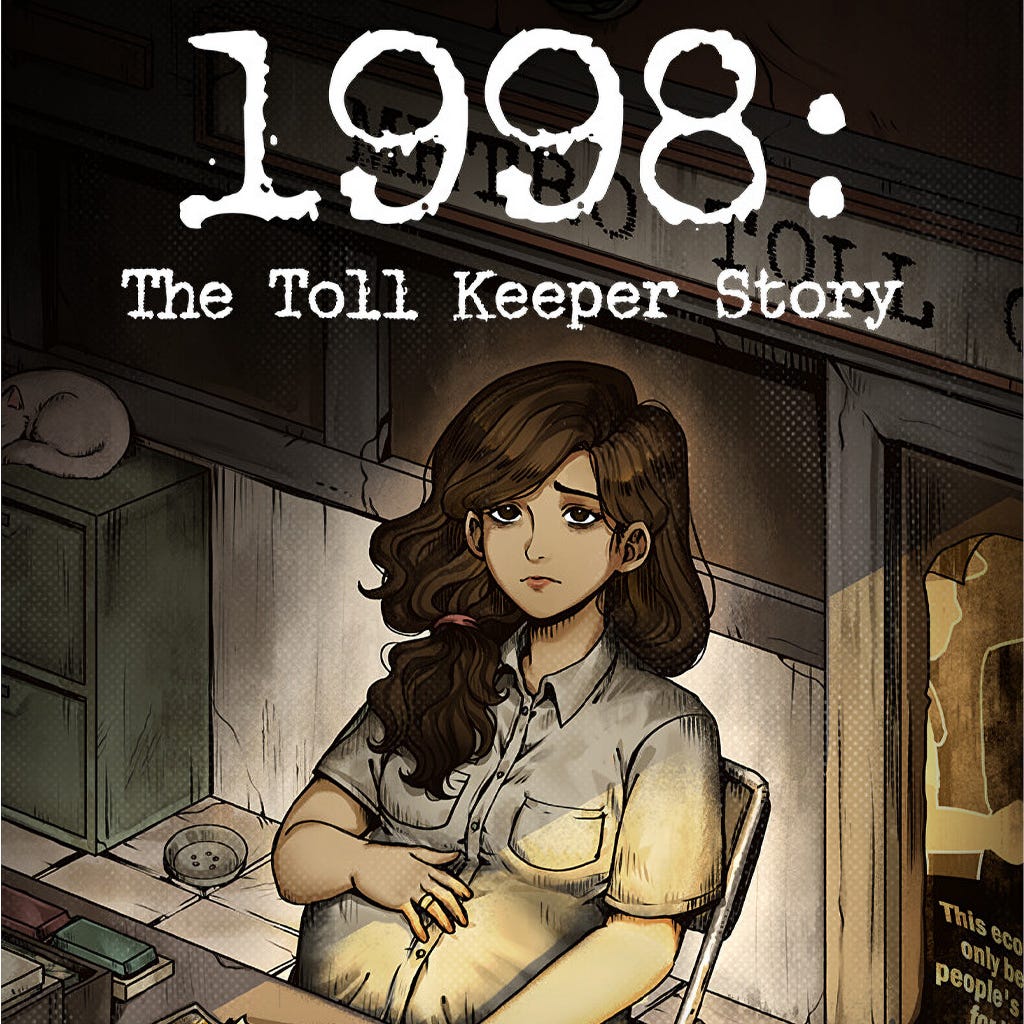
Set in the fictional Southeast Asian nation of Janapa, during a period heavily inspired by the 1998 Asian Financial Crisis and the civil unrest that engulfed Indonesia, the game puts you behind a toll booth rather than behind a gun. You play as Dewi, a pregnant woman whose husband works as a taxi driver, while the country around them slowly begins to fall apart. Prices rise, protests spread, and the government becomes increasingly desperate to maintain control. Dewi is not a politician, activist, or soldier, and that is precisely what makes her story so effective.
She is simply trying to make it through her shift.
An Ordinary Life in Extraordinary Times
The brilliance of 1998: The Toll Keeper Story begins with its perspective. Rather than placing you at the centre of historical events, the game puts you on the sidelines, where the consequences of those events are often felt most keenly. Dewi does not have the power to change government policy or stop the protests. She cannot fix the economy or protect an entire population. She can only decide who gets through her toll booth, whether their paperwork is legitimate, and whether she is willing to risk her own safety to help somebody else.
That limitation makes the story feel remarkably grounded. The game understands that history is not only made by presidents, generals and revolutionaries. It is also experienced by people standing behind counters, driving taxis, waiting in queues and worrying about whether they can afford tomorrow’s food. Dewi’s pregnancy adds another layer to every decision, because her choices are never entirely about herself.
The unborn child she is carrying becomes an invisible presence throughout the game. Every dangerous decision has another person attached to it, even if that person has not yet entered the world.
A Toll Booth Becomes a Moral Battlefield
On paper, the core gameplay sounds simple. Vehicles arrive, and you inspect their documents, verify identities, and determine whether they are allowed to pass. Anyone familiar with Papers, Please will immediately recognise the basic rhythm, but 1998: The Toll Keeper Story uses that framework for a different purpose.
Here, the paperwork is not merely a puzzle to solve. It becomes a window into the increasingly desperate society beyond the booth. Regulations shift as the political situation deteriorates, and something that seemed harmless in the opening stages can suddenly become dangerous. A person who might once have been turned away without a second thought may later be fleeing genuine danger. That is where the game starts to bite. The correct answer is not always the moral one, and the moral answer is not always the safest.
Rules or Humanity?
One of the most compelling aspects of the experience is the tension between following orders and helping people. When someone arrives at the toll booth with incomplete documentation, the easy solution is to refuse them. The game gives you rules for a reason, and following them can protect your employment and, by extension, your ability to provide for Dewi and her baby.
But then you encounter someone who clearly needs help. Perhaps they are frightened. Perhaps they are trying to escape an increasingly dangerous area. Perhaps their paperwork is incorrect because they simply did not have the luxury of obtaining the necessary documents. These moments force you to consider whether enforcing a rule remains morally defensible when circumstances have changed. There is no satisfying answer waiting at the bottom of the screen. That is what makes these choices work.
The Price of Survival
Money becomes increasingly important as the situation deteriorates. Dewi needs supplies, and pregnancy brings its own requirements. The game therefore creates constant pressure between doing what is right and doing what is necessary.
One particularly uncomfortable example involves state propaganda. You can take opportunities to distribute government material in exchange for additional money, which can then be used to purchase essential items such as pregnancy vitamins. It is a wonderfully unpleasant choice because the game does not need to tell you what the correct moral position is.
You understand exactly what you are doing. You also understand why you might do it. That is where 1998: The Toll Keeper Story finds much of its emotional strength. It does not portray morality as a simple choice between good and bad people. It asks what happens when decent people are placed under enough pressure that their options become increasingly compromised.
History Through the Window
The historical inspiration gives the game considerable weight. The 1998 Asian Financial Crisis caused enormous economic hardship across the region, while Indonesia experienced severe political and social unrest that eventually contributed to the fall of President Suharto’s three-decade rule.
Rather than attempting to recreate those events directly, 1998: The Toll Keeper Story creates the fictional country of Janapa and uses it as a lens through which to examine the atmosphere surrounding them. This is a sensible creative decision, as it gives the developers room to tell Dewi’s story without pretending to provide a complete historical account.
The fictional setting also allows the game to focus on ordinary experiences. Inflation, shortages, fear and distrust are more important here than dates and political speeches. You understand what is happening because you feel its consequences in Dewi’s daily life.
The Toll Booth Changes With You
The game’s progression is particularly effective because the toll booth itself gradually mirrors the wider crisis. At first, your work feels mundane. You check vehicles, inspect documents and move people through.
As tensions rise, however, the same environment begins to feel increasingly threatening. Regulations grow more oppressive, people more desperate, and the world outside the booth harder to ignore. The contrast between the repetitive nature of the work and the rapidly changing circumstances creates a strong sense of unease.
There is something almost claustrophobic about being stuck in that small booth while a country is falling apart outside. You cannot simply walk away. You have a job to do, a baby to protect and bills that still need paying.
Motherhood Without Sentimentality
Dewi’s pregnancy could easily have been handled as a cheap emotional device, but the game generally avoids that trap. Her unborn child is not simply there to make the player feel sorry for her. Instead, motherhood shapes the decisions she has to make.
That distinction is important. Dewi is not constantly thinking about motherhood in dramatic, cinematic terms. Sometimes she is simply worried about whether she has enough money for what she needs. Sometimes she is concerned about safety. Sometimes the game puts her in situations where helping someone else could put her own child at risk.
Those are uncomfortable choices because they lack obvious answers. Is protecting your unborn child selfish? Is risking yourself for a stranger noble or irresponsible? How much should you be expected to sacrifice when nobody else is coming to save you? The game leaves those questions hanging in the air.
A World That Looks Like Memory
Visually, 1998: The Toll Keeper Story has a distinctive identity. The developers use dot textures, paper-inspired surfaces and a bluish visual filter to evoke the look and feel of printed material from the 1990s.
It does not try to compete with modern photorealistic games, and thankfully it does not need to. The deliberately aged presentation reinforces the historical setting and gives the game a slightly faded, almost archival quality. It feels like you are looking through a window into another period rather than simply playing a game set in the past.
The visual design also complements the emotional tone. There is something cold and distant about the blue-tinted presentation, which works surprisingly well alongside the increasingly oppressive atmosphere. It makes Janapa feel like a memory of a place that never truly existed.
Small Decisions, Big Consequences
The greatest strength of 1998: The Toll Keeper Story is its grasp of scale. It does not pretend that Dewi can change the course of history with a single decision. Instead, the consequences are personal.
Maybe she keeps her job. Maybe she earns enough to buy something important. Maybe she helps someone who desperately needs it. Maybe she follows the rules and sleeps more easily, knowing she has protected herself and her family.
Those decisions accumulate. That accumulation is what gives the game its emotional impact. A single choice might not seem particularly important, but after hours of living with the consequences, you begin to understand that survival is often made up of dozens of tiny compromises.
When Empathy Becomes Dangerous
There are moments when the game’s moral framework becomes genuinely uncomfortable. Helping someone is not automatically heroic, because the world is not operating under normal circumstances.
A decision that feels compassionate could attract unwanted attention. Breaking regulations could jeopardise Dewi’s employment. Refusing to help could leave someone vulnerable. Even doing something for money can carry emotional consequences if you know exactly where that money came from.
This is where the game moves beyond a simple document-checking simulation. The paperwork is merely the structure. The real game is about deciding what kind of person you want Dewi to become when circumstances make being a good person increasingly difficult.
Where It Falls Short
The game’s deliberately narrow structure can occasionally work against it. Much of the experience centres on the toll booth and the repetitive process of checking vehicles and documents, so players seeking broader exploration or more varied mechanics may find the repetition restrictive.
The narrative also carries much of the game’s weight, so its effectiveness depends heavily on how invested you become in Dewi and her situation. If the characters or historical setting do not connect with you, some of the slower sections may feel more functional than emotionally powerful.
There are also moments when the morality can feel slightly too clearly signposted. The best choices are those where you genuinely cannot decide what is right, and 1998: The Toll Keeper Story is strongest when it trusts the player to reach their own conclusions rather than making the intended emotional response obvious.
A Quiet Game With Something to Say
What stays with you after playing 1998: The Toll Keeper Story is not a particular mechanic. It is the feeling of being trapped between competing responsibilities.
You want to help people. You also want to protect Dewi. You want to follow the rules because your job matters, but you increasingly question whether they are worth following. You want to believe that doing the right thing will lead to something better, but the game understands that history does not always work that way. That honesty gives the game its soul. It is not interested in turning Dewi into a hero. She does not need to save the country. She simply needs to get through another day.
Final Verdict
1998: The Toll Keeper Story is an affecting narrative simulation that finds surprising emotional power in one of the most mundane jobs imaginable. By placing players behind a toll booth during a fictionalised version of one of Southeast Asia’s most turbulent periods, GameChanger Studio offers a perspective on historical crisis that feels intimate rather than grand.
The influence of Papers, Please is obvious, but the game has enough of its own identity to stand apart. Its focus on motherhood, financial survival and the moral compromises ordinary people face gives the familiar document-checking formula a more personal edge. You are not simply deciding whether somebody has the correct paperwork. You are deciding what Dewi is willing to risk.
The 1990s-inspired visual style is another strong choice, giving the game a distinctive atmosphere that complements its historical subject matter. The bluish filters, paper textures and understated presentation evoke a faded memory, while the toll booth gradually transforms from a mundane workplace into a claustrophobic observation point overlooking a collapsing society.
It is not perfect. The repetitive structure will not suit everyone, and some of the moral choices can occasionally feel too obvious. There is also a limit to the variety the toll booth setting can offer, particularly for players who expect traditional adventure-game exploration.
But in 1998, The Toll Keeper Story succeeds where it matters most. It makes you care about the consequences of seemingly insignificant decisions. It reminds you that history is not experienced equally by everyone, and that for many people, surviving a national crisis means worrying about food, work, safety and family rather than changing the world.
Dewi is not a soldier. She is not a revolutionary. She is not a politician. She is a mother trying to get through the day. And sometimes, that is more than enough of a story.