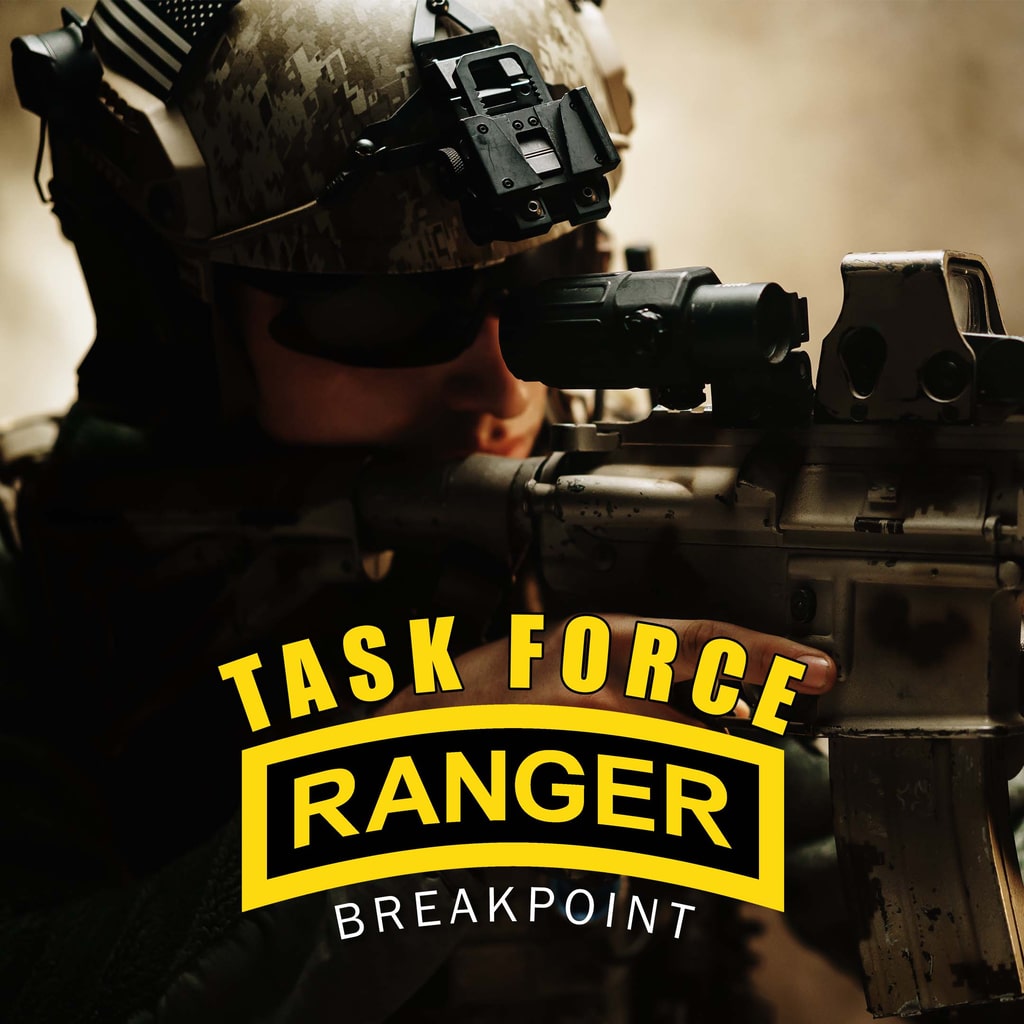
There is something comforting about a shooter that knows exactly what it wants to be. Task Force Ranger: Breakpoint is not trying to reinvent the military FPS, nor is it particularly interested in drowning the player in complicated systems, elaborate character progression or a cinematic story that takes itself too seriously. Instead, it delivers a straightforward modern combat experience built around missions, weapons and a steadily escalating stream of enemies. Sometimes that lack of ambition works against it, but there is also something refreshingly honest about a game that simply wants to put a rifle in your hands and send you into the next firefight.
Developed and published by Polygon Art, Task Force Ranger: Breakpoint is a standalone sequel to Task Force Ranger: Lead the Way! that once again puts players in the boots of an elite military operative. This time, you are part of Bravo Team, deployed to the fictional conflict zone of Al Shamal to take on the Jazeera Front. Your objectives are suitably familiar for the genre, including intelligence recovery, sabotage, elimination of enemy leadership and the destruction of military infrastructure. It is a formula we have seen countless times before, but Breakpoint understands that there is still entertainment to be found in getting the basics right.
Back Into the Conflict
The campaign wastes little time getting you into the action. Rather than building a huge narrative around your character, Breakpoint establishes its military setting and then gets on with the job. You are given a clear objective, pointed towards the battlefield, and expected to complete the mission while hostile forces do everything they can to stop you.
That simplicity is both the game’s greatest strength and one of its biggest limitations. There is very little friction between starting a mission and actually shooting things, which makes the game immediately accessible. You do not need to spend hours learning complicated systems before the combat becomes enjoyable, and the straightforward structure means you can easily pick it up for a short session.
At the same time, players looking for a deeply developed military story will probably find the experience rather thin. The setting provides context for the missions, but the campaign is primarily interested in getting you from one objective to the next. It is more about the experience of being a soldier in a hostile environment than in telling a memorable personal story.
Boots on the Ground
The actual shooting is where Breakpoint earns most of its keep. The gunplay is deliberately straightforward, giving you access to assault rifles, machine guns, sniper rifles, pistols, explosives and support weapons without burying them under layers of unnecessary complexity. Weapons generally feel responsive enough to make firefights satisfying, and the game understands that the simplest interaction in an FPS is still one of the most important. Pulling the trigger needs to feel good, and Breakpoint largely gets that right.
The arcade influence is apparent in how combat unfolds. This is not a slow tactical simulation where you spend minutes observing a compound before carefully eliminating one target at a time. Enemies arrive, bullets fly and you are expected to react quickly. There is certainly room for positioning and target prioritisation, but the overall rhythm favours action over meticulous planning.
That makes the game particularly easy to understand. You can pick up a weapon, enter a firefight and immediately know what is expected of you. There is a satisfying directness to that approach, especially when the battlefield becomes crowded and you find yourself switching between weapons to deal with different threats. It is not revolutionary, but it is dependable.
A War of Objectives
One of Breakpoint’s more appealing aspects is the variety of objectives it throws into the campaign. You are not simply asked to eliminate every enemy in sight, even though that will frequently become part of the process. Missions can involve recovering intelligence, destroying infrastructure, eliminating commanders and clearing hostile positions. These objectives give the campaign enough structure to prevent it from becoming one enormous shooting gallery.
The best missions are those where the objective naturally creates a problem. Destroying an important piece of equipment sounds simple until you have to fight through a fortified position to reach it. Eliminating a commander becomes more interesting when that target is surrounded by hostile forces and protected by the environment. These situations give combat a sense of purpose, even when the underlying mechanics remain straightforward.
There is also something satisfying about completing an objective and moving on, rather than being trapped in an enormous open world. Breakpoint keeps the focus narrow, which means missions can be approached as individual operations. You know what you are there to accomplish, and there is a clear sense of progress when the job is done.
Al Shamal
The fictional region of Al Shamal provides a suitably varied backdrop for the campaign. Operations take place across fortified desert outposts, urban districts, industrial facilities and remote mountain strongholds, giving the game enough environmental variety to keep the battlefield from becoming completely repetitive. The locations do not necessarily possess the personality of the great military shooters, but they serve their functional purpose well.
The urban environments provide tighter engagements, with buildings and streets creating opportunities for close-range firefights. Industrial areas offer a more open, mechanical atmosphere, while desert and mountain locations provide longer sightlines and opportunities to make better use of rifles. That variation affects how you approach encounters, even if the basic objective remains to reach the next target.
The environments also help sell the scale of the conflict. Moving from a fortified compound into a more remote location gives the impression that Bravo Team is operating across a wider region rather than simply repeating the same mission in a slightly different room. It is a modest touch, but it helps the campaign maintain momentum.
When the Battlefield Gets Crowded
Breakpoint is at its most enjoyable when everything starts going wrong. Enemy forces can become overwhelming, turning a relatively simple objective into a chaotic battle for survival. Armoured threats add another layer of danger, forcing you to choose which weapon or approach is best suited to dealing with them.
The game does not always demand elaborate tactics, but it does reward awareness. Standing in the open and trying to overpower everything in front of you is rarely the best approach when enemies are arriving from several directions. Finding cover, controlling your position and dealing with the most dangerous targets first can make the difference between pushing forward and being sent back to the beginning.
That is where the title earns its tactical label, even if it is more arcade shooter than military simulation. The tactics are simple, but they are present. You are still thinking about where to stand, what to shoot and when to move, rather than simply holding down the trigger until the room is empty.
Weapons and Firepower
The weapon selection is broad enough to support different approaches. Assault rifles are dependable all-rounders, machine guns bring heavier firepower, sniper rifles encourage a more patient approach, and pistols provide useful backup when things get close. Explosives and support weapons offer another option when conventional firepower is not enough.
What matters is not necessarily the number of weapons available, but how naturally they fit into combat. Breakpoint does not try to make every gun wildly different from the last. Instead, the arsenal provides familiar categories that players can understand immediately. That simplicity makes switching between weapons feel intuitive.
There is room here for a little more personality, though. The firearms largely serve their practical purpose rather than becoming memorable tools in their own right. Players looking for elaborate weapon customisation or deep ballistic simulation will not find that here. The focus is firmly on getting the player equipped and back into the fight.
Survival Mode
Outside the main campaign, Survival Mode offers a useful alternative for players who simply want to test their combat skills. Instead of working through structured objectives, you face increasingly demanding waves of enemies and try to survive for as long as possible. It is a simple idea, but one that suits the game’s arcade sensibilities perfectly.
The money earned in Survival Mode can be used to improve your equipment, giving the mode a progression loop that encourages repeated attempts. Each run becomes an opportunity to see whether you can survive longer and whether a better-equipped version of your character can handle the pressure. It is not an especially complicated system, but it gives the mode more purpose than simply counting how many enemies you can kill.
Survival Mode is also a good place to appreciate the game’s combat without worrying about mission objectives. There is something satisfying about stripping the experience back to its essentials and seeing how long you can hold your position. For players who enjoy arcade-style shooters, it could easily become one of the more replayable parts of the package.
The Arcade Spirit
Calling Task Force Ranger: Breakpoint, a tactical shooter, can create expectations that the game does not entirely meet. It is tactical in the sense that positioning, weapon choice and target prioritisation matter, but it is fundamentally an arcade FPS. The action is fast, direct and designed to keep you moving rather than asking you to recreate the painstaking pace of a real special operations mission.
That is not necessarily a criticism. In fact, it is probably better to understand what the game is trying to achieve rather than judging it against a completely different kind of shooter. Breakpoint wants to give you a military-themed action experience that can be picked up and enjoyed without a huge investment of time. Once you accept that, its simplicity becomes much easier to appreciate.
The problem is that the military shooter market is crowded, and straightforward mechanics need something distinctive to stand out. Breakpoint has moments when its simplicity works beautifully, but there are also times when it feels as though you have played this mission, fought these enemies and used these weapons somewhere else before.
Where Breakpoint Falls Short
The biggest weakness is probably the lack of a stronger identity. The game is competent at what it does, but competence alone is a hard sell in a genre packed with ambitious alternatives. There are plenty of modern military shooters that offer deeper progression, more sophisticated AI, stronger storytelling or more elaborate multiplayer systems.
Breakpoint does not necessarily need all of those things, but it could use something unmistakably its own. A more memorable campaign structure, more distinctive enemy encounters or a deeper tactical system could have helped push it beyond being a solid military shooter into something genuinely memorable. As it stands, the game is often enjoyable without being particularly surprising.
That is perhaps the most frustrating thing about it. You can have a good time playing Breakpoint, and there is very little that feels fundamentally broken, but you may struggle to explain exactly what makes it special after you put the controller down. It delivers the expected military shooter experience rather than reinventing it.
A Straightforward Soldier’s Shooter
There is nevertheless something to be said for a game that does not overcomplicate itself. Task Force Ranger: Breakpoint understands that some players simply want to enter a mission, pick up a rifle and start shooting. The campaign gives you clear objectives, the environments provide reasonable variety, and the combat is accessible enough to get into the rhythm quickly.
The game also benefits from its sense of scale. One mission might involve clearing a fortified compound, while another sends you into an industrial facility or a mountain stronghold. These changes prevent the campaign from becoming completely monotonous, even though the underlying combat loop remains familiar.
When the game gets the balance right, it can be surprisingly satisfying. Pushing through a heavily defended position, destroying an important target and escaping under fire capture the basic fantasy of a special operations shooter without requiring a huge amount of preparation. It is uncomplicated fun, and sometimes that is exactly what a game needs to be.
Final Verdict
Task Force Ranger: Breakpoint is a solid modern military shooter that understands the value of keeping things simple. Its campaign delivers a steady stream of objective-driven missions across a decent variety of environments, while accessible gunplay makes it easy to pick up and play. Combat is at its best when enemy numbers rise and you are forced to think about positioning, weapon choice and how to deal with armoured threats.
However, it does not quite live up to the deeper implications of its tactical label. This is much closer to an arcade military FPS than a detailed special operations simulation, and players expecting sophisticated squad commands or highly developed tactical systems may come away disappointed. The lack of a stronger identity also holds the game back, because its familiar weapons, objectives and encounters rarely feel like they are pushing the genre forward.
Even so, there is enjoyment to be found in its straightforward approach. Bravo Team’s missions are easy to understand, the environments offer enough variety to keep the campaign moving, and the shooting provides the immediate satisfaction that a good FPS needs. Survival Mode is a welcome addition, giving the combat a more replayable structure and providing a reason to keep upgrading your equipment after the campaign has been completed.
Task Force Ranger: Breakpoint ultimately succeeds because it knows its audience. It is not trying to be the next grand reinvention of the military shooter. It is a leaner, more accessible experience that puts the emphasis on missions, weapons and firefights. That simplicity can occasionally make it feel familiar, but it also means there is very little unnecessary baggage getting in the way of the action.
For players who enjoy uncomplicated military FPS games and want something that can be picked up without a huge learning curve, Breakpoint has enough firepower to keep things entertaining. It may not leave the same lasting impression as the genre’s heavy hitters, but there is a certain charm in its no-nonsense approach. Bravo Team is given a job, the enemy is waiting, and the solution is usually somewhere at the end of a loaded magazine.