Sometimes the simplest ideas are the hardest to pull off. Countless puzzle games have tried to stand out with unusual control schemes, only to feel like technical demonstrations rather than fully realised experiences. The Perplexing Orb Touch! takes exactly that risk, building its entire identity around one often-overlooked feature of the PlayStation 5 controller: the touch pad. Rather than treating it as an optional gimmick, TreeFall Studios has designed every puzzle, every movement and every challenge around the idea that your fingers, not your analogue sticks, are the primary way to interact with the world.
It is an ambitious concept, particularly for an arcade puzzle platformer. Players familiar with earlier entries in the Perplexing Orb series may initially be surprised by how different this spin-off feels. Gone is the direct control of the orb itself. Instead, the world moves around the player, with platforms rotating, sliding and shifting beneath the sphere as you carefully guide it towards the finish.
It is a bold change that occasionally frustrates, frequently surprises and ultimately delivers one of the more distinctive indie puzzle experiences currently available on PlayStation 5.
Learning a New Way to Play
The biggest challenge facing The Perplexing Orb Touch! is convincing players to forget decades of muscle memory. Rather than pushing the orb directly across each stage, you manipulate the environment with touch gestures on the DualSense touch pad. Swiping, dragging and tapping different coloured platforms causes them to rotate, slide or respond in unique ways depending on their properties. The orb simply reacts to the world changing around it, so success depends entirely on understanding momentum and anticipating physics.
The opening stages wisely introduce each mechanic at a comfortable pace. New platform types are added gradually, allowing players to become familiar with individual interactions before layering more complex puzzles on top. This measured approach makes what could have been an intimidating learning curve surprisingly approachable.
Even so, this control scheme requires patience. Early mistakes often stem from instinctively reaching for analogue sticks that no longer serve the primary role. Once that mental adjustment finally clicks, however, the experience becomes considerably more satisfying.
Physics Create Every Success and Failure
Much of the game’s appeal stems from its simple yet effective physics. The orb has convincing weight, momentum and inertia, so every movement carries consequences. Rotate a platform too aggressively and the orb may roll straight into danger. Move too slowly and precious seconds slip away in Time Attack challenges. The balance between precision and momentum creates puzzles that remain engaging despite their relatively straightforward objectives.
As more platform types are introduced, levels become increasingly inventive. Some require carefully timed swipes to maintain forward momentum, while others demand delicate adjustments to avoid sending the orb tumbling into the void. Because each coloured platform behaves differently, later stages often resemble mechanical contraptions that must be understood piece by piece before any meaningful progress can be made.
There are moments when the physics can feel slightly unpredictable, particularly when several moving surfaces interact simultaneously. Fortunately, those occasions are relatively uncommon and rarely overshadow the overall enjoyment.
Forty Five Carefully Constructed Challenges
The main Story Mode comprises 45 handcrafted stages that steadily increase in complexity without becoming unfair. One of the campaign’s strengths is its refusal to rely on artificial difficulty. Instead of flooding levels with hazards or demanding impossible reaction times, each new puzzle introduces fresh ideas that build naturally on previous lessons. That sense of progression gives the campaign an enjoyable rhythm.
Some stages focus on careful observation, asking players to study the environment before making their first move. Others lean more heavily on dexterity, rewarding confident touch controls and efficient platform manipulation. The variety helps prevent repetition despite the game’s singular mechanical focus.
Most levels remain relatively short, making the game ideal for brief sessions. Solving a particularly tricky puzzle provides the satisfying sense of accomplishment that defines the best physics-based puzzle games.
Replay Value Beyond the Campaign
Completing Story Mode is only part of the package.
Time Attack Mode revisits every stage with the pressure dialled up considerably. Suddenly, careful experimentation gives way to efficient execution, as every swipe and movement matters. Optimising routes becomes surprisingly addictive, particularly for players who enjoy climbing leaderboards or chasing faster completion times.
The included juggling mini-game also offers a pleasant change of pace. While undeniably simpler than the main campaign, it captures the arcade spirit of the Perplexing Orb series by focusing entirely on high-score chasing and improving personal bests.
Neither mode dramatically expands the game’s mechanics, but both encourage players to continue mastering the unusual control system after the credits roll.
Built Around the DualSense
The decision to develop exclusively for PlayStation 5 proves worthwhile. Too often, console-specific features are little more than marketing bullet points. Here, the touch pad genuinely feels essential rather than optional. Every puzzle has clearly been designed with its capabilities in mind, making the controller feel like an active part of the gameplay rather than simply an input device.
The experience also benefits from the DualSense’s responsive hardware. Touch recognition remains reliable throughout, allowing movements to feel accurate enough for the increasingly demanding later stages.
Voice work from Jon Cartwright adds personality to the adventure without becoming intrusive. His narration gives the game a lighthearted charm that complements its colourful presentation and accessible tone.
Simple Visuals, Clear Design
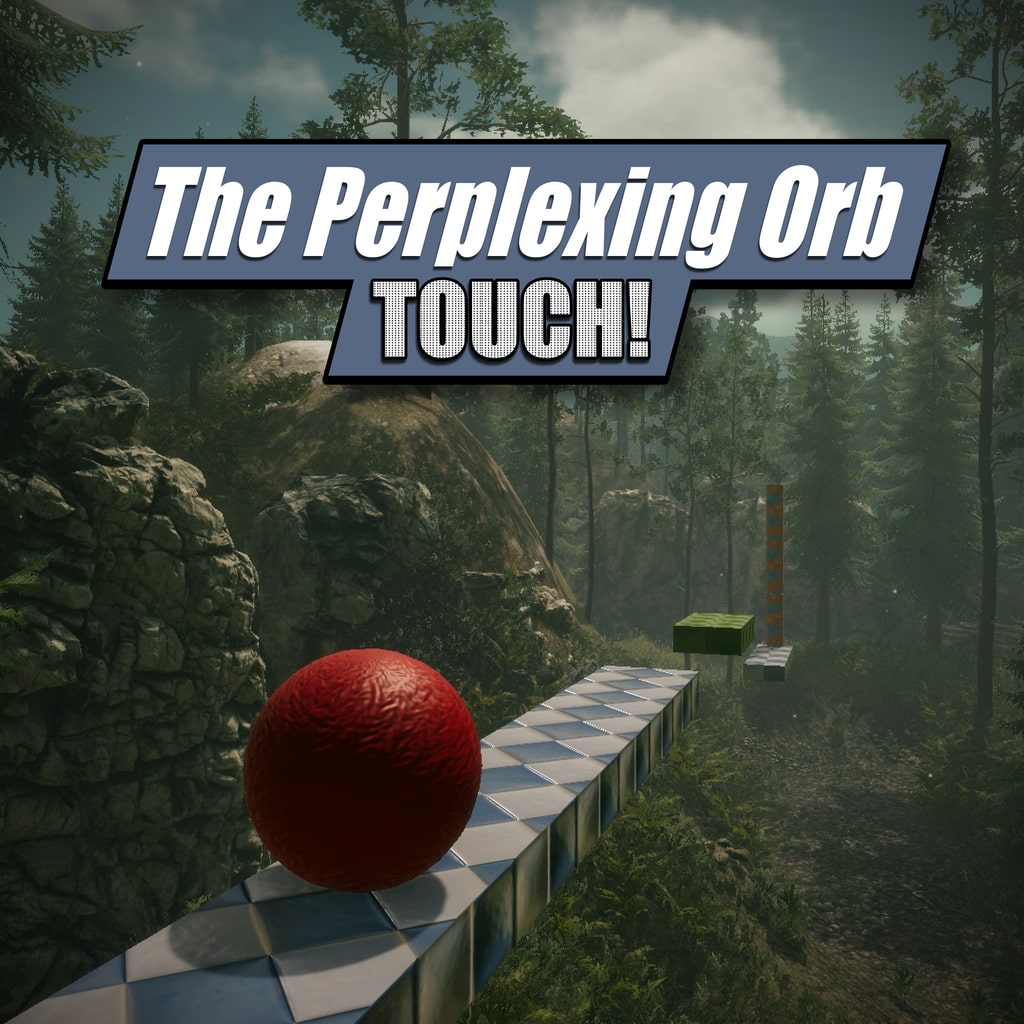
Visually, The Perplexing Orb Touch! embraces clean simplicity over technical spectacle. Floating platforms are brightly coloured, making it immediately obvious which mechanics each surface represents. That visual clarity becomes increasingly important as more platform types appear together within individual levels.
The environments themselves remain relatively minimalist, and that restraint works in the game’s favour. Busy backgrounds or excessive visual effects could easily distract from the precision required in puzzles. Instead, attention naturally remains focused on the orb and the platforms beneath it.
Performance is equally dependable. Frame rates remain consistently smooth, controls remain responsive, and loading times are virtually non-existent. For a game built around precision, technical stability is absolutely essential, and TreeFall delivers where it matters most.
A Clever Experiment That Mostly Succeeds
Designing an entire game around a single controller feature was always going to be a gamble. There will inevitably be players who never fully warm to using the touch pad as their primary input. Years of traditional controller habits are hard to overcome, and some moments can feel slightly less intuitive than simply steering the orb directly.
Yet it is difficult not to admire the commitment behind the concept. TreeFall never abandons its central idea halfway through or falls back on safer mechanics. Every puzzle reinforces the touch-driven philosophy, creating an experience that genuinely feels different from almost every other console puzzle game. That originality alone deserves recognition in a market often filled with familiar formulas.
Final Verdict
The Perplexing Orb Touch! may not reinvent puzzle platformers, but it reinvents how players interact with them. By placing the DualSense touch pad at the centre of every mechanic, TreeFall Studios has created a genuinely distinctive experience that feels purpose-built for the PlayStation 5 rather than merely adapted to it.
Its greatest strength is its confidence. Rather than treating its unconventional controls as a novelty, the game fully embraces them, crafting clever puzzles that reward patience, experimentation and gradually improving mastery. While the learning curve may initially divide players, those willing to adapt will find a satisfying blend of physics, precision and thoughtful level design.
It remains a relatively focused indie production with modest presentation, and some players may wish for greater environmental variety across the campaign. Even so, the inventive mechanics, enjoyable replay modes and polished execution make it an easy recommendation for puzzle enthusiasts seeking something refreshingly different.
In an era when many games compete by becoming bigger, louder and more complicated, The Perplexing Orb Touch! proves that a single clever idea, executed with conviction, can still stand out from the crowd.