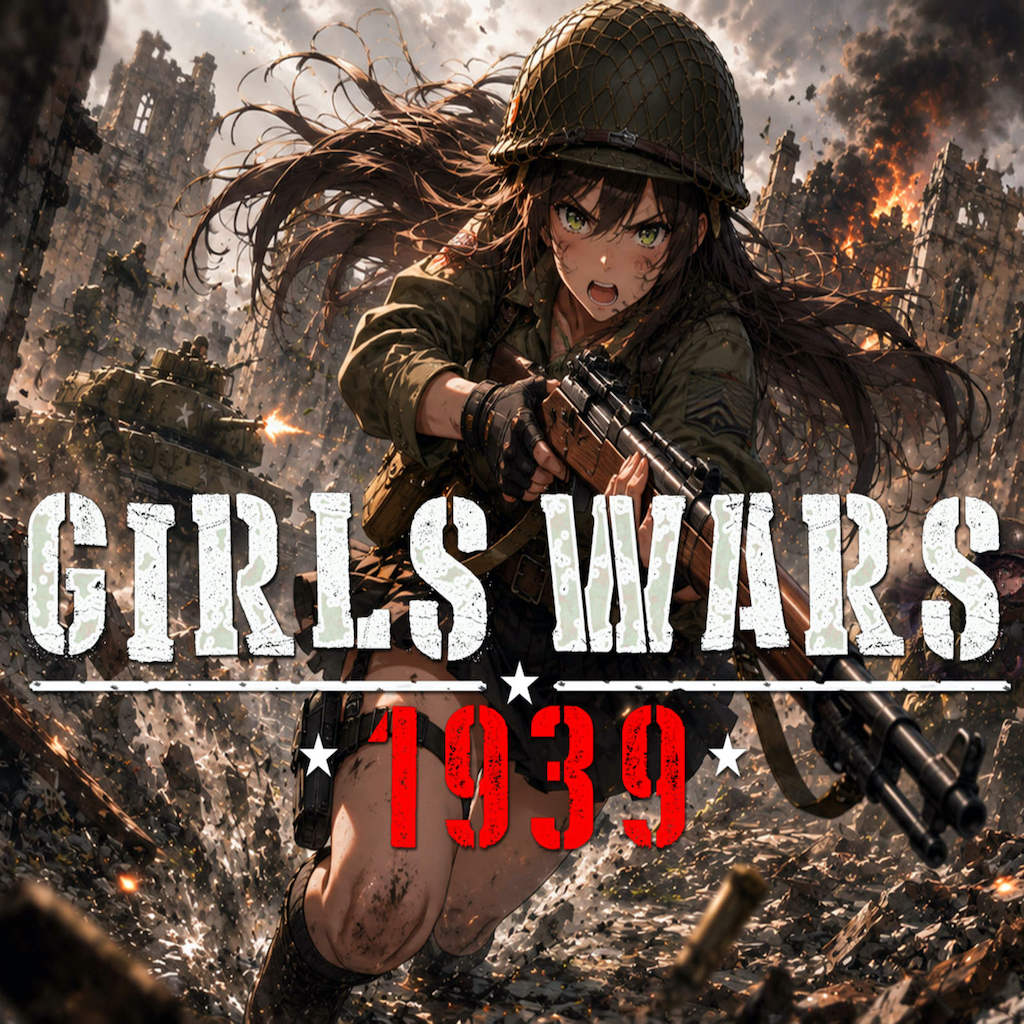
The Second World War has inspired countless video games over the decades, many striving for gritty realism or historical authenticity. Girls Wars 1939 takes an entirely different approach. Rather than recreating history as we know it, it imagines an alternate reality where anime-styled soldiers become the heroes of a conflict inspired by real events. It is an unusual premise that immediately sets expectations. This is not a military simulator or a history lesson. Instead, it is an arcade shooter wrapped in cel-shaded visuals, character-driven storytelling and exaggerated action.
That blend of history and fantasy is likely to divide opinion before the opening mission even begins. Some players may struggle with the contrast between the seriousness of its historical backdrop and its colourful anime presentation. Others will appreciate that it never pretends to be anything other than an alternate-universe adventure. Accepting that distinction is key to enjoying what Girls Wars 1939 has to offer.
Once the shooting starts, it becomes clear that the developers were aiming for accessibility over authenticity. The emphasis is on fast-paced firefights, dramatic cutscenes and an emotional journey shared by a squad of young soldiers, rather than a painstaking military simulation. While the game occasionally reaches beyond its budget, it also delivers moments that are surprisingly engaging, thanks to its confident visual identity and straightforward gameplay.
Gameplay
Combat forms the heart of the experience, and for the most part it keeps battles entertaining. Missions are built around linear objectives that send your squad through war-torn villages, forests and fortified positions, with waves of enemy soldiers standing between you and your destination. The structure is familiar, but familiarity is not always a bad thing when the shooting feels responsive.
Weapons are plentiful throughout the campaign, and one of the more enjoyable mechanics lets you pick up firearms from defeated enemies. Rather than sticking to a single loadout for an entire mission, you’re encouraged to adapt as circumstances change. Running low on ammunition or spotting a more powerful rifle nearby often creates small tactical decisions that keep firefights feeling fresh.
Gunplay itself sits somewhere between arcade action and traditional cover-shooter mechanics. Taking cover behind walls, sandbags and damaged vehicles is essential during heavier encounters, yet movement remains fluid enough that you’re never rooted in place for long. Charging between cover while returning fire creates a satisfying rhythm, even if enemy behaviour occasionally becomes predictable.
The AI-controlled squadmates provide welcome support throughout the campaign. They assist during firefights, exchange dialogue while exploring and help reinforce the bond between the central cast. They are not particularly sophisticated from a tactical standpoint, but they contribute enough to make battles feel like genuine squad engagements rather than lonely shooting galleries.
Mission variety also deserves some praise. Although the overall objective usually involves advancing from one combat arena to the next, side activities and optional conversations break up the action. Small moments between battles give characters room to breathe, helping players become invested in their relationships before the next firefight erupts.
Unfortunately, repetition begins to creep into the experience in later chapters. Enemy encounters rarely evolve beyond introducing larger numbers or tougher opponents, and objectives remain fairly conventional throughout. More imaginative mission design could have elevated the campaign beyond its comfortable formula.
Story
Girls Wars 1939 tells an alternate-history tale that places friendship, sacrifice and determination at its centre. Rather than focusing on the broader politics of the conflict, the narrative stays closely tied to its cast of young soldiers as they navigate increasingly dangerous missions together.
The writing does a respectable job of balancing lighter character interactions with more serious battlefield moments. Squad banter often provides welcome relief between combat sequences, allowing personalities to shine beyond their uniforms. As relationships develop, the emotional stakes naturally rise, making later events more impactful than the early missions initially suggest.
The story occasionally leans into familiar anime conventions, complete with dramatic speeches and larger-than-life personalities. While some dialogue can feel overly sentimental, it generally fits the tone the game establishes from the beginning. Players expecting subtle historical drama may find the presentation melodramatic, but those willing to embrace its style will likely appreciate the emotional commitment.
It is also worth noting that the game uses a fictionalised alternate-history setting inspired by World War II rather than attempting to faithfully recreate historical events. That distinction allows the developers creative freedom, although it also means players looking for historical accuracy should temper their expectations accordingly.
Presentation
Visually, Girls Wars 1939 is unmistakably distinctive. The cel-shaded art style gives every battlefield the look of an animated film, with bold outlines, vibrant colours and expressive character models standing in sharp contrast to the surrounding destruction. It is a striking look that helps the game establish its own identity within a crowded shooter genre.
Character animation is particularly expressive in story scenes. Facial expressions and exaggerated reactions reinforce the anime influence without feeling entirely out of place. Even in combat, colourful visual effects add excitement to firefights while ensuring every explosion and muzzle flash carries plenty of impact.
Environmental detail is more inconsistent. Some battlefields capture the devastation of war effectively, while others appear noticeably sparse. Limited budgets become apparent in certain textures and repeated environmental assets, preventing the world from feeling as immersive as the strongest moments suggest.
The soundtrack complements the presentation nicely, alternating between energetic orchestral battle themes and quieter emotional pieces during story scenes. Voice performances bring the characters to life with enthusiasm, even if some occasionally drift into familiar anime stereotypes. Combined with convincing weapon effects and solid positional audio, the overall sound design does a commendable job of supporting the action.
Performance
From a technical standpoint, Girls Wars 1939 delivers a largely stable experience. Combat remains responsive, aiming feels precise, and firefights rarely suffer from major performance issues. Given the visual effects on display during larger battles, the overall stability is reassuring.
There are occasional rough edges. Enemy animations can appear stiff during quieter moments, and some environmental objects lack the level of polish found elsewhere. Minor clipping and AI pathfinding hiccups also occur from time to time, but they seldom disrupt the overall experience in any meaningful way.
Loading times remain reasonable, allowing the campaign to maintain a steady pace between missions and story sequences. While the game clearly operates within the limitations of a modest production budget, it performs well enough that technical shortcomings rarely overshadow the gameplay itself.
Final Verdict
Girls Wars 1939 is an unusual shooter that succeeds largely because it commits wholeheartedly to its identity. It never tries to compete with realistic military simulations or blockbuster action games. Instead, it delivers an accessible campaign built around anime-inspired visuals, straightforward third-person combat and a cast of likeable characters whose relationships drive the story’s emotional core.
Its shooting mechanics are enjoyable, the cel-shaded presentation gives it genuine personality and the ability to scavenge enemy weapons keeps firefights engaging throughout much of the campaign. Although mission design becomes repetitive and some production values reveal the game’s independent roots, there is enough charm here to overlook many of its shortcomings.
Players expecting historical authenticity or deep tactical gameplay may struggle with its alternate-history approach and arcade-focused combat. Those looking for an entertaining single-player shooter with colourful visuals and an emotional narrative, however, will discover a game that offers more heart than its unusual premise might initially suggest.
Girls Wars 1939 is not a flawless experience, but it is an earnest one. It confidently embraces its blend of anime storytelling and accessible action, resulting in a shooter that stands apart from more conventional World War II games. Sometimes that willingness to be different is enough to make a lasting impression.