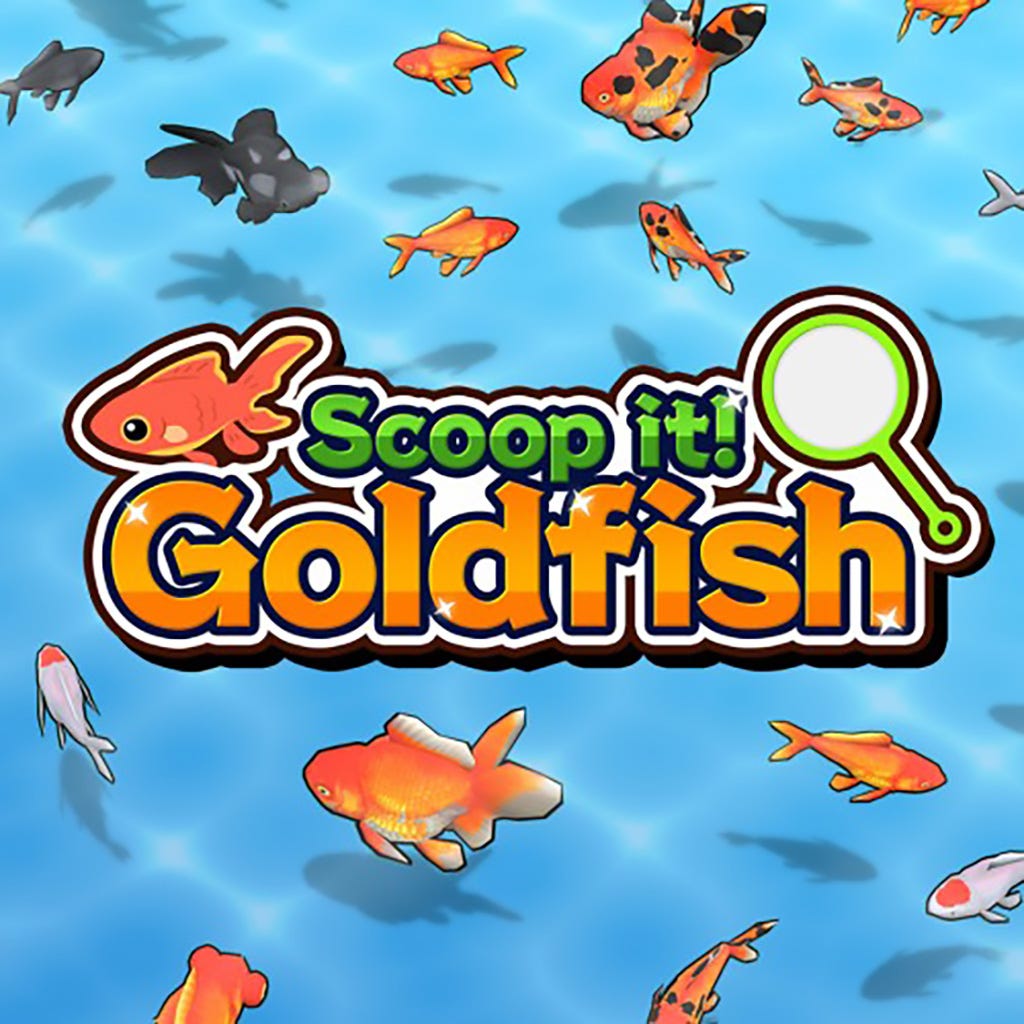
Some games take inspiration from the biggest blockbusters in the industry, while others, like Super Goldfish Scooping, draw on one of Japan’s most charming summer festival traditions. Anyone who has visited a Japanese matsuri has probably seen rows of children and adults delicately scooping tiny goldfish with a fragile paper net known as a poi. It is usually a slow, relaxing pastime where patience is rewarded, and one careless movement leaves you standing there with nothing more than a soggy ring of paper.
SAT BOX has taken that gentle tradition and transformed it into something altogether more energetic. Rather than quietly competing against yourself, Super Goldfish Scooping throws power-ups, oversized fish, explosive hazards, sharks and multiplayer chaos into the mix. It sounds like an odd combination on paper, but it somehow retains the spirit of the original activity while embracing the sort of arcade madness that makes party games so entertaining.
This is not trying to be a deep simulation or an emotional adventure. It is a colourful, cheerful arcade game designed to be picked up for a few minutes before somehow convincing you to play “just one more round.” Thankfully, it has enough variety to keep those short sessions surprisingly addictive.
Gameplay
At its heart, Super Goldfish Scooping remains incredibly easy to understand. You move your scoop around the pond, carefully collect fish, and try to earn the highest score possible before your time expires or your scoop gives way. The controls are responsive and intuitive, allowing players of all ages to jump straight into the action without lengthy tutorials.
The clever part is how the game steadily builds on such a straightforward concept. Different species of fish are worth varying amounts of points, encouraging players to chase valuable targets rather than simply scooping whatever swims closest. That immediately introduces a satisfying element of risk versus reward, especially when larger catches require better positioning and quicker reactions.
The paper scoop itself also becomes something to manage rather than simply use. Like its real-life counterpart, it cannot withstand endless abuse, meaning every failed attempt inches you closer to disaster. This creates a surprising amount of tension because every decision carries weight. Do you rush after a valuable fish before somebody else gets there, or play it safe and slowly build your score? Those little moments of hesitation add welcome depth to what initially appears to be a simple arcade experience.
Power-ups help keep each round unpredictable. Enlarging your scoop makes catching fish considerably easier, while speed boosts allow you to dart across the pond before your rivals can react. Some items are considerably less friendly, giving players the opportunity to interfere with opponents and completely change the momentum of a match. These mechanics prevent multiplayer sessions from becoming straightforward score contests, instead creating plenty of laugh-out-loud moments where victory changes hands in the final few seconds.
Stage Variety
One of the game’s biggest strengths is its selection of themed arenas. Each environment introduces fresh mechanics that force players to adapt rather than simply repeating the same strategy across every match.
The Classic Stage captures the atmosphere of a traditional Japanese festival beautifully. Lanterns glow softly in the background while colourful fish drift peacefully through the water. It feels closest to the real activity, making it an ideal introduction for new players before the game introduces more elaborate gimmicks.
The Japanese Stage offers a more strategic challenge by introducing flowing water currents. Fish no longer drift lazily around the pond; instead, they move unpredictably with the stream. Suddenly, positioning becomes just as important as quick reactions, rewarding players who can anticipate movement rather than simply chasing targets.
Then there is the wonderfully chaotic Colorful Stage. Here, the developers fully embrace arcade absurdity, filling the arena with toy-themed hazards, explosive pufferfish, hungry sharks, and giant boss fish that demand multiple successful scoops before finally being captured. Every few seconds, something unexpected happens, making it easily the most entertaining environment in the game.
These evolving mechanics ensure that no single strategy dominates every level. Each stage asks players to think slightly differently, keeping repeated sessions fresh for far longer than expected.
Multiplayer Madness
While solo Score Attack offers a satisfying chase for leaderboard positions, multiplayer is unquestionably where Super Goldfish Scooping shines brightest.
Supporting up to four local players, matches quickly descend into delightful chaos. Friends scramble for valuable fish while avoiding hazards and opportunistically using items to sabotage one another. It is the sort of game that regularly produces dramatic last-second victories, followed immediately by laughter, accusations of cheating and demands for an instant rematch.
Importantly, the competitive mechanics never become so aggressive that weaker players feel excluded. Random events and well-timed power-ups can swing matches dramatically, ensuring everyone remains involved until the final seconds. That balance makes it an excellent choice for family gatherings or casual evenings with friends.
The inclusion of worldwide rankings also gives solo players something meaningful to chase. Perfecting routes, improving efficiency and learning the behaviour of each stage gradually become an enjoyable pursuit for anyone who enjoys climbing online leaderboards.
Presentation
Visually, Super Goldfish Scooping embraces a bright, cheerful aesthetic that perfectly suits its light-hearted gameplay. The colourful fish are easy to distinguish during frantic moments, while the environments burst with personality without becoming visually cluttered.
Animations are smooth throughout, with fish darting naturally through the water and hazards behaving in a satisfyingly exaggerated fashion. Watching sharks suddenly gulp down nearby fish or boss creatures lumber across the screen never loses its charm.
The soundtrack complements the action nicely, mixing upbeat melodies with traditional Japanese influences that reinforce the festival atmosphere. Sound effects remain playful throughout, adding satisfying audio feedback whenever you successfully land an especially valuable catch.
The presentation is simple rather than spectacular, but that simplicity works in the game’s favour. Nothing distracts from the fast-paced gameplay, allowing players to remain focused on the frantic action unfolding around them.
A Few Minor Snags
Despite its charm, Super Goldfish Scooping is not without limitations. The core gameplay loop, while enjoyable, can feel repetitive during extended solo sessions. Without friends joining the action, the experience relies heavily on improving high scores rather than unlocking substantial new content.
The selection of stages, although varied, could also have benefited from additional environments or seasonal themes. Given how imaginative the existing levels are, it is difficult not to wish there were even more creative ideas waiting to be discovered.
Online functionality is largely limited to leaderboard competition rather than direct multiplayer matchmaking. Local multiplayer remains fantastic, but players hoping to regularly compete against opponents online may find the options more limited than expected.
Final Verdict
Super Goldfish Scooping succeeds because it knows exactly what it wants to be. It takes an endearing slice of Japanese culture, wraps it in colourful arcade design, and layers enough modern mechanics on top to create something that feels nostalgic yet fresh. It never overcomplicates its premise, instead letting straightforward gameplay and constant surprises carry the experience.
Its greatest strength is how approachable everything feels. Children can immediately grasp the objective, while experienced players will gradually uncover smarter routes, better strategies and increasingly efficient ways to maximise their scores. Add lively local multiplayer to the mix, and it becomes an excellent party game that regularly generates genuine laughter.
It may not offer the deepest progression systems or the longest campaign, but not every game needs to. Sometimes all you need is a paper scoop, a pond full of colourful fish and a few competitive friends determined to become the ultimate goldfish scooping champion.