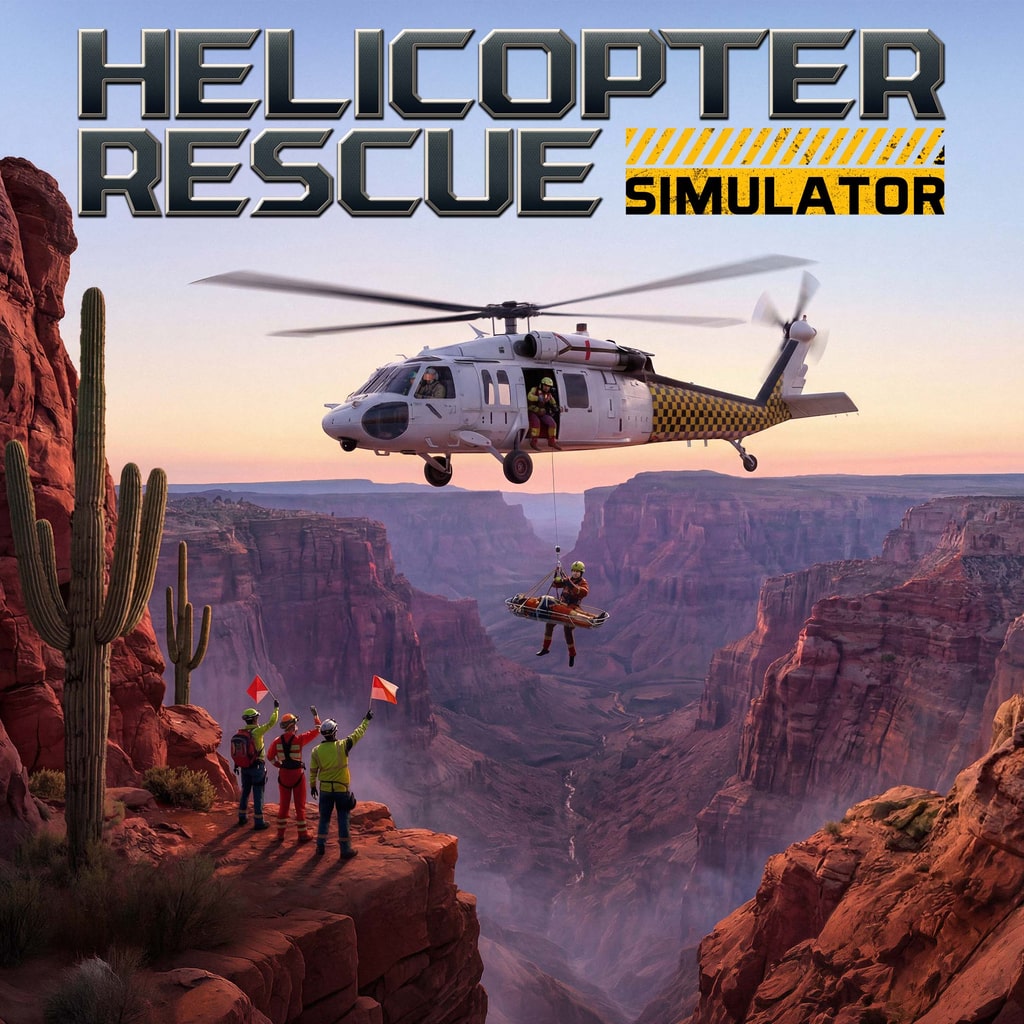
There is something undeniably compelling about climbing into the cockpit of a rescue helicopter. It is a role built around urgency, responsibility, and hope rather than speed or destruction. Every flight has a purpose, every landing could mean the difference between life and death, and every successful mission carries a quiet sense of accomplishment. That premise alone gives Helicopter Rescue Simulator an immediate advantage over many budget simulation games.
Developed by SUCCESS GAMES, Helicopter Rescue Simulator places you in the role of an emergency pilot responding to incidents across an Arizona inspired landscape. From isolated desert trails to towering canyon passes, your job is to reach injured civilians, assess their condition, administer the correct treatment, and transport them safely back to hospital. It is a straightforward concept that is easy to understand, making the game approachable for players who simply want to jump into the action without spending hours learning complex controls.
The game never attempts to compete with the most realistic flight simulators on the market, and that feels like a deliberate decision rather than a limitation. Instead, it focuses on creating a casual experience that values accessibility over authenticity. That choice makes it inviting for newcomers, although experienced simulation fans may find themselves wishing for a little more depth beneath the surface.
Gameplay
The core gameplay loop is simple, but it manages to remain engaging during the opening hours. Each mission begins with an emergency call that pinpoints the location of someone in need of assistance. After lifting off, you navigate across the open world, locate the casualty, determine the correct treatment based on their symptoms, and then fly them back to the nearest medical facility. The routine is easy to grasp, allowing players to settle into the rhythm almost immediately.
Flying the helicopter is intentionally forgiving, and that works in the game’s favour. The controls are responsive without becoming overly sensitive, making take-offs, landings, and low altitude navigation feel comfortable even for players with little experience in aviation games. Rather than wrestling with complicated cockpit systems or realistic flight physics, you can focus entirely on reaching your destination and completing the rescue.
The medical element adds a welcome layer of interaction that helps separate the game from other arcade style flying experiences. Assessing patients before deciding on the correct treatment gives each mission a little more personality than simply collecting passengers. While these diagnosis mechanics remain fairly basic, they reinforce the feeling that your role extends beyond simply piloting a helicopter.
Mission rewards come in the form of experience points that gradually unlock additional helicopters. Progression is relatively modest, but it provides enough incentive to continue taking on rescue operations. Unlocking a new aircraft offers a satisfying sense of achievement, even if the differences between helicopters are not especially dramatic.
The Arizona Wilderness
One of the game’s strongest assets is its setting. The Arizona inspired environment offers sprawling deserts, winding canyons, rocky cliffs, and wide open skies that naturally suit helicopter travel. Flying above these landscapes creates a genuine sense of scale, reminding you just how isolated some rescue locations can be.
There are moments when the game captures the quiet beauty of emergency aviation surprisingly well. Watching the sun rise over distant mountains while heading towards a rescue site creates an atmosphere that feels peaceful despite the urgency of your mission. The long flights also provide opportunities to appreciate the environment without constantly feeling rushed.
The world itself is not overflowing with activity, but that emptiness often works in its favour. Rescue helicopters frequently operate in remote areas, and the isolated terrain helps reinforce that feeling. It is easy to imagine stranded hikers or injured campers needing assistance in locations where help cannot simply arrive by road.
Unfortunately, the technical presentation occasionally undermines the immersion. Texture quality is inconsistent, environmental detail can feel sparse, and noticeable object pop in becomes difficult to ignore during longer flights. These shortcomings never completely spoil the experience, but they do remind you that this is a modest production working within clear budget limitations.
Accessibility First
What Helicopter Rescue Simulator perhaps does best is recognise its intended audience. This is not a game built exclusively for aviation enthusiasts with expensive flight sticks and extensive simulator experience. It is designed for players who simply enjoy flying and want to experience the satisfaction of helping others without spending hours studying technical manuals.
That accessibility extends beyond the controls. Missions are clearly presented, objectives are easy to follow, and progression never feels confusing. You are almost always aware of what needs to be done next, making the game ideal for short sessions where players simply want to complete a few rescue operations before moving on.
This straightforward structure also makes the game surprisingly relaxing. Although every mission revolves around emergencies, the overall pace remains calm and measured. There is very little pressure to rush, allowing players to enjoy the act of flying as much as the rescue itself.
For younger players or newcomers to simulation games, this approach makes Helicopter Rescue Simulator considerably more inviting than many of its more demanding competitors.
Where the Experience Begins to Stall
As enjoyable as the opening missions can be, repetition gradually becomes the game’s biggest obstacle. Once you have completed a handful of rescues, the overall structure changes very little. Fly to the destination, identify the patient, administer treatment, and return to hospital. The scenery may change, but the objectives rarely do.
Greater mission variety would have significantly strengthened the experience. Dynamic weather, mechanical failures, multiple casualty incidents, mountain rescues, or large scale natural disasters could have transformed routine missions into memorable set pieces. Instead, the campaign settles into a predictable rhythm that struggles to maintain excitement over extended play sessions.
The simplified flight model also limits long term engagement. While approachable controls make the game accessible, they leave little room for mastery. More experienced players may find themselves wishing for optional advanced flight settings that reward careful helicopter handling without alienating casual audiences.
Progression also feels somewhat restrained. Unlocking additional helicopters provides motivation to continue, but the upgrade system lacks the depth needed to create a lasting sense of development. Expanding the customisation options or introducing meaningful aircraft improvements would have made every completed mission feel more rewarding.
Presentation
Visually, Helicopter Rescue Simulator performs well enough to support its gameplay without ever becoming particularly memorable. The helicopter models are respectable, the user interface remains clean throughout, and the landscapes feature enough variety to keep exploration interesting during the early stages of the campaign. It is a functional presentation that understands where its priorities lie.
Audio is similarly competent without leaving a lasting impression. Rotor blades produce satisfying mechanical feedback, while environmental effects help establish the atmosphere during flights across the desert. However, the soundtrack rarely stands out, and repeated audio cues become increasingly noticeable during longer play sessions.
The game also misses opportunities to heighten the emotional impact of its rescue missions. Stronger voice acting, more dramatic radio communications, or evolving emergency scenarios could have added greater urgency to each operation. Instead, many missions unfold with a calmness that occasionally feels at odds with the life saving situations they depict.
Verdict
Helicopter Rescue Simulator succeeds because it understands exactly what kind of experience it wants to offer. Rather than chasing absolute realism, it delivers an accessible rescue adventure that almost anyone can enjoy. Flying across beautiful desert landscapes while responding to emergency calls remains consistently satisfying, particularly during shorter play sessions where the straightforward mission design feels at its strongest.
The game’s biggest weakness is its lack of evolution. Repetitive objectives, modest progression, and simplified flight mechanics prevent it from developing into something truly memorable. Players hoping for a deep aviation simulator or a complex emergency response experience will likely reach its limits sooner than they expect.
Even so, there is an honest charm to its uncomplicated design. It provides a relaxing alternative to more demanding simulators, allowing players to experience the rewarding role of an air rescue pilot without becoming buried beneath technical systems. While it never quite reaches the heights suggested by its premise, it still offers an enjoyable journey for players looking to spend a few peaceful hours saving lives from above.