There is something undeniably special about stepping into a game that pre-dates many of the conventions we now take for granted. Long before quest markers, cinematic cutscenes and voiced dialogue became standard, developers relied almost entirely on imagination. A handful of colourful sprites, a simple melody and a heartfelt premise often had to carry an entire adventure. EGGCONSOLE Harry Fox PC-8801 is very much a product of that era, yet it also stands apart from many of its contemporaries.
Originally released in 1984 by MicroCabin for the NEC PC-8801, Harry Fox tells an unexpectedly emotional story. Rather than casting players as a fearless knight or treasure hunter, it places them in the paws of a mother fox desperately searching for a cure to save her sick cub. Even today, that premise feels refreshingly sincere. It gives the adventure a warmth that immediately separates it from many early computer games, where story often served merely as an excuse for exploration.
As part of D4 Enterprise’s growing EGGCONSOLE preservation initiative, this release brings another slice of Japanese gaming history to modern platforms. Like the other titles in the collection, the goal is preservation rather than reinvention. That means you are experiencing Harry Fox very much as players did over four decades ago, complete with its strengths, frustrations and unmistakable charm.
A Journey Driven by Love
The story begins in the peaceful Forest of Romus, where tragedy strikes when a young fox contracts the mysterious Romus Disease. According to legend, no one has ever recovered from the illness. Faced with losing her child, the mother recalls an old tale passed down by her grandmother about a sacred piece of fried tofu hidden within Rille Shrine.
It sounds wonderfully strange, but Japanese folklore has long associated foxes with shrines and fried tofu, making the premise feel surprisingly authentic rather than bizarre. The narrative draws heavily on traditional mythology, creating an adventure that feels like an interactive fairy tale rather than a conventional fantasy quest.
Although storytelling remains minimal by modern standards, every step of the journey carries emotional weight because players always understand what is at stake. You are not searching for treasure or chasing glory. Every puzzle solved and every dangerous path crossed serves one simple purpose: saving your child. That emotional foundation gives the adventure an identity that endures today.
Exploration Through Simplicity
Gameplay centres on exploring interconnected screens, speaking with woodland creatures and solving environmental puzzles. Like many adventure games from the early eighties, it explains very little outright. Players are expected to experiment, pay close attention to conversations and gradually uncover the correct sequence of actions through observation.
This design creates a genuine sense of discovery. Every new screen feels like another page in an illustrated storybook, with charming animal characters scattered throughout the forest, offering hints, cryptic dialogue, or useful items. Progress often depends on remembering seemingly insignificant conversations from much earlier in the adventure, encouraging careful exploration rather than rushing towards an objective.
At the same time, its age is impossible to ignore. Direction is sparse, puzzles occasionally rely on obscure logic, and there are moments when progress feels more like trial and error than thoughtful deduction. Modern players accustomed to clearer signposting may find themselves consulting guides simply to work out where to go next.
Thankfully, the included save states significantly reduce frustration. Being able to preserve progress before attempting particularly difficult sections makes the experience considerably more approachable without compromising its original design.
A Window Into Gaming History
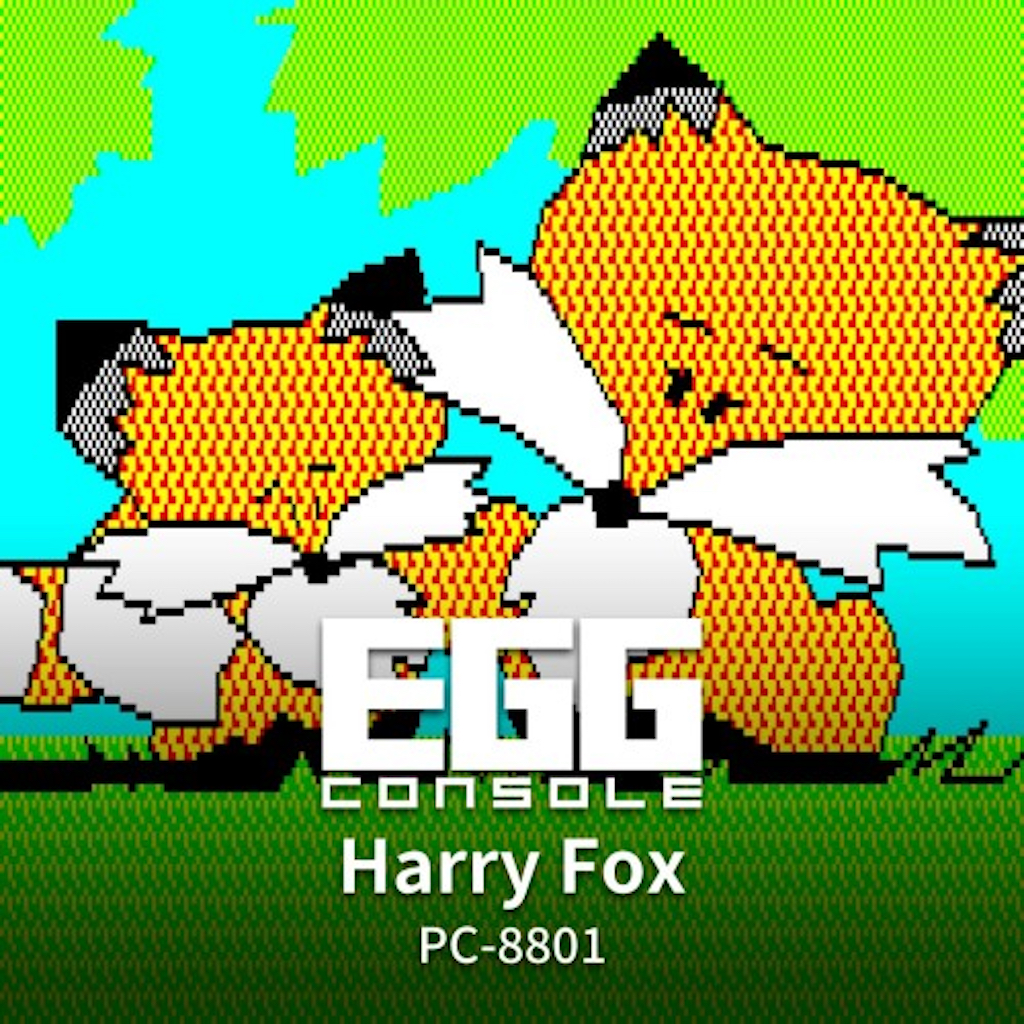
Visually, Harry Fox is unmistakably an early PC-8801 title. Character sprites are simple, environments use bold colours and chunky pixel art, and animations remain extremely limited. Yet its presentation has an undeniable appeal.
The forests feel inviting despite their technical simplicity, while the character designs possess an innocence that perfectly complements the game’s gentle tone. There is a storybook quality to everything on screen, making it easy to see why the game found an audience in Japan during an era when adventure games often targeted a far narrower demographic.
The soundtrack is equally restrained, featuring short melodic loops that quickly become familiar companions throughout the journey. While repetitive by modern standards, the music captures the cosy atmosphere with remarkable accuracy. Rather than trying to create tension through bombastic orchestration, it quietly supports the adventure without overwhelming it.
It is fascinating to remember that games like this helped establish storytelling techniques that later generations would expand upon. Looking at Harry Fox today is like opening an old family photo album. The images may have faded, but the emotions remain surprisingly vivid.
Preservation Done Right
One of the EGGCONSOLE series’ greatest strengths remains its commitment to historical preservation. Rather than modernising classic games beyond recognition, D4 Enterprise lets players experience them as authentically as possible, while introducing a handful of quality-of-life features.
Save states are perhaps the most valuable addition. Games from this era were rarely designed with convenience in mind, and replaying lengthy sections after every mistake can quickly become exhausting. The freedom to save whenever necessary removes much of that frustration while respecting the original gameplay.
Speed adjustment options are also useful, particularly during slower exploration sequences. Meanwhile, the included gallery of original packaging and manuals provides welcome historical context. For gaming historians and collectors, these extras transform the release from a simple reissue into a fascinating digital museum piece.
However, the game itself remains entirely in Japanese. While menus and instruction screens have been translated into English, the original software has not. That decision preserves authenticity but inevitably limits accessibility for many players unfamiliar with the language.
The Challenges of Its Age
As touching as Harry Fox remains, it would be dishonest to ignore its limitations. Collision detection occasionally feels imprecise, movement lacks the fluidity expected today, and some puzzle solutions border on frustratingly opaque. These are not flaws introduced by the re-release but characteristics inherited from the original 1984 release.
The absence of scene selection also means that revisiting specific moments requires replaying large portions of the adventure. Combined with the language barrier, this can make the experience demanding in ways that have little to do with intended difficulty.
Those expecting a polished modern adventure will almost certainly struggle. Harry Fox belongs to an era when experimentation, patience and persistence formed the core of gameplay. Appreciating it requires accepting those historical design philosophies rather than judging them solely by contemporary standards.
Final Verdict
EGGCONSOLE Harry Fox PC-8801 is less about rediscovering a forgotten masterpiece and more about appreciating an important piece of gaming history. Beneath its primitive mechanics lies a remarkably heartfelt adventure centred on a mother’s determination to save her child. That emotional core remains surprisingly powerful, even after more than forty years.
The EGGCONSOLE treatment once again succeeds by respecting the original release while introducing thoughtful modern conveniences that reduce unnecessary frustration. Save states, speed controls and archival extras make this the definitive way to experience Harry Fox, even if its age inevitably shows throughout the adventure.
This is not a game for everyone. Players seeking fast-paced action or modern storytelling will likely find its deliberate pacing and cryptic progression difficult to embrace. However, those with an appreciation for retro adventures, Japanese gaming history, or the origins of narrative-driven design will discover a charming little time capsule with genuine heart beneath its dated exterior.
Some classics impress through innovation that still feels modern. Others succeed by reminding us of where the medium began. Harry Fox comfortably belongs in the latter category, offering a quiet, thoughtful journey that deserves to be remembered, even if it asks for a little patience along the way.