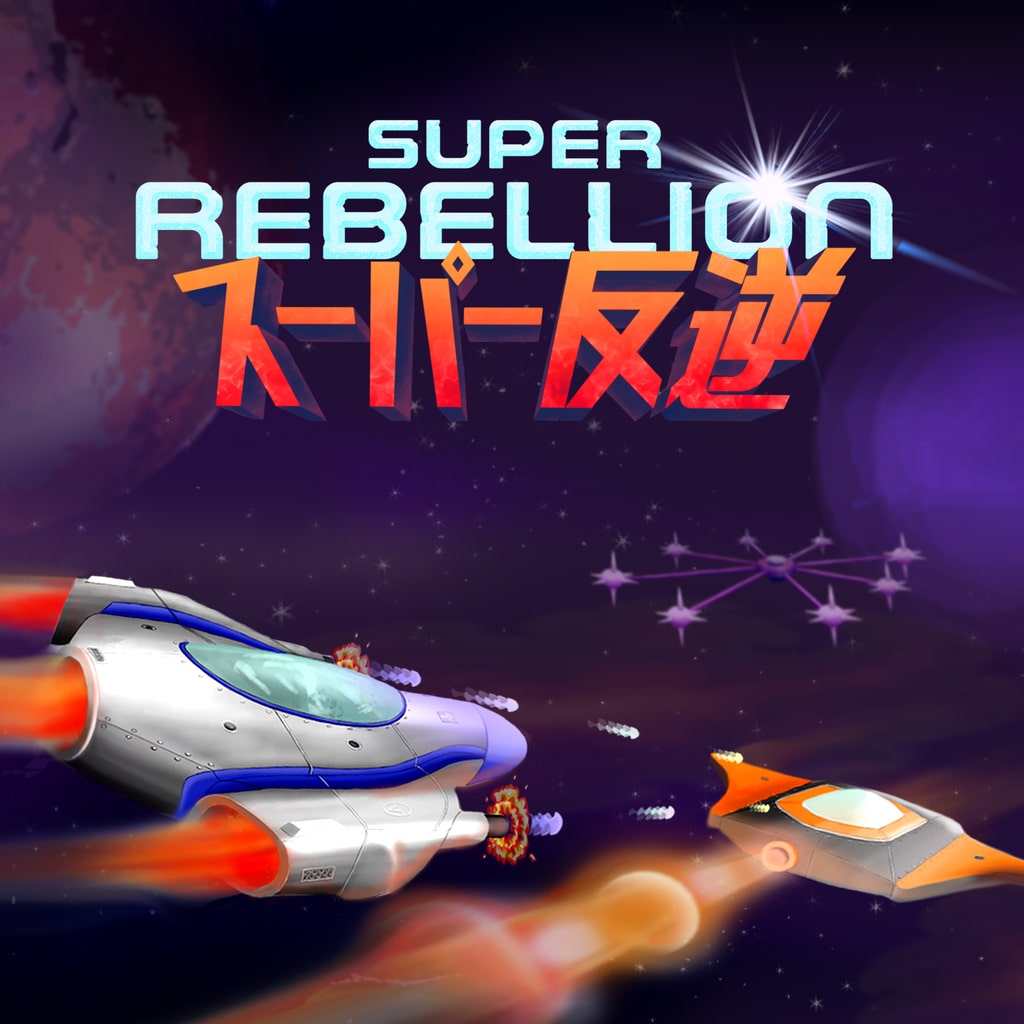
The shoot ’em up genre has always thrived on simplicity. At its best, it offers immediate excitement, rewards skill, and an irresistible urge to try just one more run after a crushing defeat. Even decades after the arcade era faded, developers continue searching for new ways to capture that magic. Some succeed through innovative mechanics, while others lean heavily into nostalgia. Super Rebellion firmly belongs in the latter camp.
Developed and published by Colossus Game Studio, this vertically scrolling shooter is a love letter to the Japanese science fiction serials, anime, and music that inspired generations of arcade classics. From its opening moments, the game embraces a distinctly old-school identity. Alien invaders threaten humanity, brave pilots launch a desperate counterattack, and players are thrown into an uphill battle against impossible odds.
There is certainly charm in that straightforward approach. Super Rebellion never pretends to be anything other than a classic arcade shooter. The problem is that while it captures the appearance of its inspirations, it rarely captures the depth or excitement that made those games memorable in the first place.
Humanity’s Last Stand
The story unfolds in 203X, a familiar science-fiction future where humanity has been overwhelmed by a powerful alien empire. Earth has fallen, civilisation has collapsed, and the surviving population has united beneath a rebel banner in a final attempt to reclaim their world.
As part of an elite squadron, players are sent into Earth’s orbit to confront a seemingly endless alien fleet. The odds are impossible, the mission borders on suicide, and victory seems unlikely from the outset.
It is hardly groundbreaking storytelling, but that feels intentional. The narrative echoes countless classic space operas and anime adventures from previous decades. There are shades of vintage television serials, arcade shooters, and Saturday afternoon cartoons throughout the presentation.
What little story there is serves primarily as flavour rather than meaningful narrative development. Brief introductions and ending sequences provide context, but the real focus remains on the action itself. The game features multiple endings that trigger based on player performance. Progressing further into the campaign unlocks more heroic conclusions, while early failures result in less flattering outcomes. It is a neat idea that gives repeated attempts a little extra purpose, even if the storytelling itself remains fairly basic.
Simple Controls, Simpler Combat
At its core, Super Rebellion follows a formula instantly familiar to genre veterans. You control a spaceship moving across a vertically scrolling battlefield, firing continuously at incoming enemy formations. Power-ups occasionally appear, enemies fill the screen with projectiles, and oversized bosses await at the end of each stage.
The controls are perfectly functional. Movement feels responsive, firing is immediate, and collecting power-ups is straightforward. Newcomers can jump in within seconds without needing to study complicated systems or mechanics.
Unfortunately, simplicity eventually becomes one of the game’s greatest weaknesses. Many of the genre’s finest examples create depth through weapon management, scoring systems, risk-reward mechanics, or intricate movement options. Super Rebellion offers very little beyond basic shooting and occasional special attacks. Most encounters involve holding down the fire button and weaving through enemy projectiles until everything explodes.
There is a certain satisfaction in watching waves of enemies disintegrate beneath a barrage of laser fire, but that enjoyment fades faster than expected. Without deeper mechanics to support the action, the gameplay begins to feel repetitive long before the campaign reaches its conclusion.
A Few Interesting Ideas
To its credit, Super Rebellion attempts to introduce a handful of concepts that set it apart from purely traditional arcade shooters. Enemy formations are not entirely fixed. Rather than memorising identical patterns on every run, players encounter slight variations in enemy placement and attack timing. This places greater emphasis on reflexes and adaptability than in some classic shooters.
The multiple-ending system also adds a small layer of replayability. Success and failure directly influence how the game remembers your pilot’s contribution to humanity’s rebellion. While these endings are relatively simple, they provide at least some incentive to push further into the campaign.
Perhaps the most interesting feature arrives in the final episode. Instead of concluding with a traditional final level, the game transforms into an endless survival challenge. Difficulty steadily increases as players attempt to climb online leaderboards and survive for as long as possible.
It is a welcome shift that finally introduces a stronger sense of long-term challenge. Unfortunately, reaching that point requires working through a campaign that never fully develops its core mechanics.
Music Saves the Day
If there is one area where Super Rebellion consistently excels, it is the soundtrack. The music captures the spirit of classic Japanese action entertainment with remarkable fidelity. Heavy synth melodies, energetic rock riffs, and fast-paced electronic tracks create an atmosphere that often feels more exciting than the gameplay itself.
Several stages benefit enormously from this musical energy. Even during repetitive combat encounters, the soundtrack helps maintain momentum and injects personality into the experience. On multiple occasions, the music elevated otherwise routine sections into genuinely enjoyable moments.
Local co-operative play also adds some much-needed excitement. Sharing the screen with a friend transforms the straightforward combat into a more chaotic and entertaining experience. The wider playfield provides enough space for both players to operate comfortably without constantly interfering with one another. While co-op does not solve the game’s deeper issues, it certainly makes them easier to overlook.
Rough Around the Edges
Unfortunately, Super Rebellion’s presentation outside its soundtrack leaves much to be desired. Visuals often feel unfinished. Background environments lack detail, sprite work appears inconsistent, and menus contain noticeable errors that immediately undermine the game’s professional polish. Small mistakes can be forgiven in independent projects, but their frequency here creates an impression of a product that could have benefited from further refinement.
The boss encounters prove even more problematic. Throughout most stages, the difficulty remains relatively manageable. Enemy formations are predictable enough to navigate, and success feels largely achievable through steady concentration. Boss fights, however, frequently abandon that balance. Massive laser attacks can appear with little warning, covering large portions of the screen and dealing significant damage before players have an opportunity to react.
Rather than encouraging mastery, these moments often encourage memorisation. Defeat rarely feels like a result of poor decision-making. Instead, it frequently feels like punishment for lacking prior knowledge of specific attack patterns. That distinction matters in a genre built around skill development.
Final Verdict
Super Rebellion is clearly a game made with affection for classic arcade shooters. Its developers understand the aesthetics, music, and atmosphere that defined the genre in its golden years. The energetic soundtrack, straightforward controls, and local co-op options demonstrate a genuine appreciation for old-school arcade design. Unfortunately, nostalgia alone cannot carry the entire experience.
The core combat lacks the mechanical depth needed to sustain long-term engagement, while rough visuals and frustrating boss encounters prevent the game from settling into a comfortable rhythm. There are flashes of potential throughout the campaign, particularly in the survival mode and performance-based endings, but they never fully compensate for the repetitive gameplay loop.
Players seeking a brief, inexpensive arcade distraction may still find some enjoyment here, particularly with a friend. However, genre veterans seeking a memorable shoot ’em up experience will likely find stronger alternatives elsewhere. Super Rebellion has plenty of heart, but it struggles to turn that passion into something truly memorable.