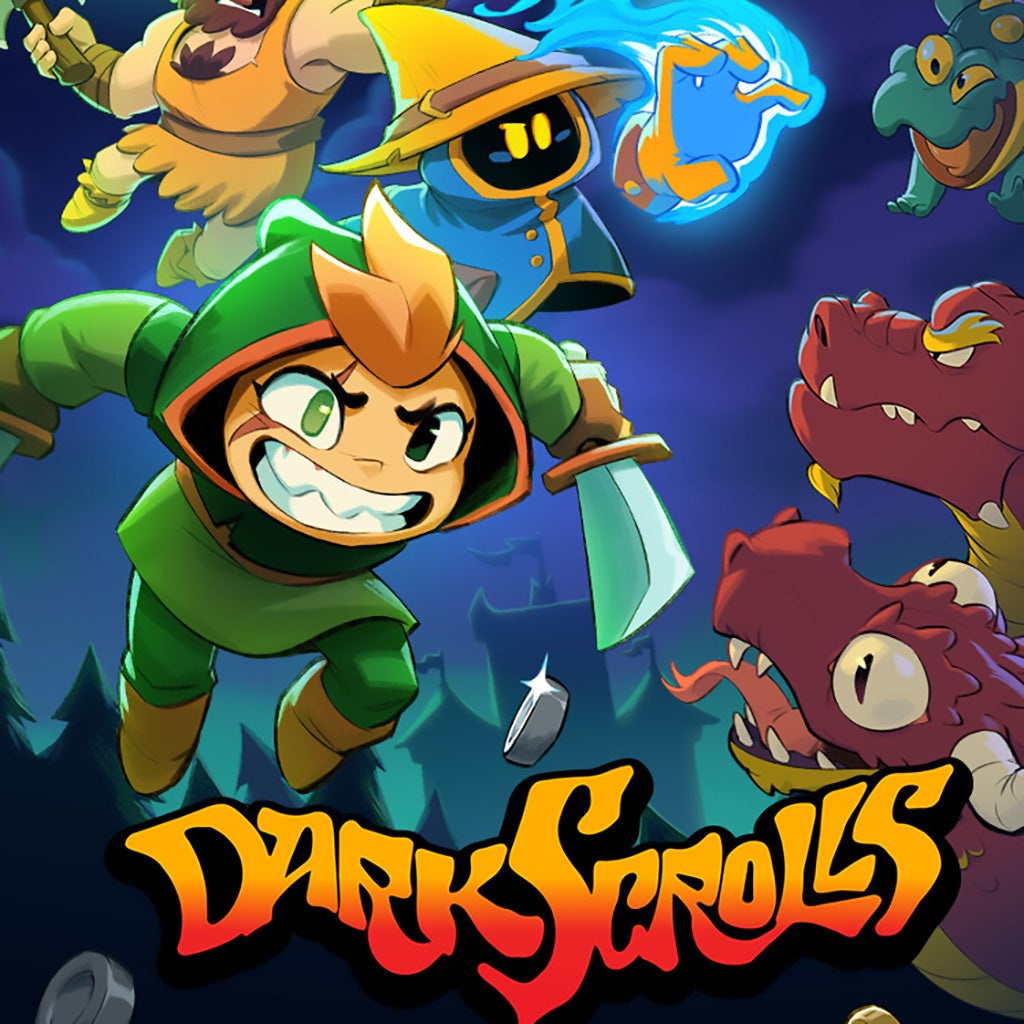
There is something wonderfully nostalgic about games that embrace pure arcade energy. Long before sprawling open worlds and hundred-hour campaigns became the norm, games lived and died by their ability to throw players into immediate danger and dare them to survive just a little longer. Dark Scrolls, the latest retro-inspired adventure from doinksoft and Devolver Digital, taps directly into that old-school philosophy while layering modern roguelite mechanics on top of the chaos.
At first glance, Dark Scrolls looks like a straightforward fantasy action game. Heroes run from left to right, monsters fill the screen, and colourful pixel art bursts from every corner. Spend a little more time with it, however, and you discover a surprisingly unusual hybrid. This is a game that blends auto-scrolling platforming, bullet-hell combat, character unlocks, procedural progression, and cooperative play into one frantic package. The result is a game that often feels wonderfully chaotic, occasionally frustrating, but almost always entertaining.
A Story That Knows Better Than To Take Itself Seriously
Dark Scrolls opens with a story that feels lifted straight from a forgotten arcade cabinet of the late 1980s. A collection of powerful dark scrolls has been scattered across the land, and a group of unlikely heroes must retrieve them before disaster strikes. The setup largely serves as an excuse to throw players into danger, and the game is fully aware of that.
Rather than building an elaborate fantasy world filled with lore and political intrigue, Dark Scrolls focuses its charm on its cast of eccentric characters. You begin with a handful of fairly traditional heroes, including a barbarian and a rogue, but the roster quickly expands into something delightfully absurd. Before long, you are rescuing characters that seem to have wandered in from entirely different games.
A stray dog joins the adventure. A saxophone-playing rat appears. An alien somehow finds their way into this fantasy setting. Each addition feels like a small reward in itself, helping sustain curiosity across repeated runs. While none of these characters possess deep narrative arcs, their sheer personality helps the game establish a light-hearted identity that remains consistently enjoyable.
Controlled Chaos
The defining feature of Dark Scrolls is its relentless forward momentum. Unlike traditional platformers that let players explore at their own pace, the screen here constantly pushes forward. Standing still simply is not an option. Enemies appear from every direction, hazards emerge without warning, and the environment itself often seems determined to crush you beneath its wheels.
This design creates an immediate sense of urgency. Every jump matters. Every enemy encounter demands attention. Every second spent hesitating risks disaster. The tension generated by this constant movement becomes one of the game’s greatest strengths. Even familiar levels remain exciting because there is always pressure. You are not simply learning patterns. You are reacting to them in real time while keeping pace with the advancing screen.
That pressure can occasionally become overwhelming, particularly for solo players. Yet it also creates countless memorable moments when disaster somehow transforms into triumph through a combination of quick thinking and pure luck.
Building The Perfect Run
While Dark Scrolls embraces arcade simplicity on the surface, a surprisingly layered progression system underpins the action. As players defeat enemies and collect coins, they gain access to Bruce & Goose’s Shoppe, a wonderfully named merchant stop that serves as a temporary refuge between battles. Here, coins can be exchanged for perks, summoned allies, elemental enhancements, and a variety of bizarre upgrades.
The most interesting aspect of this system is the Star Meter. Rather than functioning as a straightforward power gauge, many perks activate differently depending on whether the meter is filling or draining. This creates an ongoing risk-and-reward dynamic that encourages experimentation and adaptation.
A mediocre build can suddenly become devastating when the right combinations align. Explosions fill the screen. Summoned allies charge into battle. Entire waves of enemies vanish beneath a storm of projectiles. During these moments, Dark Scrolls captures the addictive satisfaction that fuels the best roguelites. You are constantly chasing that next perfect combination, convinced the next run might be the one where everything finally comes together.
Better Together
Although Dark Scrolls is perfectly playable alone, it is clear that cooperative play was central to the design philosophy. Bringing a friend along transforms the experience. What can feel stressful in solo mode becomes laugh-out-loud chaos when shared with another player. Reviving fallen teammates, coordinating attacks, and desperately scrambling through bullet-filled corridors create a level of energy that is difficult to replicate elsewhere.
The cooperative mechanics are straightforward yet effective. Players can support one another without overcomplicating the action, keeping the focus firmly on survival.
There is also something wonderfully old-fashioned about the experience. It recalls the days of crowded sofas, frantic shouting, and celebrations after narrowly surviving impossible encounters. Dark Scrolls understands the appeal of that dynamic and embraces it wholeheartedly.
Pixel Art With Personality
Visually, Dark Scrolls is a delight. Doinksoft has long been known for strong pixel art, and that expertise is on full display here. Character sprites are expressive and full of personality, while enemies are sufficiently distinct to remain legible even in the busiest battles.
The environments may not be particularly varied over extended sessions, but they are colourful and inviting. The game understands that clarity matters during intense action, ensuring key visual information remains visible even when projectiles flood the screen.
The soundtrack deserves praise as well. It captures the adventurous spirit of classic fantasy games while maintaining a lively energy that complements the frantic gameplay. The music rarely steals the spotlight, but it consistently reinforces the game’s upbeat atmosphere.
Where The Scroll Begins To Fray
As enjoyable as Dark Scrolls can be, it is not without shortcomings. The biggest issue concerns movement. Given how heavily the game relies on precise, pressure-driven platforming, the controls occasionally feel looser than they should. Some jumps lack the precision required for such a demanding experience, making failure feel less like a mistake and more like a consequence of slightly awkward physics.
The progression system can also be difficult to parse. New players may be unsure which upgrades carry over between runs and which disappear on death. Greater clarity would have made the long-term progression feel more rewarding.
Perhaps most significantly, the procedural structure occasionally reveals its limitations. While room layouts change between runs, many environments begin to blur together after extended play sessions. The sense of discovery gradually fades, leaving the combat and character roster to carry the experience forward.
Final Verdict
Dark Scrolls may not reach the heights of the genre’s very best roguelites, but it remains a thoroughly enjoyable adventure built on genuine charm. Its colourful cast, frantic pace, satisfying build experimentation, and excellent co-op create a package that is consistently entertaining, even when its flaws become apparent.
The loose platforming and occasionally repetitive progression keep it from becoming an instant classic, yet there is an undeniable energy to everything it does. It feels like a game built by developers who genuinely love the arcade experiences that inspired it.
For players seeking a polished solo roguelite epic, there are stronger options available. For those looking to spend an evening battling through absurd fantasy chaos with a friend, laughing at repeated failures and celebrating unlikely victories, Dark Scrolls delivers exactly what it promises. It may not become the stuff of legend, but it is certainly a quest worth taking.