There is something inherently exciting about helicopters in video games. Whether it is weaving through canyons under heavy fire, launching rockets at enemy convoys, or performing daring rescue operations against the odds, rotorcraft have long been associated with some of gaming’s most memorable action sequences. The fantasy of becoming an elite combat pilot remains as appealing as ever.
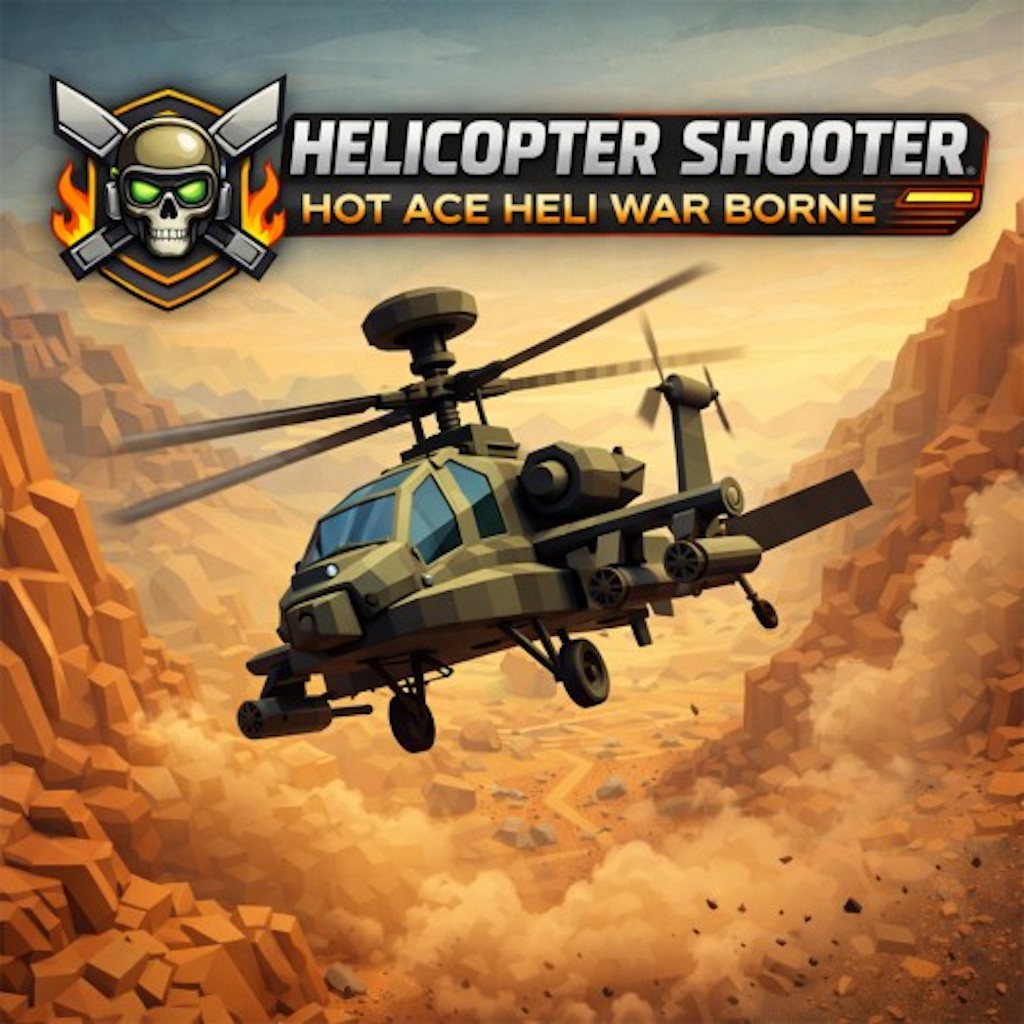
Helicopter Shooter – Hot Ace Heli War Borne arrives on Nintendo Switch, hoping to tap into that fantasy. Developed and published by Sniper Games, it positions itself as a fast-paced aerial combat experience focused on action, resource management, and mission-based objectives. On paper, there are genuinely promising ideas here. Combat helicopters, rescue operations, transport mechanics, and escalating battlefield challenges sound like ingredients for an entertaining arcade flight game.
Unfortunately, while the game occasionally hints at something more interesting beneath the surface, it never fully commits to its best ideas. What remains is a lightweight shooter that offers a brief distraction but struggles to sustain engagement for any meaningful length of time.
A Strong Premise That Never Quite Develops
The core concept is straightforward. Players pilot a military helicopter and complete a series of combat missions across hostile environments. Enemy soldiers, vehicles, defensive emplacements, and airborne threats stand between you and your objectives. Success requires balancing offence, movement, and resource management while navigating increasingly dangerous encounters.
At first, the formula works reasonably well. The controls are simple enough to grasp within minutes, allowing newcomers to jump straight into the action. Machine guns provide rapid suppression against lighter enemies, while rockets deliver satisfying bursts of destructive power against tougher targets.
The game also introduces a hook system to add variety to missions. Certain objectives require lifting cargo, transporting equipment, or rescuing civilians from dangerous situations. These moments break up the shooting and force players to think about positioning and manoeuvrability rather than simply blasting everything that moves.
Sadly, this mechanic never evolves much beyond its introductory novelty. What initially feels like a refreshing change of pace eventually becomes another repetitive task inserted between combat encounters.
Combat That Peaks Early
For the first hour or so, Helicopter Shooter manages to generate modest excitement. Explosions fill the screen, enemy vehicles swarm your position, and there is constant pressure to keep moving. The helicopter itself feels responsive enough. Banking through tight spaces and adjusting altitude become second nature fairly quickly. Weapon swapping is fast and intuitive, making it easy to react to changing threats in battle. The problem is that the game runs out of ideas almost immediately.
Enemy encounters begin to blur together after only a handful of missions. Most adversaries charge directly towards your position with little regard for self-preservation. Tanks occupy predictable positions. Infantry units follow simple attack patterns. Airborne enemies rarely require anything beyond basic target tracking.
Without meaningful tactical variety, every mission starts to feel remarkably similar. Fly into an area, eliminate a wave of enemies, complete a simple objective, move to the next zone, and repeat. Aerial combat games live and die by their ability to create dynamic situations. Here, encounters often feel scripted and static rather than reactive and exciting.
The Hook Mechanic Deserved Better
The game’s most distinctive feature is undoubtedly its cargo and rescue system. Using the helicopter’s hook, players can attach objects and transport them across the battlefield. This includes supply crates, mission-critical equipment, and civilians requiring evacuation. Carrying these objects alters handling, making flight more challenging and introducing an element of risk management. In theory, this mechanic should be the game’s defining feature.
In practice, it feels underutilised. Most transport objectives are simplistic point-to-point exercises that rarely introduce meaningful complications. Enemy resistance remains predictable, environmental hazards are limited, and mission scenarios lack the creativity needed to turn these sequences into memorable set pieces.
There are flashes of potential when combat and transport objectives overlap, forcing players to defend themselves while carrying vulnerable cargo. Unfortunately, these moments are too rare to leave a lasting impact.
Bare-Bones Presentation
Visually, Helicopter Shooter sits firmly within the budget eShop category. The helicopter models are reasonably detailed, particularly when viewed up close. Explosions provide enough visual feedback to make combat readable, and weapon effects communicate impact effectively.
Beyond that, however, the presentation struggles to impress. Maps feel sparse and repetitive. Military bases, industrial facilities, and canyon environments lack distinctive visual identities. Many locations appear to be built from reused assets arranged in slightly different configurations. As a result, missions often blend together visually. After several hours, it becomes difficult to remember one battlefield from another.
The lack of environmental storytelling further contributes to the sterile atmosphere. These locations rarely feel like real places caught in the middle of a conflict. Instead, they resemble empty arenas built solely to host enemy spawns.
Character models fare no better. Enemy units are generic and repetitive, with little variation in appearance or behaviour. Even when new enemy types appear, they rarely alter the overall flow of combat.
Sound Design Running on Autopilot
The audio is functional rather than memorable. The soundtrack leans heavily on generic action themes designed to inject energy into combat encounters. While the music serves its purpose initially, repeated tracks quickly become noticeable given the limited variety.
Weapon effects lack the punch required for a game built around military hardware. Machine guns sound lightweight, rockets lack satisfying impact, and explosions often feel oddly muted given the scale of destruction on screen.
There is also very little atmospheric audio to help sell the battlefield setting. Ambient sounds are minimal, and missions often feel strangely empty despite the supposed chaos unfolding around you. A stronger audio presentation could have elevated the action considerably. Instead, it reinforces the game’s overall sense of genericness.
Performance Holds Steady
One area where Helicopter Shooter performs reasonably well is technical stability. The game maintains a consistent frame rate throughout most encounters, even when multiple enemies and effects fill the screen. Load times remain short, controls respond reliably, and crashes or major bugs are absent during normal play.
For a budget title, that level of stability deserves credit. Unfortunately, technical competence alone cannot compensate for a lack of depth. A stable game still needs compelling content to keep players invested, and that is where Helicopter Shooter consistently falls short.
Value and Longevity
Perhaps the biggest issue facing Helicopter Shooter – Hot Ace Heli War Borne is how quickly players see everything it has to offer. The progression system introduces new challenges at a painfully slow pace. Weapons improve incrementally, difficulty gradually increases, and objectives become slightly more demanding. Yet the core gameplay remains almost unchanged from start to finish. Within the first twenty to thirty minutes, most players will have experienced the full scope of the game’s mechanics.
There is little incentive to revisit completed missions, and the absence of multiplayer removes what could have been a significant source of replayability. Leaderboards, co-operative missions, or competitive modes might have added much-needed longevity, but none are present. As a result, the experience feels surprisingly disposable.
Final Verdict
Helicopter Shooter – Hot Ace Heli War Borne is not without merit. Its responsive controls, occasional bursts of arcade action, and cargo transport mechanic hint at a more interesting game beneath the surface. For a brief period, soaring through hostile skies while unleashing rockets into enemy formations can be genuinely enjoyable.
The problem is that the game never expands beyond that initial appeal. Repetitive mission structures, simplistic enemy AI, uninspired environments, and a severe lack of content leave the experience feeling shallow long before the credits roll.
There are countless ways to make helicopter combat exciting. This game touches on a few of them but never fully embraces any. What remains is a serviceable budget shooter that functions adequately but struggles to justify much of the time spent with it.