Arena shooters have always lived and died by their ability to create momentum. The best examples make every second feel like a desperate struggle for survival while empowering players to become unstoppable forces of destruction. Games like DOOM Eternal, Dusk, and even classics such as Quake understand that speed alone is never enough. Movement, enemy variety, level design, weapon synergy, and player creativity combine to create the magic that keeps players hooked.
Serious Carnage – Adrenaline Shooter clearly understands one part of that formula. It wants players moving constantly. From the moment the first wave begins, standing still feels like a death sentence. Enemies pour from glowing portals, projectiles fill the screen, and survival depends on staying in motion. For a brief period, that relentless pace creates excitement. Unfortunately, once the initial rush wears off, the game reveals how little lies beneath its aggressive exterior.
Developed and published by Thorium G, Serious Carnage feels less like a fully realised arena shooter and more like a rough prototype stretched into a complete release. It has moments when the foundation shows promise, but those moments become increasingly difficult to find as the hours pass.
Running in Circles
The central gameplay loop is remarkably simple. Players enter a closed arena, survive waves of enemies emerging from portals, eliminate everything in sight, and move on to the next encounter. Along the way, enemies drop souls that fuel special abilities and power boosts, giving players temporary advantages against overwhelming odds.
At first, the constant pressure creates a satisfying sense of urgency. Enemies rush from every direction, demanding quick reactions and smart weapon use. The game actively rewards aggressive play, encouraging players to push forward rather than hide in corners waiting for opportunities.
The problem is that almost every encounter plays out the same way. Arena shooters thrive when they force players to adapt. Different enemy types should demand different strategies. Level layouts should influence movement decisions. Weapons should encourage experimentation. Serious Carnage struggles with all three.
Most encounters quickly devolve into running around the perimeter of an arena while firing into crowds of enemies that follow predictable paths. Once players identify the safest route through a room, the challenge largely disappears. The game’s speed remains high, but decision-making becomes increasingly shallow.
Weapons Without Personality
A strong arsenal can often carry an otherwise average shooter. There is something inherently satisfying about discovering new tools of destruction and learning how they complement one another. Serious Carnage offers a reasonable selection of firearms, ranging from rapid-fire weapons to explosive launchers capable of clearing large groups of enemies.
Initially, switching between weapons provides some variety. Different situations call for different approaches, and the game encourages players to adapt their loadouts on the fly as ammunition becomes scarce. In theory, this should create a dynamic combat rhythm.
In practice, many of the weapons feel surprisingly similar. While damage values vary, few possess the distinct personality needed to make them memorable. The shotgun lacks the devastating impact players expect. Explosive weapons create visual spectacle but rarely deliver the satisfying punch associated with powerful ordnance. Even after unlocking most of the arsenal, combat never evolves in meaningful ways.
The Rage Mode system offers brief moments of empowerment, allowing players to unleash devastating attacks after building sufficient momentum. These sequences inject welcome bursts of excitement into battles, but they are not enough to overcome the repetitive structure surrounding them.
Arena Design That Holds Everything Back
Perhaps the game’s greatest weakness lies in its level design. Fast-paced shooters depend heavily on the spaces where combat unfolds. Clever arena layouts create opportunities for tactical positioning, daring escapes, and creative solutions. Players should feel they are mastering both their weapons and the environment. Serious Carnage rarely offers that opportunity.
The arenas are largely flat, featureless boxes with little variation between them. There are few elevation changes, no meaningful traversal mechanics, and almost nothing in the environment that influences combat strategy. Without ramps, jump pads, environmental hazards, or layered pathways, movement quickly becomes repetitive.
As a result, the game’s impressive speed often works against it. Players move quickly because they have to, not because the level design encourages exciting movement options. What should feel exhilarating instead becomes mechanical. After enough encounters, every arena begins to blur into a single extended firefight.
Boss Battles That Lack Impact
Boss encounters are positioned as major milestones throughout the experience. These larger enemies are meant to test everything players have learned while providing memorable moments between standard wave battles. Unfortunately, they suffer from many of the same issues that affect the rest of the game.
Most bosses simply have larger health pools and stronger attacks rather than introducing genuinely unique mechanics. Defeating them often feels less like solving a challenging puzzle and more like enduring a prolonged damage race. While some designs are visually larger and more intimidating, few leave a lasting impression once the battle concludes. The best boss fights in the genre create stories players remember long after the credits roll. Serious Carnage’s bosses are functional obstacles, but little more.
Style Without Identity
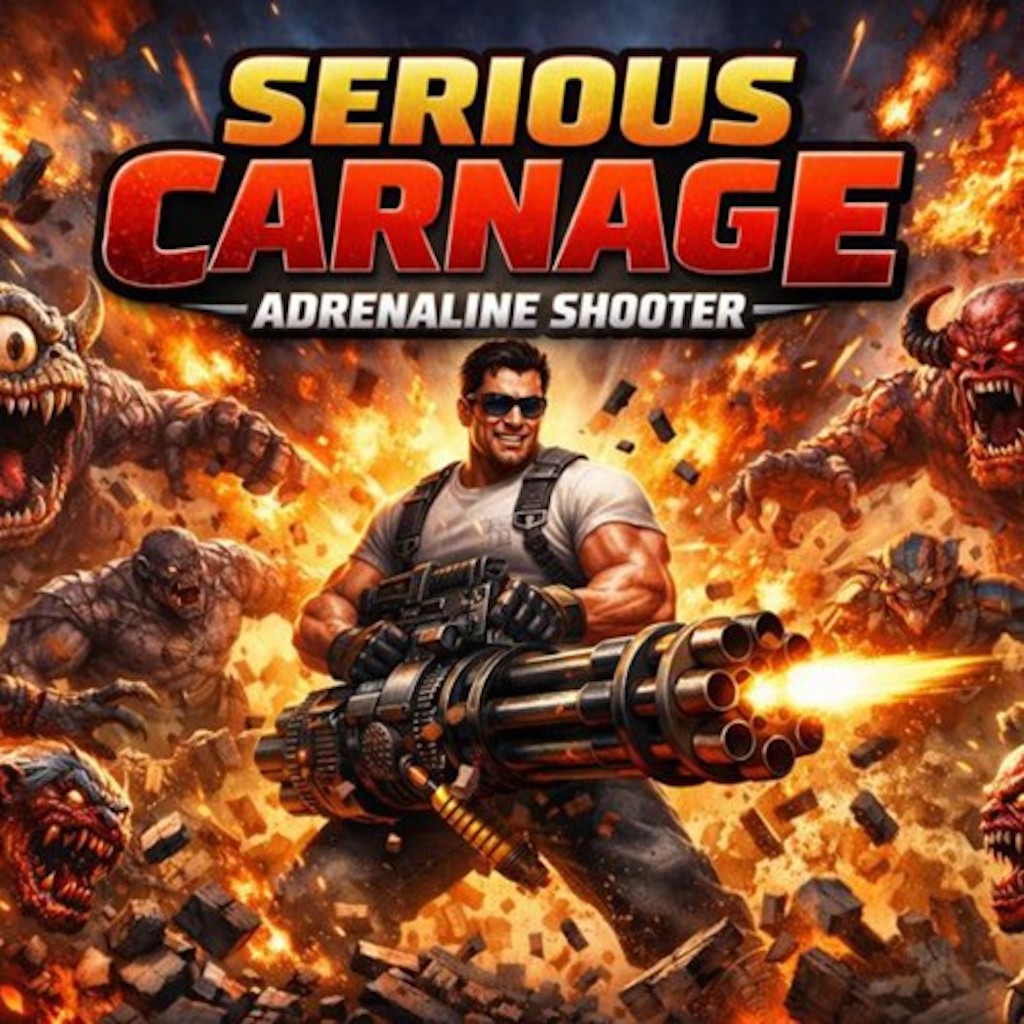
Visually, Serious Carnage aims for a gritty sci-fi horror aesthetic. Dark metallic environments, glowing portals, and demonic enemies dominate the presentation. There are occasional flashes of atmosphere, particularly as waves intensify and the screen fills with chaos.
However, the overall art direction feels generic. The environments lack distinct visual landmarks, and enemy designs often blend together during intense encounters. Many arenas feel interchangeable, making it difficult to remember specific locations after finishing them.
Performance on the Nintendo Switch remains reasonably stable throughout most of the experience. Even during larger encounters, the frame rate generally holds. Given the number of enemies frequently appearing on screen, that stability deserves credit.
The audio presentation fares less well. The heavy metal soundtrack attempts to inject energy into the action, but the tracks become repetitive surprisingly quickly. More disappointing are the weapon effects, which often lack the power needed to make combat feel satisfying. Great shooters make every trigger pull feel meaningful. Here, many weapons sound oddly weak, diminishing the impact of every encounter.
A Rush That Fades Too Quickly
There is a version of Serious Carnage that could have been genuinely entertaining. The focus on aggression, constant movement, and arcade-style action is not inherently flawed. In fact, in the opening stages, the game briefly captures the chaotic energy it aims for.
The problem is that those moments never develop. New arenas fail to introduce meaningful twists. Enemy behaviour remains predictable. Weapons never become particularly exciting. Before long, the adrenaline that initially drives the experience wears off. What remains is a repetitive loop that mistakes speed for depth and chaos for complexity.
Final Verdict
Serious Carnage – Adrenaline Shooter aims to be a relentless test of reflexes and aggression, but it lacks the creativity and design depth to sustain that ambition. While the fast-paced movement and wave-based combat offer short bursts of entertainment, repetitive arenas, uninspired enemy design, and forgettable weaponry quickly undermine the experience.
There is a kernel of fun beneath the noise, particularly for players seeking a simple arcade distraction. Unfortunately, that fun proves fleeting. The game delivers action in abundance, but very little of it feels meaningful.
Arena shooters thrive when every encounter feels like a thrilling dance of skill, movement, and destruction. Serious Carnage simply asks players to keep running in circles until the shooting stops.