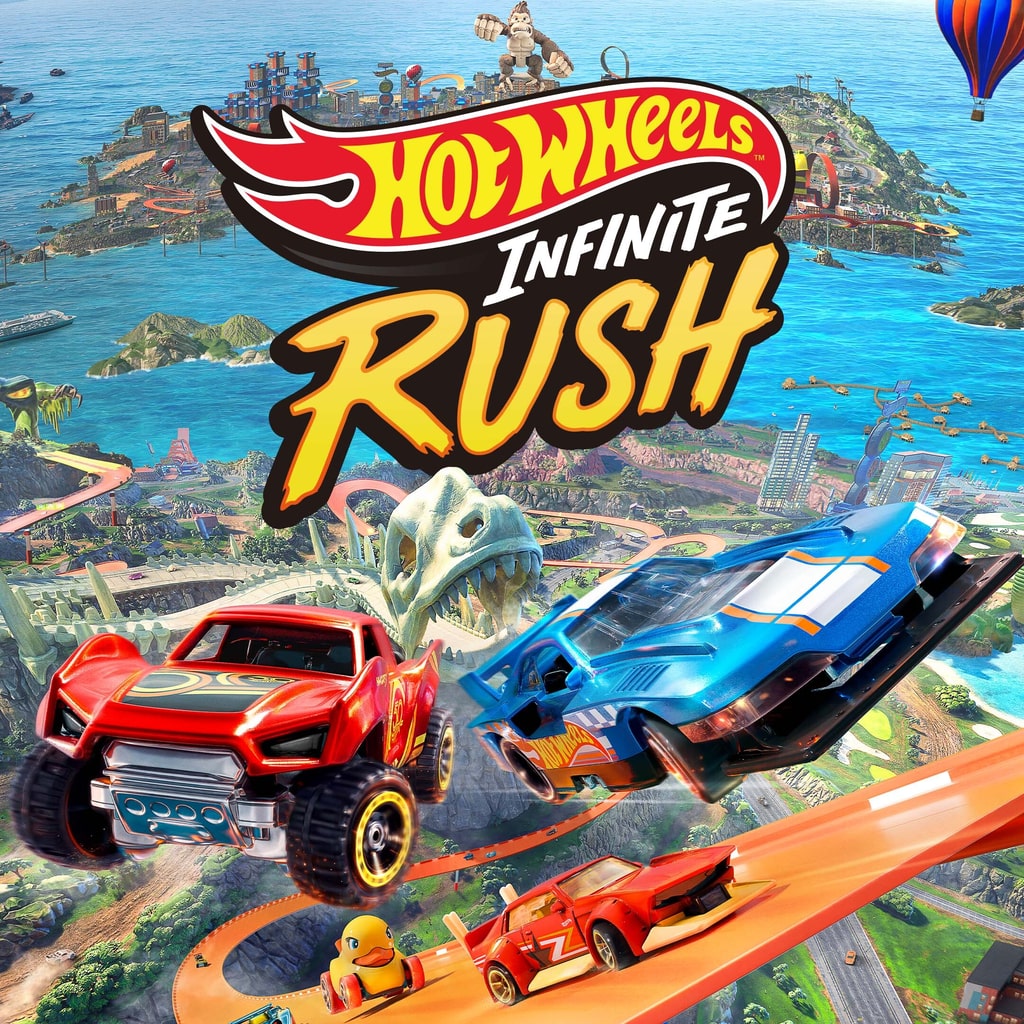
For years, Hot Wheels games have thrived on a simple promise. Build a track, hit absurd speeds, crash spectacularly, repeat. HOT WHEELS Infinite Rush keeps that spirit alive, but it is clearly trying to grow beyond the confines of the toy box. Instead of selecting isolated races from a menu of curated tracks, you are dropped into fully realised island environments that feel more like playgrounds than circuits.
Milestone S.r.l. has leaned hard into scale here. Four distinct islands form the backbone of the experience, each a self-contained racing ecosystem. One moment you are weaving through a sunlit coastal resort, the next you are threading between skyscrapers in a neon-soaked cityscape or tearing across desert terrain that seems designed purely to punish overconfidence. The result is a shift in tone that feels closer to an arcade adventure game than a traditional racer, even if speed remains the language everything speaks.
Islands that actually want to be explored
The biggest surprise in Infinite Rush is how strongly it encourages you to slow down between races. Exploration is not merely a transitional space; it is part of the game’s identity. Each island is packed with hidden routes, environmental stunts, and spontaneous challenges that appear without warning. A relaxed drive can suddenly turn into a timed drift trial or a stunt run that sends you careering off ramps you did not even realise were part of the landscape.
The Rush Masters serve as the narrative anchors for each region. They are not just traditional boss racers but almost mythic figures within their own island ecosystems. You earn their attention by completing events, building reputation, and demonstrating consistency across different challenge types. Only then do you unlock the right to challenge them directly in high-stakes races that feel like a culmination of everything the island has taught you.
This structure changes the emotional rhythm of play. Instead of racing being a repeatable loop, it becomes a process of escalation. You are not just winning events; you are building towards confrontations that feel earned rather than queued.
The Rush Squad and the joy of constant switching
At the heart of the moment-to-moment gameplay is the Rush Squad system, which may become one of Infinite Rush’s defining features. Rather than committing to a single vehicle, you build a small roster of four, each representing one of the core archetypes: Versatiles, Titans, Drifters, and Speeders. These are not cosmetic differences. They fundamentally change how you approach terrain, corners, and environmental hazards.
The real twist is how seamlessly you can swap between them during free-roam. A tight urban section invites a Drift switch, while a sudden barricade of destructible debris practically demands a Titan. It creates a rhythm in which adaptation becomes second nature, almost like changing gears in real time based on instinct rather than menu navigation. When it works, it makes traversal feel alive in a way the series has never quite achieved before.
It also subtly shifts the player’s identity. You are no longer just a driver but more like a strategist managing momentum across multiple tools. That extra layer of decision-making gives even simple movement a sense of intent.
A sandbox that refuses to sit still
One of the most noticeable design philosophies in Infinite Rush is that nothing is allowed to remain static for long. Events trigger dynamically, sometimes overlapping and forcing improvisation. A stunt challenge might collide with a drift trial already in progress, turning what should be a controlled scoring run into a frantic scramble for survival and style points.
This unpredictability is both its greatest strength and an occasional weakness. When the systems align, the world feels electric, as if every corner of the island is conspiring to create spectacle. But there are moments when the sheer density of activity can overwhelm clarity, especially when multiple objectives overlap in tight spaces. It rarely breaks the experience, but it occasionally blurs it.
Still, the ambition is hard to ignore. This is a Hot Wheels game that actively resists becoming repetitive by refusing to let the player settle into comfort.
Track building reborn for a living world
The return of Track Builder is not just a feature here; it feels like a philosophy carried into the open world itself. Instead of isolated custom tracks floating in abstract space, you now build directly into the environment. Tracks wrap around buildings, snake through terrain, and snap into place via a smarter system that reduces the friction of creation.
The new snap tool is particularly impressive. It allows pieces to conform naturally to terrain without constant adjustment, which in previous entries often turned building into a precision chore. Here, it feels more like sculpting motion into the world rather than forcing geometry to behave.
Even more interesting is the introduction of action markers, which teach AI racers how to interact with your creations. This small detail opens the door to community content that feels less like novelty and more like a shared design language between players and the game itself.
Presentation, personality, and pure speed
Visually, Infinite Rush embraces the exaggerated toy aesthetic with confidence. Everything is glossy, oversized, and deliberately artificial, a look that suits the franchise perfectly. The islands feel like living dioramas rather than realistic environments, keeping the identity firmly rooted in Hot Wheels fantasy rather than simulation ambition.
Performance targets appear solid across current-generation hardware, with split-screen still retaining clarity even during chaotic multi-vehicle moments. The game’s sense of speed remains its strongest sensory hook. When everything clicks, it still delivers that unmistakable Hot Wheels sensation of barely controlled velocity turning into spectacle.
Final verdict
HOT WHEELS Infinite Rush is not just another entry in the series; it is a structural rethink. By adopting an open-island design and introducing the Rush Squad system, Milestone has taken a franchise known for curated chaos and transformed it into something closer to an evolving playground of speed and experimentation.
It is not flawless. At times, the density of events can overwhelm clarity, and the shift away from tightly designed stunt tracks may not satisfy purists who preferred more curated chaos. But the ambition is undeniable, and when it works, it delivers some of the franchise’s most dynamic racing. A bold reinvention that occasionally stumbles but never stops moving forward.