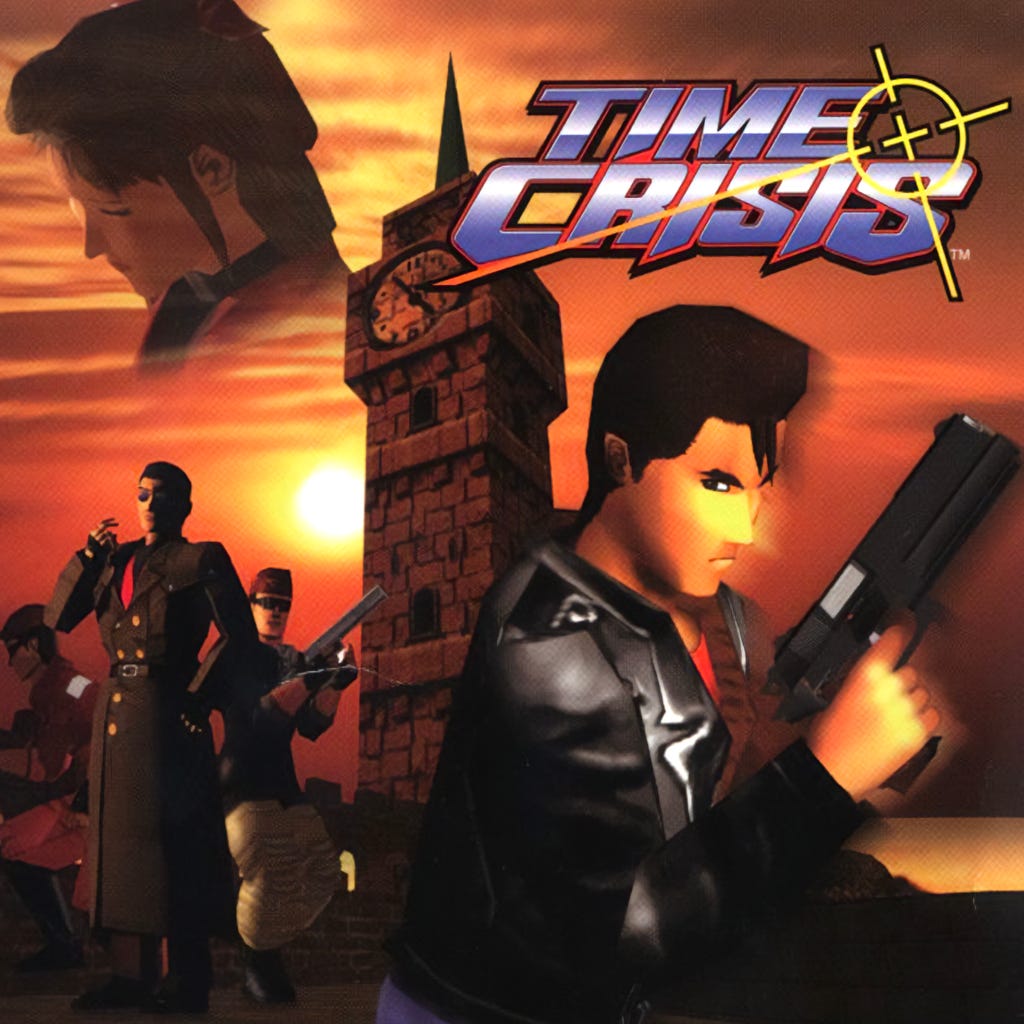
Some games are remembered for pushing technology forward. Others are remembered for introducing mechanics that changed how entire genres were played. Time Crisis belongs firmly in the second category. When it exploded into arcades in 1995, Namco’s light-gun shooter immediately stood out from its competitors thanks to one brilliantly simple idea: taking cover. That single innovation transformed what had been a straightforward shooting gallery into something far more exciting, forcing players to balance aggression with survival.
For many players, Time Crisis became one of the defining arcade experiences of the 1990s. The combination of explosive action, cinematic presentation, and the iconic foot pedal created an experience unlike anything else on the market. It wasn’t just about shooting quickly. It was about knowing when to shoot, when to hide, and when to take a risk.
Now the PlayStation classic returns for PS4 and PS5 through the PlayStation Plus Premium Classics catalogue. Enhanced with modern features such as rewind, quick saves, video filters, and gyro aiming, this latest release aims to preserve the original experience while making it playable on modern televisions. The question is whether a thirty-year-old arcade shooter can still hold its own in an era dominated by sprawling open worlds and online multiplayer giants. The answer, surprisingly, is yes.
Simplicity Is Its Greatest Strength
One of the first things that becomes apparent when revisiting Time Crisis is how refreshingly straightforward it is. You play as secret agent Richard Miller, tasked with rescuing the kidnapped daughter of a president from a heavily guarded castle controlled by a military tyrant. The story is pure action-movie nonsense, delivered with all the over-the-top energy you would expect from a mid-1990s arcade cabinet.
However, the plot is largely irrelevant. Time Crisis succeeds because every moment is focused on delivering excitement. There are no skill trees, no crafting systems, and no lengthy tutorials. The game places a gun in your hands and immediately throws you into danger. Enemy soldiers emerge from windows, balconies, doorways, and rooftops, forcing you to react in fractions of a second.
This relentless pacing remains one of the game’s greatest achievements. Modern shooters often spend hours building towards their biggest moments. Time Crisis starts at full speed and rarely slows down. Every encounter feels urgent because the game constantly pressures you to keep moving forward.
The Revolutionary Cover System
It is difficult to overstate how important the cover mechanic was when Time Crisis first appeared. Before its arrival, most light-gun shooters left players exposed at all times. Success depended almost entirely on reflexes and accuracy. Time Crisis added another layer by letting players duck behind cover, temporarily shielding them from incoming fire while they reloaded their weapon.
Even today, the mechanic feels brilliant. Popping out from behind cover to eliminate enemies before diving back to safety creates a satisfying rhythm that remains highly engaging. Every firefight becomes a small tactical puzzle. Stay exposed too long and you’ll take damage. Hide for too long and the countdown timer begins to work against you.
The result is a game that keeps players constantly engaged. There is never an opportunity to relax completely. Every second demands attention, creating an intensity that many modern shooters struggle to replicate.
A Surprisingly Strong Home Conversion
While many players remember the arcade original, this release is based on the expanded PlayStation version from 1997. That distinction matters because the home release added significantly more content, including the excellent Special Stages mode. These additional missions expand the story and offer alternative routes through the game’s events, dramatically increasing replay value.
The Special Stages feel particularly impressive today, as they showcase how ambitious home console adaptations could be in the 1990s. Rather than simply recreating the arcade experience, Namco added meaningful new content that encouraged players to keep returning. Multiple routes, branching scenarios, and hidden outcomes gave the game a surprising amount of depth for what is fundamentally a rail shooter.
Even now, replaying missions to discover different outcomes remains genuinely entertaining. It transforms Time Crisis from a brief arcade curiosity into a game capable of holding attention long after the credits roll.
Modern Features Make a Difference
One of the biggest challenges facing any classic light-gun game is that traditional light guns no longer work on modern televisions. Thankfully, the developers have implemented a surprisingly effective gyro-aiming solution using the PlayStation 5’s DualSense controller.
While it cannot fully replicate the feeling of pointing a physical GunCon at a CRT television, it works far better than expected. After a short adjustment period, aiming becomes natural and responsive. Landing quick headshots and tracking moving enemies remain satisfying throughout the campaign.
The modern emulation features are equally welcome. Rewind functionality helps soften some of the game’s more brutal difficulty spikes, while quick saves allow players to tackle challenging sections without constantly restarting entire stages. Various video filters also give players options for presentation, allowing them to recreate different visual styles to suit personal preference. These additions respect the original experience while making it more approachable for modern audiences. Crucially, none of them feel intrusive.
Showing Its Age
As enjoyable as Time Crisis remains, it is still a PlayStation game from 1997. Character models are extremely blocky, environmental detail is limited, and animations often appear stiff by modern standards. Players who grew up during the original PlayStation era will likely find this charming. Younger players may struggle to look beyond the ageing visuals.
The gyro aiming system, while impressive, is not perfect. During longer play sessions, cursor drift becomes increasingly noticeable. Recalibrating the aiming reticle is simple, but having to do it regularly can occasionally interrupt the flow of particularly intense encounters.
Another disappointment is the continued absence of PlayStation trophies. For many modern players, earning trophies adds an extra layer of replayability. The lack of support feels like a missed opportunity, particularly given how naturally Time Crisis lends itself to challenge-based objectives. These issues never ruin the experience, but they do prevent this release from becoming the definitive preservation effort some fans may have hoped for.
Why It Still Matters
Perhaps the most impressive thing about Time Crisis is how modern its design still feels despite its age. So many arcade shooters from the 1990s now feel like historical curiosities. Time Crisis remains genuinely fun. Its mechanics are easy to grasp, difficult to master, and endlessly satisfying to execute.
There is a purity to the design that feels increasingly rare in contemporary gaming. Every mechanic serves a purpose. Every encounter contributes to the overall pacing. Every stage introduces new threats without overcomplicating the formula. The game knows exactly what it wants to be and never loses focus.
That confidence allows Time Crisis to remain relevant decades after its original release. It serves as a reminder that great game design often outlasts technological advances. While graphics age and hardware evolves, strong mechanics endure.
Final Verdict
Time Crisis remains one of the finest arcade shooters ever made. Its revolutionary cover system, relentless pacing, and thrilling action sequences continue to deliver an experience that feels remarkably fresh despite its age. The additional content from the PlayStation version, together with thoughtful modern features such as rewind and quick saves, ensures this release offers plenty of value for both newcomers and returning fans.
The ageing visuals, occasional gyro drift, and lack of trophy support prevent this from being a perfect revival. Even so, the core experience remains every bit as addictive as it was three decades ago. Few games capture the excitement of being an action hero quite as effectively as Time Crisis. Whether you’re revisiting a childhood favourite or experiencing Richard Miller’s adventure for the first time, this classic still has plenty of firepower left.