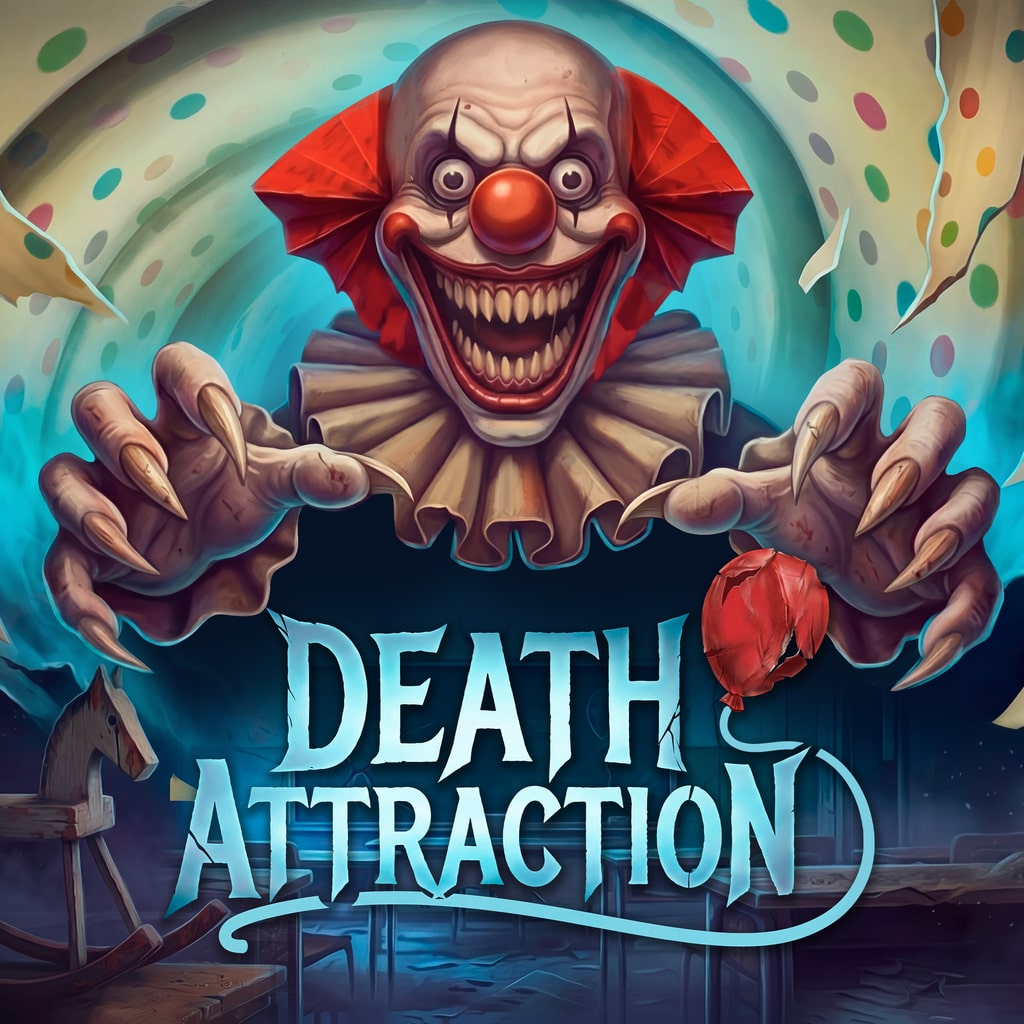
Clowns and horror have become inseparable over the years. Whether in films, television, or video games, the image of a smiling entertainer transformed into something sinister has proved remarkably effective at unsettling audiences. Death Attraction embraces that tradition wholeheartedly, placing players in a twisted funhouse where a murderous clown stalks every shadow and every flickering corridor feels like a trap waiting to spring.
Originally released as a free-to-play mobile and browser experience, Death Attraction has now made the jump to the Nintendo Switch with upgraded controls and a handful of console-focused enhancements. At first glance, it is easy to dismiss it as another low-budget horror game hoping to capitalise on familiar fears. The premise is straightforward, the environments modest, and the production values clearly operating within limitations.
Yet horror has never been solely about graphical fidelity or blockbuster budgets. Some of the genre’s most memorable experiences rely on atmosphere, pacing, and the player’s imagination. Death Attraction understands this surprisingly well. While it may never reach the heights of genre giants, it succeeds far more often than it fails by focusing on tension and uncertainty rather than spectacle.
The Carnival Never Sleeps
The game’s opening moments immediately set an unsettling tone. You awaken inside a dark, seemingly abandoned carnival attraction, surrounded by flickering lights, warped music, and a creeping sense that something is very wrong. The funhouse itself becomes a character of sorts, constantly twisting familiar amusement-park imagery into something threatening.
What makes the setting work is its commitment to discomfort. The environments are not particularly detailed, but they do not need to be. Narrow hallways, distorted mirrors, faded decorations, and malfunctioning neon signs create an atmosphere that feels trapped between childhood nostalgia and a fever dream.
The looping carnival soundtrack deserves particular praise. It lingers in the background, repeating familiar melodies just enough to become unsettling. Combined with distant footsteps, sudden noises, and the occasional glimpse of your painted pursuer, the audio design often does more heavy lifting than the visuals themselves.
There is a certain charm to the simplicity of it all. Rather than overwhelming players with excessive lore or elaborate cutscenes, Death Attraction trusts its setting to do most of the storytelling. The result is an experience that feels surprisingly focused.
More Than Just Running and Hiding
Many modern horror games lean heavily on chase sequences and scripted scares. While Death Attraction certainly contains its fair share of both, it places greater emphasis on exploration and puzzle-solving than some players might expect.
Progression is built around uncovering clues, solving environmental puzzles, and gradually unlocking new sections of the funhouse. Keys, codes, hidden objects, and keen observation all play a role in your survival. Rather than simply sprinting from one objective marker to another, players are encouraged to slow down and pay attention to their surroundings.
This design choice helps set Death Attraction apart from countless other indie horror projects. The puzzles are not especially complex, but they are engaging enough to make exploration feel meaningful. Solving a locked-room challenge while knowing the clown could appear at any moment creates a tension that pure action sequences often struggle to achieve.
The balance between puzzle-solving and survival works particularly well in the first half of the game. Every new area feels like a mystery waiting to be unravelled, and the uncertainty about what lies ahead keeps players engaged.
A Killer That Loses His Edge
Unfortunately, Death Attraction’s biggest weakness stems from its central attraction. While the clown initially feels threatening and unpredictable, that illusion gradually fades as the game’s systems reveal themselves.
Early encounters are genuinely effective. Catching a glimpse of the clown at the end of a corridor or hearing movement nearby creates moments of real anxiety. The problem is that repeated play exposes how scripted many of these encounters are.
Veteran horror fans will quickly notice patterns. Certain triggers reliably activate scares, and the clown’s behaviour often feels more like a sequence of pre-planned events than that of an adaptive hunter. Once those patterns become familiar, much of the tension evaporates.
This is not a dealbreaker for a budget horror title, but it does limit the game’s long-term effectiveness. Fear thrives on uncertainty, and Death Attraction becomes increasingly predictable the longer it continues.
Budget Horror With Heart
Visually, Death Attraction makes its origins clear. The environments are functional but basic, with simple geometry and relatively low-detail textures. Players expecting cutting-edge horror visuals will likely be disappointed.
However, there is something admirable about how effectively the game works within those constraints. The developers understand that a strong atmosphere can often compensate for technical limitations. Clever lighting, dark corners, and carefully chosen colour palettes help elevate environments that might otherwise feel forgettable.
The Nintendo Switch version performs well throughout the experience. The addition of proper controller support makes movement feel more natural than in earlier versions, while HD rumble provides occasional moments of added immersion during chase sequences and jump scares.
Most importantly, the visual shortcomings rarely undermine the core experience. Death Attraction knows exactly what kind of game it is and avoids overreaching. That self-awareness helps maintain a level of consistency that many low-budget horror projects struggle to achieve.
Perfect for a Rainy Evening
One of Death Attraction’s greatest strengths is its accessibility. Not every horror game needs to be a sprawling twenty-hour ordeal filled with complex mechanics and endless collectables. Sometimes a focused experience that delivers a few hours of tension before the credits roll has value.
At its modest price point, Death Attraction feels designed for exactly that purpose. It is the sort of game that can easily fill a rainy evening or a late-night gaming session. The compact runtime prevents the formula from being completely exhausted, and the straightforward progression ensures players are rarely left wandering aimlessly.
This shorter format also works in the game’s favour by limiting the impact of its repetitive elements. By the time the clown’s routines become too familiar, the experience is already approaching its conclusion. There is a refreshing honesty to that approach. Death Attraction understands its scope and rarely wastes the player’s time.
Final Verdict
Death Attraction will not redefine survival horror, nor does it try to. Instead, it delivers a focused, atmospheric experience built around a classic horror premise and executes it with surprising confidence. The carnival setting is consistently effective, the puzzles provide enough variety to break the tension, and the overall atmosphere punches above the game’s modest budget.
Its shortcomings are equally clear. Predictable scripting, basic visuals, and limited enemy behaviour prevent it from becoming truly memorable alongside the genre’s best. Yet there is enough quality within its haunted halls to justify the price of admission.
For horror fans seeking a brief but entertaining descent into carnival-themed madness, Death Attraction offers exactly what it promises. It may not be the greatest show on Earth, but it is certainly a creepy one.