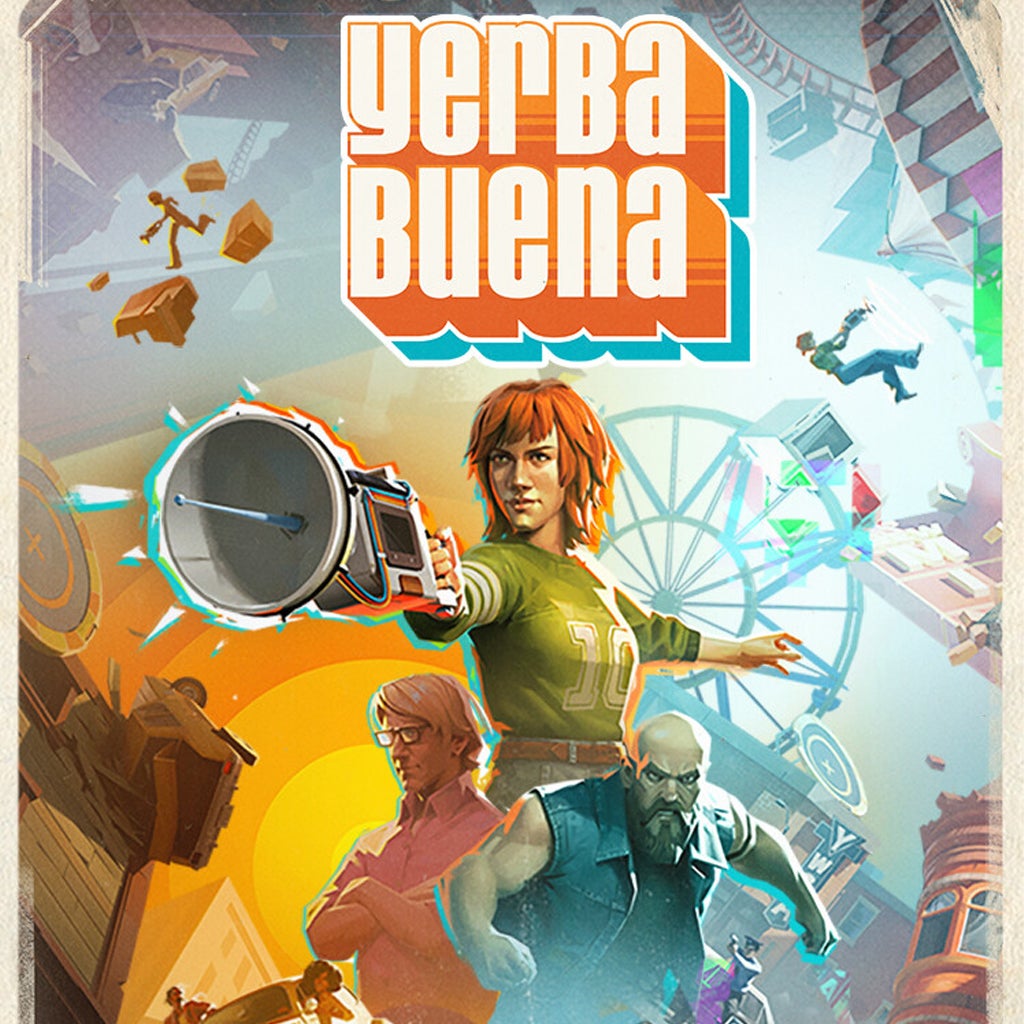
There is something immediately inviting about Yerba Buena. Before the reality-bending mechanics reveal themselves and the story disappears down its wonderfully strange rabbit hole, the game presents itself as a colourful slice of seventies nostalgia. Streets glow with painterly warmth, neighbourhoods pulse with personality, and protagonist Barb seems destined for a small, ordinary story. That illusion does not last long.
The game’s central twist arrives early and changes everything. Barb discovers she is not really a person at all, but an NPC trapped in an abandoned, deteriorating video game world. As corruption spreads across the city and reality begins to collapse around her, she is forced into the role of protagonist despite never having been written for it. It is a fascinating setup that instantly separates Yerba Buena from the crowd.
The game leans hard into that identity crisis, using both narrative and gameplay to reinforce the idea of a world that no longer understands its own rules. Sometimes that ambition works beautifully. Other times it feels awkward and uneven. Yet even at its weakest, Yerba Buena never feels uninteresting.
The Oscillator Is Pure Puzzle Brilliance
The beating heart of Yerba Buena is the Oscillator, a tool that defines the experience. Rather than simply moving objects or activating switches, the Oscillator lets players scan an object’s physical properties and apply them elsewhere. Momentum, bounce, density, speed, and directional force can all be copied and pasted into entirely new contexts. A trampoline’s elasticity can turn an ordinary platform into a springboard. A moving vehicle’s velocity can launch massive environmental structures across an entire street.
It sounds clever on paper, but the real joy comes from experimentation. The game gradually moves away from obvious solutions and encourages players to think laterally. Instead of asking what an object is, you begin asking what it can become.
That shift transforms puzzle-solving into creative problem-solving. Solutions stop feeling predetermined and start feeling discovered. It becomes less about finding the right answer and more about rewriting the rules until something works. Those moments are where Yerba Buena truly shines.
A Beautifully Broken San Francisco
The setting deserves enormous praise for carrying much of the game’s emotional weight. This version of seventies San Francisco feels like memory filtered through corruption. Warm retro aesthetics clash with digital instability. Entire neighbourhoods flicker with visual errors while reality tears itself apart at the edges. Buildings warp unexpectedly. Logic loops appear in everyday spaces. Streets feel familiar and alien at the same time.
The artistic direction commits fully to its surreal identity. Colours remain vibrant even as the world itself begins to fall apart. Psychedelic influences blend with retro design sensibilities to create environments that feel dreamlike without losing their sense of place.
Importantly, these visual ideas are not merely decorative. The glitching world directly informs exploration and puzzle design. Environmental instability constantly creates new opportunities and challenges, reinforcing the narrative themes through play itself. It gives the world remarkable cohesion.
Barb Never Quite Steps Into the Spotlight
The one area where Yerba Buena struggles most is its protagonist. Barb is intentionally ordinary. Her arc centres on becoming someone important after being background scenery. The problem is that the game occasionally leans too hard into that ordinariness.
She often feels passive during key moments, while the world around her does the heavier lifting. The setting, concepts, and supporting ideas leave stronger impressions than Barb herself.
This becomes increasingly noticeable as the narrative grows genuinely compelling. Around the middle, the story pivots into broader science-fiction territory and begins exploring identity, existence, and the nature of artificial worlds.
Those themes land surprisingly well. The writing becomes stranger, more ambitious, and more confident. Unfortunately, Barb never develops quite enough personality to anchor those ideas emotionally. She remains serviceable, but never unforgettable.
The Slow Start Holds It Back
Patience is required with Yerba Buena because the opening hours move at a frustrating pace. Early sections lean heavily on tutorials and tightly controlled puzzle spaces. Large portions unfold within amusement-park-themed areas that exist primarily to teach mechanics. They do their job, but they also hold the game back. The issue is not that these sections are bad. The issue is that the game becomes dramatically better later.
Once Yerba Buena stops explaining itself and starts trusting players, everything improves. Puzzle complexity expands, environmental interactions become more creative, and the narrative embraces its stranger ideas. It almost feels like two different games sharing the same structure. One is cautious and instructional. The other is imaginative and fearless. The second version is the one worth waiting for.
Wonderfully Strange Storytelling
The narrative often feels dreamlike in the best possible sense. Characters accept bizarre shifts in reality with remarkable calm. One antagonist can effectively reload saves after dying, and everyone simply accepts it as part of the world’s logic. Moments that should feel absurd somehow become strangely believable within this universe.
The writing embraces weirdness rather than apologising for it. Not every narrative leap lands perfectly. Certain scenes are difficult to interpret, and some character motivations remain fuzzy. Yet the game earns goodwill through sheer commitment to its identity. It refuses to become predictable. That confidence gives Yerba Buena a personality many puzzle games never achieve.
Exploration and Movement Stay Consistently Strong
Outside puzzle-solving, movement and exploration remain enjoyable throughout. Platforming avoids unnecessary frustration and focuses on fluid traversal through unusual spaces. The game recognises that environmental interaction is the real draw and never overwhelms players with excessive precision challenges.
Exploration consistently rewards curiosity. Hidden routes, alternative interactions, and environmental surprises appear regularly enough to encourage experimentation. The world feels designed for players who enjoy probing systems and asking “what happens if I try this?” Usually, the answer is unexpected. That sense of discovery carries the experience through its slower moments and helps maintain momentum even when the pacing stumbles.
Final Verdict
Yerba Buena is messy in ways that ambitious games often are. Its opening hours drag, Barb struggles to fully connect as a lead character, and parts of the narrative wander into territory that is hard to grasp.
Yet none of those flaws detract from what the game accomplishes elsewhere. The Oscillator is one of the smartest puzzle mechanics in recent memory. The world design is imaginative and visually striking. The later chapters embrace creativity with refreshing confidence.
Most importantly, Yerba Buena trusts players to experiment, break systems, and think differently. It values curiosity more than perfection. That spirit gives the game its soul. Beneath the glitches and strange logic lies a thoughtful puzzle adventure willing to take risks, and those risks are exactly what make it memorable.