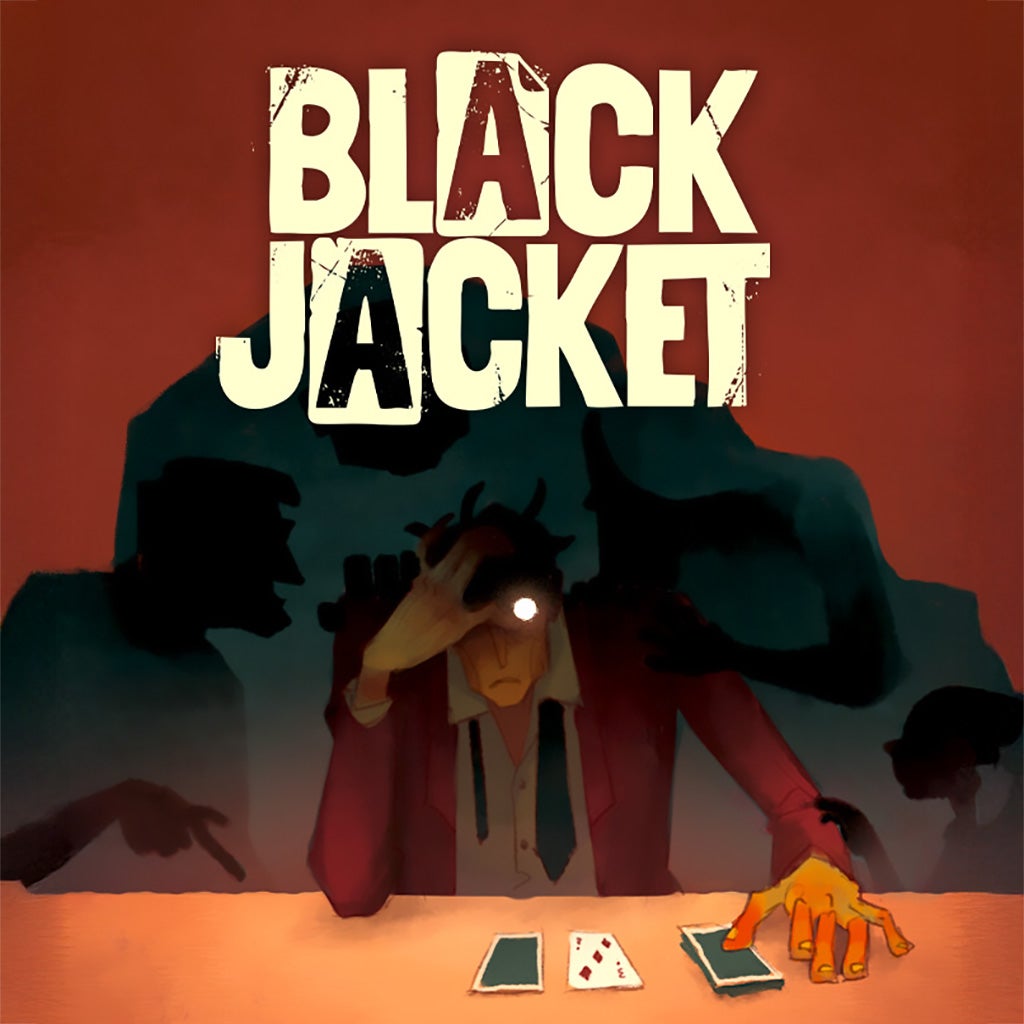
There is a strange kind of romance attached to card games. Not the glamorous version sold by casino advertisements, but the quieter image many of us carry from old films and late-night stories. A smoky room. Tired people hunched over cards as if their lives depended on them. The sound of fingertips tapping on wood as someone silently decides whether to risk everything on one final draw. Black Jacket captures that atmosphere perfectly.
Developed by Mi’pu’mi Games and published by Skystone Games, Black Jacket takes the familiar framework of blackjack and twists it into a roguelite deckbuilder steeped in guilt, desperation, and underworld mythology. Released on May 12, 2026, for PlayStation 5, Xbox Series X/S, Nintendo Switch, and PC, it invites comparisons to breakout strategy hits like Balatro, but it quickly proves it has its own identity. This is not a game about winning money. It is about survival. About bargaining your way through purgatory, one impossible hand at a time.
You play as a lost soul trapped in a grim afterlife casino, trying to earn enough coin to bribe the Ferryman and escape the cycle. Around you sit other damned figures, visible only by their hands resting on soot-covered tables. Their faces remain hidden. Their stories emerge slowly through play, subtle dialogue, and the ways they manipulate the game itself. The result is one of the most atmospheric deckbuilders released in recent memory.
Blackjack Reimagined
At first glance, Black Jacket appears simple. The foundation is still blackjack. Reach 21 without going over. Beat the dealer. Collect coins. But within minutes, the rules begin to fracture. Cards alter values mid-hand. Artifacts bend probabilities. Some abilities force opponents to draw additional cards against their will, while others let you swap values or manipulate hidden information before a reveal. Entire matches become less about gambling and more about engineering controlled chaos.
The brilliance of Black Jacket lies in how naturally these systems evolve. It never feels like complexity for its own sake. Every new mechanic expands your understanding of the table itself. One run might revolve around aggressive “Overcommit” strategies, forcing opponents into disastrous draws. Another might focus on precision deck manipulation, peeking ahead and orchestrating perfect combinations several turns in advance. Eventually, you stop thinking like a blackjack player and start thinking like a magician rigging the universe behind the curtain. Somehow, despite all the madness, the core simplicity of blackjack never disappears. That balance is incredibly difficult to achieve.
The Psychology of Risk
What truly elevates Black Jacket above many other roguelites is its grasp of tension. Most deckbuilders eventually become power fantasies. You stack synergies until victory feels inevitable. Black Jacket never lets that comfort settle. Even late in successful runs, there is always the sense that one reckless draw could unravel everything.
That lingering uncertainty gives every decision emotional weight. Do you play conservatively and survive another round, or risk a dangerous combo that could dramatically multiply your earnings? Do you spend precious coins on safer artefacts, or chase cursed items with a devastating upside? The game constantly tempts you into greed. Sometimes it rewards you for it. Sometimes it ruins you. That emotional push and pull becomes addictive.
It captures the dangerous thrill that real gambling games chase, but filters it through meaningful strategy rather than pure luck. Losses rarely feel unfair because you can usually trace them back to a decision you consciously made three turns earlier.
Souls Across the Table
One of Black Jacket’s smartest creative decisions is its refusal to fully reveal its characters. Your opponents exist mostly through gestures, voice lines, and playstyles. One spirit hesitates constantly, telegraphing insecurity with cautious draws. Another aggressively manipulates the deck with reckless confidence. Over time, their personalities emerge not through exposition dumps, but through how they play. This creates a strange intimacy.
You begin to recognise them before they even speak. Their hands become signatures. Their habits become tells. The writing itself is restrained yet effective. Rather than drowning the player in lore, the game allows mystery to linger in the air like cigarette smoke. Fragments of tragedy are scattered throughout these encounters, quiet reminders that everyone trapped here lost something before arriving at these tables. That subtle storytelling gives the world emotional texture without interrupting the pacing.
Style Written in Ash and Neon
Visually, Black Jacket is stunning in a grimy, understated way. The afterlife casino feels suspended between noir cinema and Eastern European folklore. Cards appear singed at the edges. Ash drifts through dimly lit rooms. Skeletal dealers move with stiff, unnatural precision, while warm orange light cuts through the darkness like dying embers. It is stylish without tipping into self-indulgence.
The animations also carry surprising weight. Cards slam against the table with sharp confidence. Winning hands land with satisfying force. Small visual flourishes constantly reinforce the tension of play.
The soundtrack deserves equal praise. Jazz-inspired instrumentals weave with low industrial ambience, creating a mood that feels melancholic rather than overtly sinister. It sounds like regret stretched across eternity.
A Roguelite That Respects Your Time
One of the most refreshing aspects of Black Jacket is its pacing. Runs feel substantial without becoming exhausting. Progression arrives steadily, unlocking new cards, artefacts, and rule variations at a satisfying pace. Even failed attempts usually reveal a new interaction or strategy worth experimenting with later.
Accessibility options are also excellent. High-contrast visuals, simplified controls, and flexible interface settings ensure the game remains approachable even as the strategic depth increases.
Importantly, the game never feels hostile to newcomers unfamiliar with blackjack. Early encounters gradually teach foundational concepts before introducing the more absurd mechanics. By the time the truly complex combinations emerge, you already understand the language the game speaks.
The Weight of One More Hand
Like many great roguelites, Black Jacket thrives on the dangerous illusion that the next run could be perfect. You tell yourself you will stop after one more attempt. Then another synergy appears. Another artefact changes your strategy entirely. Another opponent reveals a new facet of themselves through the cards they hold. Hours slip away quietly.
Yet beneath all the mechanical brilliance lies something more human. Black Jacket is ultimately about people trapped in cycles, desperately searching for ways to rewrite outcomes they no longer control. The card table simply becomes the place where those emotions manifest. That thematic consistency gives the experience unusual depth for the genre.
Final Verdict
Black Jacket takes a familiar casino game and transforms it into something deeply strategic, atmospheric, and emotionally absorbing. Its fusion of blackjack mechanics with roguelite deckbuilding creates a constant state of tension in which every draw feels meaningful and every risk carries weight.
More importantly, it understands the psychology of card games. The fear. The greed. The hope that one final hand might change everything. With exceptional atmosphere, clever systems, and a hauntingly stylish presentation, Black Jacket stands as one of the year’s most inventive indie strategy games.