Certain childhood creativity never really leaves us; it lingers in the paper aeroplanes we folded during quiet school afternoons, in the stickers we placed on multiple surfaces, including bedroom walls, books, and even the fridge, and in entire imaginary worlds we built beneath the kitchen table with nothing more than a blanket and a bit of stubborn belief. It is the kind of creativity that turns the ordinary into something vast, where a hallway becomes a canyon, and a cardboard box becomes a spaceship. Adrift Team clearly understands this feeling, not as nostalgia to be referenced, but as something to be lived again.
Launching this spring on PlayStation, after charming PC and Switch audiences in 2024, it takes those childhood instincts and builds an entire puzzle language around them. Everyday household spaces are reimagined as shifting gravitational playgrounds filled with drifting paper ships, improvised planetary forces, and playful experimentation that feels both familiar and freshly strange.
While it is, at its core, a physics-based puzzle game, it also carries something less tangible. It evokes that quiet, electric feeling of being small in a space you are still learning to understand, where imagination does most of the heavy lifting and every object feels as if it might secretly be part of a much larger universe.
A Household Turned Into a Universe
At first glance, Stickin’ the Landing looks almost disarmingly simple. You control a small paper spaceship drifting through handcrafted stages set in familiar domestic locations such as kitchens, bathrooms, gardens, and bedrooms. Instead of piloting the ship directly, you place stickers on the environment that generate gravitational pull. These “stickies” bend your trajectory, slingshot your craft around hazards, and guide you towards the goal. What could have been a neat gimmick quickly becomes the foundation for a surprisingly deep physics toybox.
The household setting is not merely decorative either. Every room feels reimagined through a child’s imagination. A kitchen becomes a planetary field of metallic objects and tight corridors. A bathroom turns into a slippery, awkward void where timing matters more than force. A garden opens into wider, calmer spaces that encourage experimentation. The familiarity of these environments makes the puzzle logic easier to grasp, even as the systems grow more complex. It is a clever trick. Comfort lowers the barrier to entry, but never at the cost of depth.
Sticker Physics and the Joy of Experimentation
The heart of the game lies in its gravitational sticker system. Each sticker placed on the map creates a force field that pulls your ship in a specific direction, with strength determined by its size and proximity. The result is a surprisingly faithful interpretation of Newtonian motion, wrapped in a playful, almost scrapbook-like presentation.
Small adjustments matter. A sticker placed a few pixels too close can overcorrect your trajectory. A slightly larger one can send you drifting far beyond your intended arc. Learning how forces interact becomes intuitive rather than mathematical. Crucially, the game never insists on a single solution. It actively encourages improvisation.
Some players will craft elegant orbital paths that look almost scientific in their precision. Others will cobble together chaotic sequences of gravitational nudges that somehow, miraculously, work. Both approaches are valid. That freedom gives each level a personal quality, as if the solution belongs to the player rather than the designer. It is this openness that keeps experimentation engaging well into the later stages.
Level Design Built on Curiosity
Across more than 120 handcrafted levels, Stickin’ the Landing gradually and thoughtfully increases its difficulty. Early puzzles serve as gentle introductions, teaching you how gravity behaves without ever overwhelming you with terminology or rigid rules.
Later stages layer mechanics in more creative ways. Moving obstacles force you to adjust your mid-flight plans. Hidden stars tucked into awkward corners reward curiosity and risk-taking. Secret levels add optional challenges that feel almost like rewards for those willing to rethink earlier solutions.
What stands out most is how readable everything remains. Even when a level becomes complex, you rarely feel lost. Failures almost always feel like miscalculations rather than confusion, which is crucial for maintaining momentum in a physics-based puzzle game. The learning curve is steady, and, more importantly, it feels fair.
Presentation That Feels Handmade
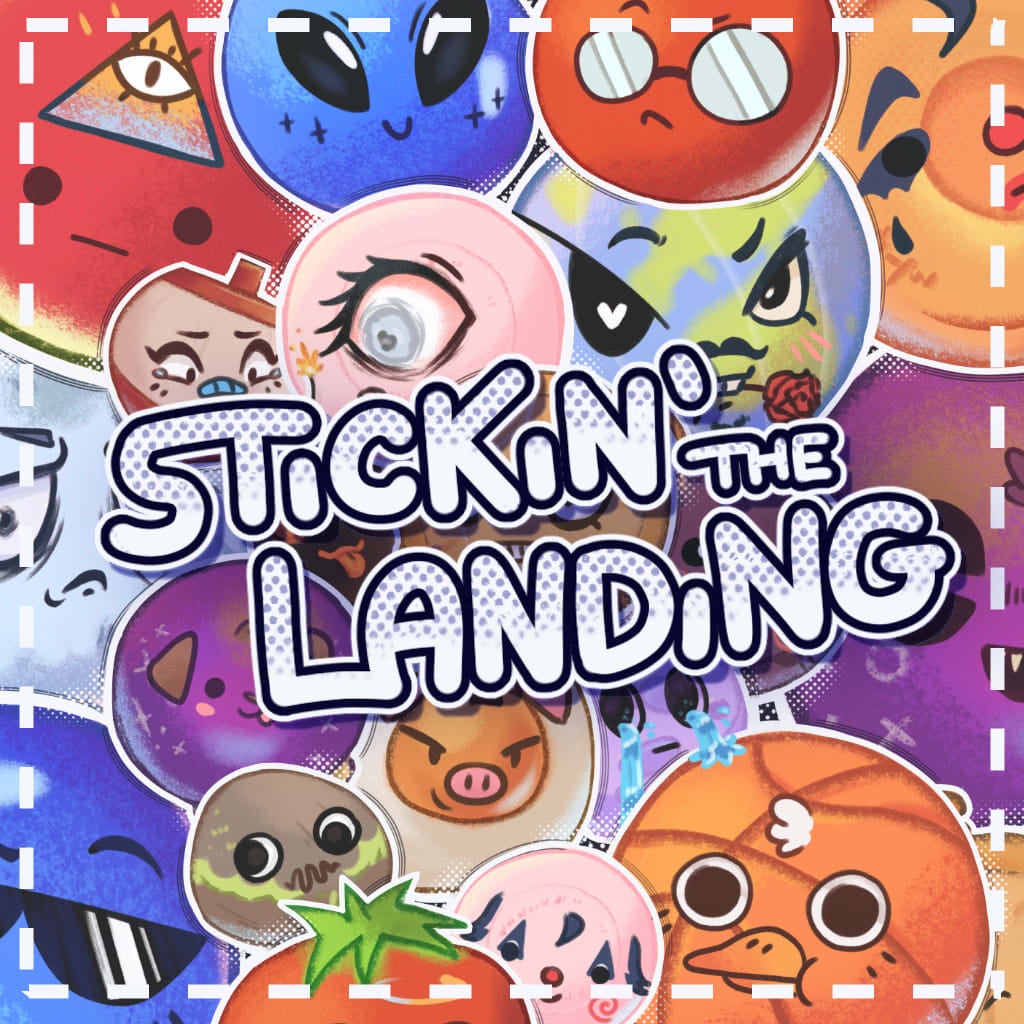
Visually, Stickin’ the Landing embraces a warm, handcrafted aesthetic that feels like a blend of sketchbook doodles and DIY flipbooks. Nothing feels sterile or overly polished. Stickers wobble slightly. The ship crumples gently when it crashes. Even UI elements feel as if they were cut and pasted by hand. The emotional tone this creates is surprisingly strong. Instead of tension or frustration, there is a sense of playfulness that carries through even the more difficult puzzles.
The soundtrack complements this beautifully. Soft, whimsical melodies sit in the background without demanding attention. It is the kind of music that fades into your thoughts rather than pulling you out of them, reinforcing the game’s meditative quality. Everything feels designed to make experimentation comfortable.
A Relaxed but Occasionally Tricky Challenge
One of the game’s greatest strengths is also the source of occasional friction. Because Stickin’ the Landing is built around trial and error, some later puzzles can drift into slightly fiddly territory. Small placement mistakes may require several restarts to correct, even if you understand the solution conceptually.
Thankfully, the game is extremely forgiving. Instant resets remove frustration almost entirely, allowing you to iterate quickly without penalty. There is no punishment loop, no loss of progress, and no pressure beyond your own curiosity.
Still, players expecting a purely relaxing experience may find a few later stages more demanding than expected. That tension between relaxation and precision is where the game finds its identity.
Final Verdict
Stickin’ the Landing succeeds because it understands that puzzles are not just about logic but about imagination. It turns a simple gravitational mechanic into a playground of creative solutions, wrapped in a warm, handcrafted aesthetic that retains its charm.
It may not reinvent the genre, and a handful of later puzzles can feel slightly finicky, but its openness, personality, and sense of discovery carry it well beyond its humble premise. This is a game about turning ordinary spaces into something extraordinary, and it captures that feeling with genuine heart.