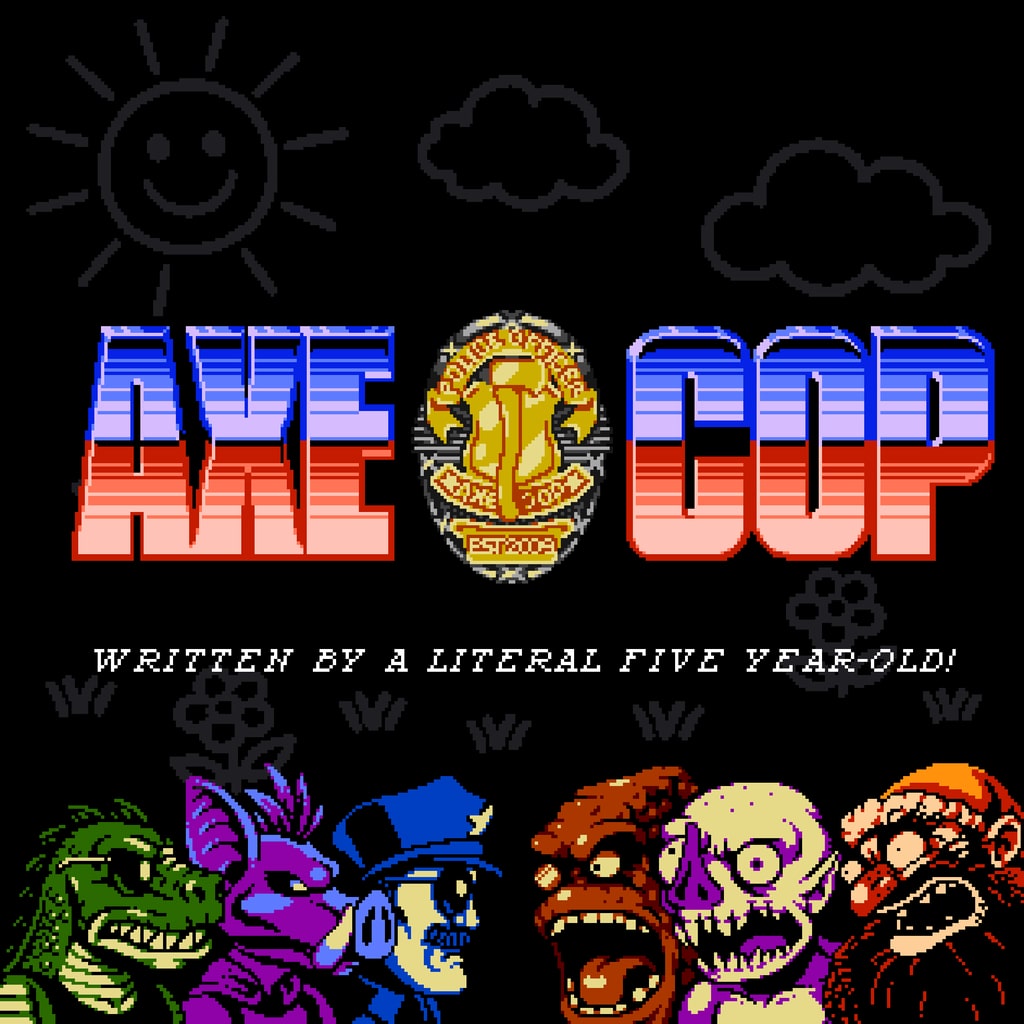
Developed by Red Triangle Games and brought to consoles by Electric Airship and Penguin Pop Games LLC, Axe Cop finally made its wider debut in 2026, after first appearing on PC years earlier. It is based on the webcomic created by Malachai Nicolle, who, at the time of its conception, was five years old. That detail is not a novelty. It is the entire foundation of the game.
You play as Axe Cop, a hero who found his axe at a crime scene and decided that was enough to qualify him as the greatest law enforcer imaginable. From there, things escalate quickly. Dinosaurs join the team. Villains appear with names that sound like they were shouted across a playground. Logic bends, breaks, and disappears entirely.
The central plot revolves around collecting magic gems to power a machine that can turn bad guys into good guys. It sounds simple, but the journey between those points is anything but.
Gameplay
At its core, Axe Cop is a turn-based RPG in the classic mould. You build a party, engage in battles, level up, and unlock abilities. On a mechanical level, it is familiar territory, drawing clear inspiration from older handheld and console RPGs.
Combat is straightforward yet functional. Each character brings a unique set of abilities, ranging from practical to completely absurd. One might deal heavy damage. Another might throw a remote-controlled sock. Yet another might rely on music as a weapon. It is not about balance in the traditional sense. It is about variety and unpredictability.
The systems are easy to grasp, which works in the game’s favour. There is no need for complex tutorials or deep optimisation. You understand the rules quickly, allowing the focus to shift towards the experience itself rather than the mechanics.
That said, the simplicity can sometimes feel limiting. Battles rarely evolve beyond their initial structure, and while new abilities add flavour, they do not dramatically change the flow of combat. For players seeking strategic depth, the game may feel a bit too light.
Where Axe Cop succeeds is in how it integrates its mechanics with its tone. The unpredictability of the narrative carries over into combat in small but meaningful ways. You are never entirely sure what the next ability will do or how the next encounter will play out.
Writing and Tone
The writing is the reason Axe Cop exists, and it is also the reason it works. There is a purity to its absurdity that feels genuine rather than forced. Because the story originates in a child’s imagination, it avoids the self-aware humour that often defines parody. It is not trying to be clever. It simply is what it is.
Characters are introduced without warning, often with little explanation. Locations shift abruptly. One moment you are in a volcano filled with dinosaurs, the next you are inside a giant monster, and then suddenly you are in London. The game does not pause to justify these transitions. It moves forward with complete confidence, trusting you to keep up or simply accept the chaos.
Dialogue reflects this same energy. Conversations jump between ideas, ignore conventional structure, and often resolve in ways that feel disconnected from how they began. It creates a sense of constant surprise, even if that surprise is sometimes nonsensical.
What makes it effective is that it never feels cynical. There is no sense that the game is mocking its own premise. Instead, it embraces it fully, allowing the humour to emerge naturally from its unpredictability.
World and Presentation
Visually, Axe Cop leans into a retro aesthetic that suits its mechanical simplicity. Environments are colourful and varied, reflecting the wide range of locations drawn from the comic’s universe.
Character designs are intentionally exaggerated, often bordering on the ridiculous. This works in the game’s favour, reinforcing the tone and ensuring that every new addition to your party or every new enemy feels distinct.
The presentation is not technically impressive, but it does not need to be. It understands its identity and sticks to it. There is a consistency in how everything is presented that helps ground the otherwise chaotic experience.
Music and sound design follow a similar approach. Tracks are upbeat and energetic, supporting the game’s pace without drawing too much attention to themselves. Sound effects are simple but effective, adding a layer of feedback that keeps combat engaging.
Structure and Pacing
Axe Cop moves quickly. The story rarely lingers in one place for long, which helps maintain momentum. There is always something new happening, whether it is a new character, a new location, or a sudden shift in narrative direction.
This pacing works well for shorter sessions. It keeps the experience fresh and prevents repetition from becoming too noticeable. However, over longer play sessions, the lack of structure can feel a bit overwhelming.
Because the game does not follow a traditional narrative arc, it can sometimes feel like a series of loosely connected events rather than a cohesive journey. This is not necessarily a flaw, but it does affect how the story is experienced.
Final Verdict
Axe Cop is not a traditional RPG, even if it adopts its structure. It is an experiment in creativity, a game built on the idea that imagination does not need rules to be engaging.
Its mechanics are simple, sometimes to a fault, and its narrative can feel chaotic, challenging conventional storytelling. Yet within that chaos lies something genuinely refreshing. It is funny without trying too hard, unpredictable without feeling random, and consistently entertaining in an effortless way.
For players seeking deep systems and carefully constructed narratives, it may not fully satisfy. But for those willing to embrace its energy, it offers something rare. A reminder that games do not always need to make sense to be memorable.