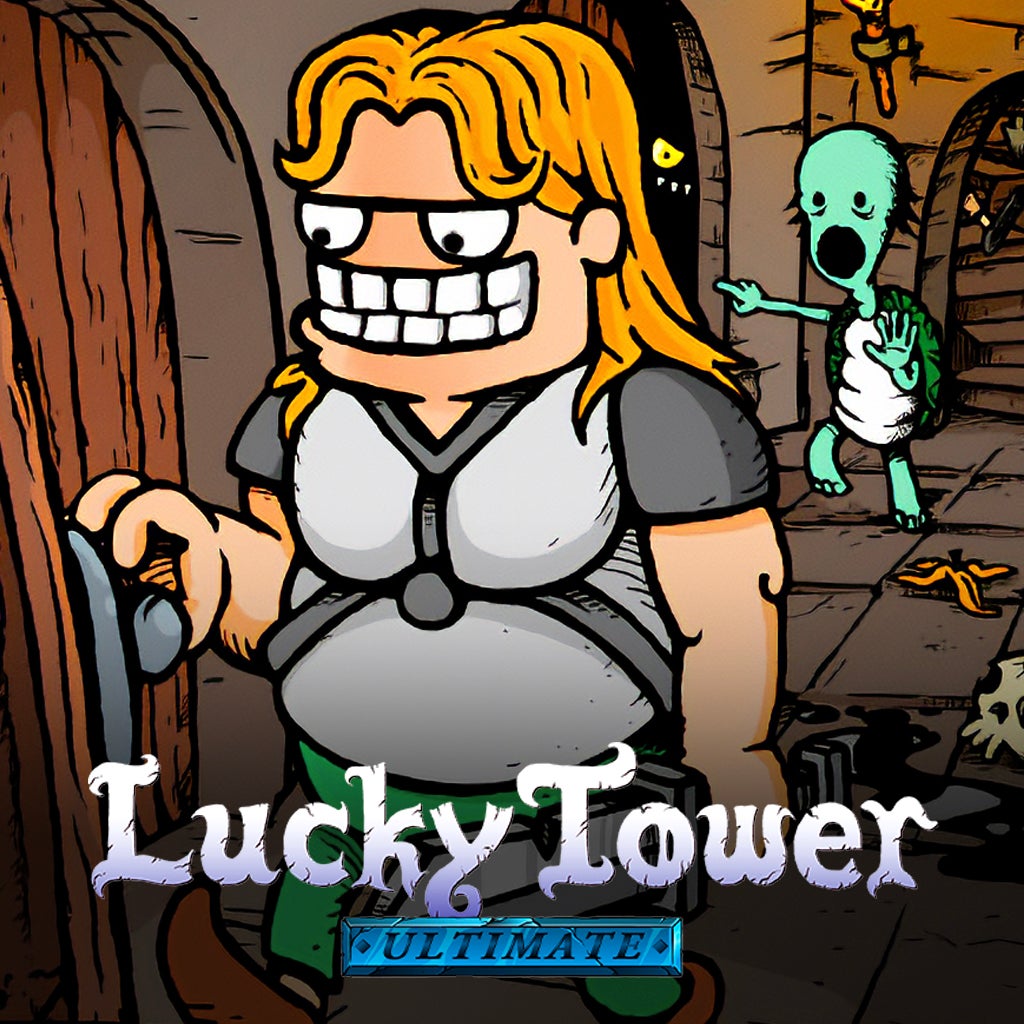
There are games that challenge your skill, and then there are games that delight in dismantling your expectations. Lucky Tower Ultimate, developed by Studio Seufz and published by AMC Games, sits firmly in the latter camp.
With its full 1.0 release, this long-evolving project finally feels complete. It expands far beyond its origins as a simple “choose a door and hope” Flash concept, transforming into a chaotic roguelike adventure packed with slapstick humour, systemic experimentation, and a surprising amount of long-term progression.
What makes it stand out is not just its difficulty or randomness. It is the way it weaponises both against you.
“Lucky Tower Ultimate is a game where success feels accidental, failure feels inevitable, and both are equally funny.”
The Tower That Refuses to Play Fair
At its core, Lucky Tower Ultimate is about survival through improvisation. You play as the gloriously self-obsessed knight Von Wanst, dropped into a constantly shifting tower with little more than your wits and whatever objects you can grab along the way.
The structure is deceptively simple. Move from room to room, avoid traps, deal with enemies, and try to find a way out. But the execution is anything but straightforward.
Rooms are unpredictable. A seemingly harmless door might lead to treasure, or drop you directly into a lethal trap. Enemies behave erratically. Items can be useful, useless, or actively dangerous, depending on context.
The game thrives on uncertainty. It does not want you to feel comfortable. It wants you to adapt.
Improvisation as a Core Mechanic
What elevates the experience is the systems’ flexibility. Almost everything can be used as a weapon. Vegetables, furniture, enemy corpses, it all becomes part of your toolkit.
This creates a constant sense of possibility. You are rarely stuck for a specific item. Instead, you are challenged to rethink what you already have.
Combat itself is intentionally scrappy. It is less about precision and more about opportunism. Knock an enemy into a trap. Throw an object to create space. Use the environment to your advantage.
The result is a game that feels less like a traditional action title and more like a sandbox of chaotic interactions.
Death as Progression
You will die. Often. Frequently, suddenly, sometimes unfairly, and occasionally in ways that feel almost comical in their inevitability.
But death is not the end. It is part of the loop.
Each run teaches you something. A trap pattern. An enemy’s behaviour. A subtle environmental cue. Over time, what initially feels random begins to reveal structure.
Escaping the tower is only the beginning. Doing so unlocks the village hub, a meta-progression layer where you can upgrade, customise, and interact with a growing cast of characters.
This shift is crucial. It gives the game a sense of forward momentum that offsets its punishing design.
The Village and Long Term Goals
The addition of the village hub in the full release adds depth that earlier versions lacked. It serves as both a reward and a motivator.
Here, you can engage in commerce, customise your home, and build relationships with companions. These companions are more than allies. They have their own quests, personalities, and reactions to your behaviour.
Treat them well, and they may assist you. Mistreat them, and they might turn against you. This dynamic adds a layer of unpredictability that extends beyond the tower itself.
The endgame content introduced in version 1.0 ties everything together. The overarching goal of fulfilling Von Wanst’s so-called destiny, brewing a legendary potion, and confronting Evelius gives the experience a narrative anchor.
It is still absurd, still comedic, but now it feels complete.
A World That Reacts
One of the most interesting aspects of Lucky Tower Ultimate is its reactivity. Characters remember your actions. Systems intersect in unexpected ways. Small decisions can have delayed consequences.
This creates a sense of cohesion that contrasts with the game’s chaotic surface. Beneath the randomness lies a network of rules and interactions that reward observation.
It is not just about surviving individual rooms. It is about understanding how the world responds to you.
Presentation and Personality
Visually, the game adopts a hand-drawn style that leans heavily into caricature and exaggeration. Characters are expressive, environments are lively, and animations emphasise physical comedy.
The tone is consistent throughout. Everything feels slightly absurd, off-kilter, and intentionally playful.
The addition of over 600 new voice lines in the 1.0 release enhances this further. Dialogue is sharp, often self-aware, and delivered with a comedic rhythm that reinforces the game’s identity.
Sound design complements this approach. Impacts are exaggerated, traps are noisy, and every action feels slightly theatrical.
It is a game that knows it is ridiculous and leans into that fully.
Where It Frustrates
For all its strengths, Lucky Tower Ultimate can be frustrating.
The randomness, while central to its design, can occasionally feel excessive. At times, failure feels less like a learning experience and more like bad luck.
This is especially noticeable in early runs, where a lack of knowledge, combined with unpredictable room generation, can lead to abrupt and unsatisfying endings.
The interface can also feel cluttered at times, particularly when managing inventory or navigating the village systems. It is functional, but not always elegant.
Additionally, while the humour is a major strength, it may not resonate with everyone. Its reliance on slapstick and absurdity can feel repetitive over longer sessions.
A Cult Classic Fully Realised
What Lucky Tower Ultimate ultimately achieves is a refinement of its identity. It takes a simple concept, three doors and uncertain outcomes, and expands it into a fully fledged roguelike experience without losing its core unpredictability.
It does not attempt to smooth out its rough edges. Instead, it embraces them, turning frustration into part of the experience.
This approach will not appeal to everyone. It demands patience, resilience, and a willingness to laugh at your own failures.
But for those who engage with its systems, it offers a uniquely chaotic and rewarding loop.
Final Verdict
Lucky Tower Ultimate is a bold, unapologetically unpredictable roguelike that thrives on experimentation, failure, and absurdity. Its expanded systems and endgame content lend it a sense of completeness, while its reactive world and flexible mechanics keep each run engaging.
It is not always fair, nor is it always smooth, but it is consistently distinctive.