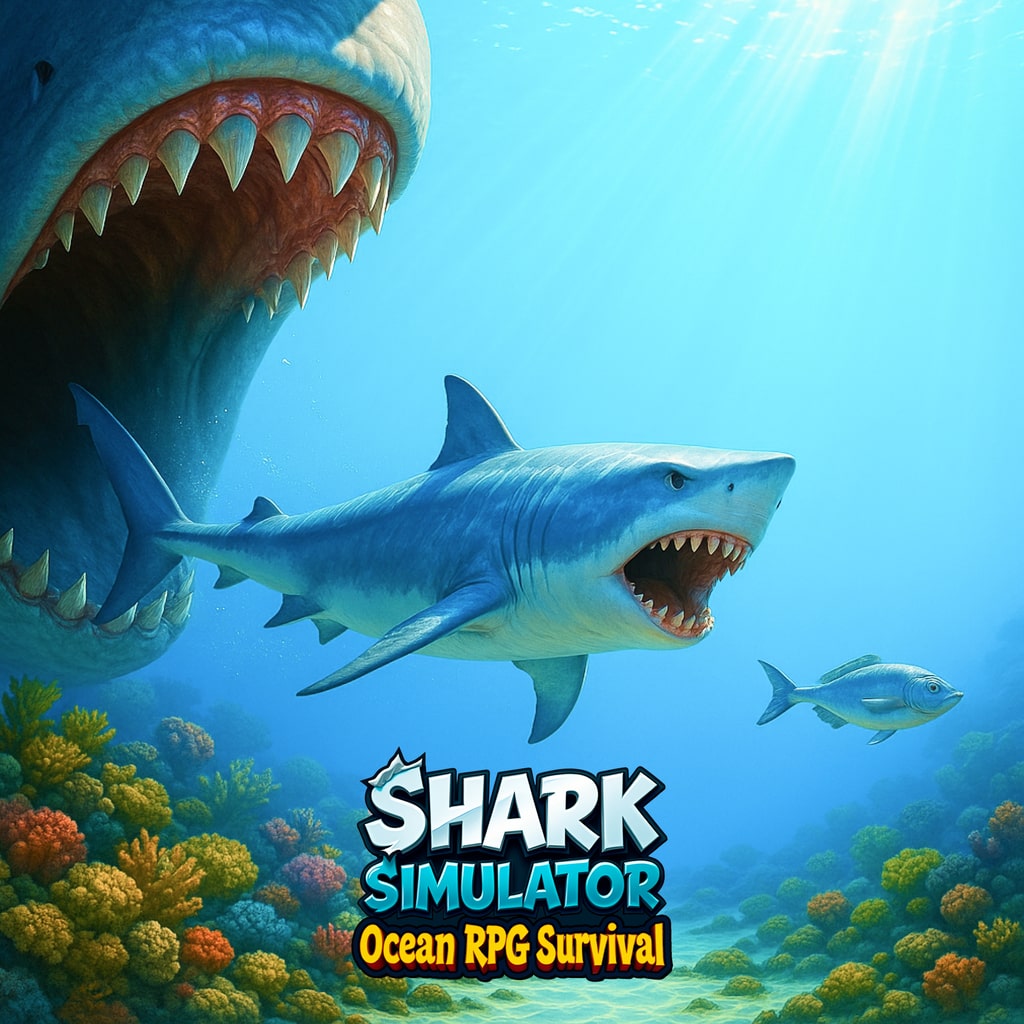
There’s something inherently compelling about the fantasy of playing as a shark. It taps into a primal, power-driven fantasy—gliding through the water, hunting prey, and rising to the top of the food chain. Games like Maneater have shown how entertaining that concept can be when paired with tight mechanics and a sense of progression. Shark Simulator: Ocean RPG Survival, however, takes a far more stripped-back approach, delivering a budget-friendly arcade experience that only occasionally aligns with its more ambitious “RPG survival” branding.
Originally released on Nintendo Switch in late 2024 and now making its way to PlayStation 4 in 2026, this latest version offers little in the way of meaningful expansion. What you get is a simple, pick-up-and-play predator simulator that prioritises accessibility over depth—for better and for worse.
A Predator in a Shallow Sea
At its core, Shark Simulator is about one thing: eat or be eaten. You begin as a relatively weak shark, tasked with hunting smaller fish, completing basic objectives, and gradually growing stronger. It’s a loop that feels instantly familiar—consume, upgrade, repeat—but, unlike more fleshed-out titles in the genre, the systems here are notably thin.
Movement is fluid enough, with responsive controls that make swimming through the water feel smooth, if not particularly nuanced. Attacking prey is similarly straightforward: lock on, dash forward, and bite. There’s a certain satisfaction in chaining together successful hunts, especially early on, when every meal feels like progress.
However, the illusion of a “living ocean” quickly begins to fade. The environments, while initially appealing, lack the dynamism needed to sustain long-term engagement. Fish follow predictable patterns, enemy encounters rarely surprise, and the ecosystem never quite feels like it reacts to your presence in a meaningful way.
RPG in Name Only
Despite its title, Shark Simulator’s RPG elements are extremely light. Yes, you can upgrade your shark’s stats—speed, bite power, endurance and unlock different shark species, but these systems are more incremental than transformative.
There’s little sense of build diversity or playstyle evolution. Upgrades simply make you better at what you were already doing, rather than opening up new strategies or mechanics. Unlocking new sharks should feel like a milestone, but in practice it often amounts to a slight statistical bump rather than a game-changing shift.
Missions, too, are fairly basic. Tasks typically involve hunting a set number of creatures or reaching a designated area. While they provide structure, they rarely challenge the player in meaningful ways. There’s little narrative context or progression beyond the mechanical loop, which makes the experience feel somewhat hollow over time.
Bite-Sized Fun
That said, Shark Simulator isn’t without its charms. When approached as a casual arcade experience, it can be surprisingly enjoyable in short bursts. There’s a relaxing rhythm to swimming through coral reefs, hunting schools of fish, and steadily upgrading your predator.
The game doesn’t demand much of the player, which can be a strength. There’s no steep learning curve, no punishing systems, and no pressure to optimise every decision. It’s the kind of game you can dip into for 20 minutes, unwind, and move on.
Visually, the underwater environments are colourful and clear, even if they lack detail. Coral reefs, caves, and lagoons are all present and accounted for, and while they don’t push the hardware in any meaningful way, they serve their purpose. The audio design is similarly functional, with ambient ocean sounds and subtle effects that reinforce the setting without standing out.
Where It Falls Short
The biggest issue with Shark Simulator is repetition. Without meaningful variation in gameplay, objectives, or environments, the experience quickly feels stale. What starts as a satisfying loop gradually becomes a grind, with little incentive to push forward beyond completion.
The lack of challenge also plays a role. Enemy encounters rarely demand strategic thinking, and once you’ve upgraded your shark to a certain point, the sense of danger largely disappears. There’s no real tension, no moments of surprise—just a steady, predictable climb to the top.
Performance is generally stable, particularly on PlayStation 4, but the game’s simplicity means it never really has the opportunity to impress on a technical level. This is very much a budget title, and it shows in both scope and execution.
A Missed Opportunity Beneath the Surface
Perhaps the most frustrating aspect of Shark Simulator is its sense of untapped potential. The idea of a shark-focused RPG survival game is inherently appealing, yet here it feels as if the concept was only explored at a surface level.
Imagine a deeper ecosystem, where different species interact dynamically. Imagine meaningful choices in how you evolve your shark, or a narrative that gives context to your rise through the food chain. These elements aren’t entirely absent—they’re simply underdeveloped.
As it stands, the game feels like a foundation rather than a fully realised experience. There’s enough here to entertain for a while, but not enough to leave a lasting impression.
Final Verdict
Shark Simulator: Ocean RPG Survival is a perfectly serviceable budget title that delivers on its most basic promise: letting you play as a shark and eat things. For players seeking a simple, low-commitment experience, it offers a few hours of light, undemanding fun.
However, its lack of depth, repetitive gameplay, and underwhelming progression systems keep it from rising above mediocrity. The “RPG survival” label sets expectations the game simply doesn’t meet, and while it can be enjoyable in short sessions, it struggles to sustain interest over time.
There’s a good game lurking beneath the surface here—but in its current form, it never quite breaks through.