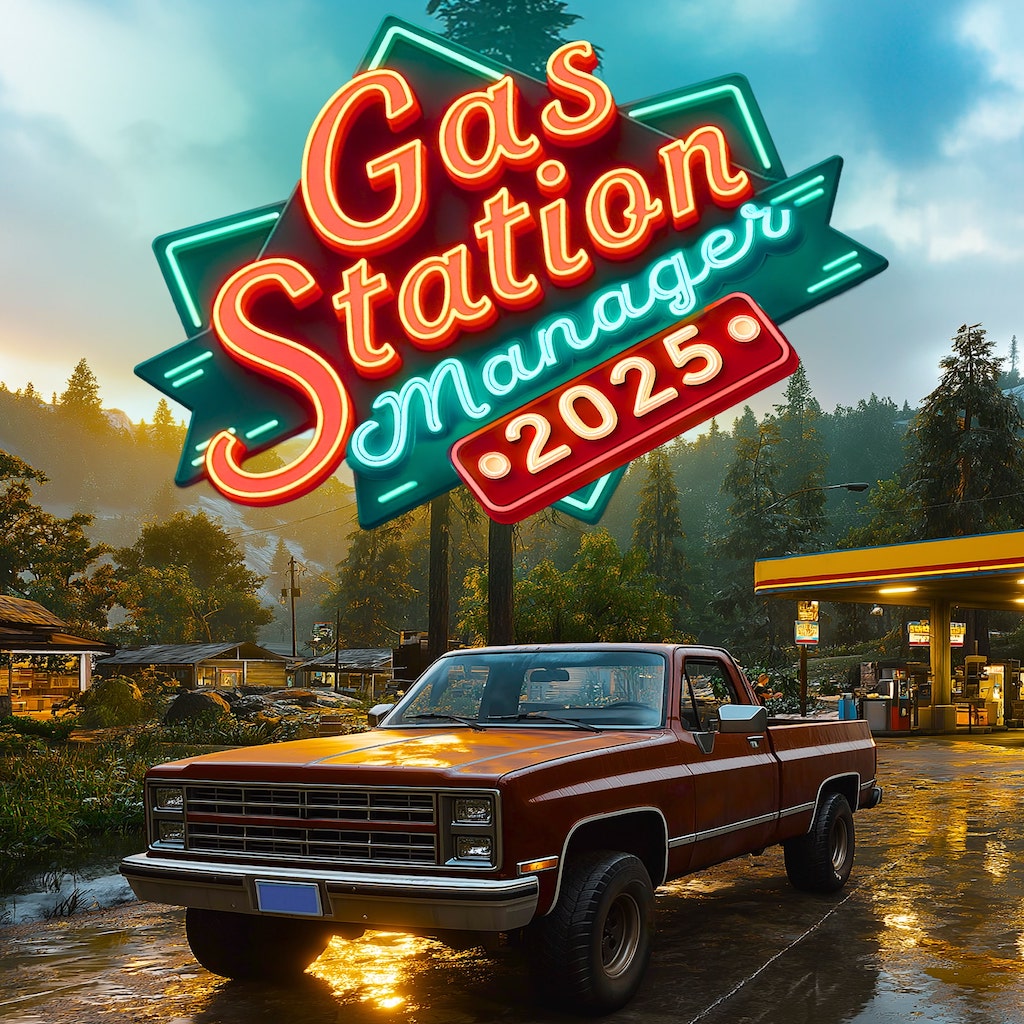
Simulation games have increasingly found success in exploring the mundane — turning everyday jobs into surprisingly compelling gameplay loops. From power washing patios to organizing supermarkets, the appeal lies in transforming routine labor into structured progression and satisfaction-driven design. Gas Station Manager 2026, developed and published by Christopher Ikeda, arrives squarely within that niche, inviting players to build a roadside business from dust and rust into a thriving commercial hub.
Released February 25, 2026 for PlayStation 4 and PlayStation 5, this console-focused management sim stands apart from similarly named PC titles by being designed specifically for controllers rather than adapted from keyboard-heavy systems. The result is a game that aims to balance hands-on job simulation with accessible business management — sometimes successfully, sometimes unevenly, but rarely without charm.
From Abandoned Stop to Roadside Empire
The premise is refreshingly simple. You inherit a forgotten gas station somewhere along a lonely highway — a place buried under sand, graffiti, and neglect. Nothing works properly. Pumps are broken, shelves are empty, trash piles everywhere, and customers certainly aren’t stopping by.
Your first hours are less about management and more about restoration.
You scrub walls.
You repaint surfaces.
You repair equipment piece by piece.
These opening moments establish one of the game’s strongest hooks: visible transformation. Every cleaned surface and repaired structure directly changes the environment, giving a tangible sense of progress that many management sims struggle to achieve early on.
Watching the station slowly come alive is deeply satisfying. What begins as a near-abandoned shack gradually becomes recognizable as a functioning business — and eventually something far larger.
You’re Not the Boss — Yet
Unlike traditional tycoon games where players operate through menus and spreadsheets, Gas Station Manager 2026 places you directly inside the action in first-person perspective.
Early gameplay requires you to personally handle nearly every task:
- Pumping fuel for customers
- Operating the checkout register
- Restocking shelves
- Cleaning restrooms
- Collecting trash
- Managing deliveries
This hands-on approach creates strong immersion. You aren’t overseeing operations from above; you are the workforce.
The pacing initially feels hectic but intentionally so. Customers arrive simultaneously, forcing prioritization decisions. Do you serve fuel customers first for quick profit? Restock snacks before shelves empty? Clean messes to maintain ratings?
These small choices give the simulation surprising tension.
The Management Layer Slowly Emerges
As profits begin rolling in, the game gradually shifts from job simulator to business management experience.
Hiring staff marks the turning point.
AI employees can be assigned roles such as cashier, cleaner, or pump attendant, freeing you to focus on expansion planning rather than constant manual labor. This transition feels rewarding because automation is earned rather than granted.
Expansion options include:
- Building a car wash
- Adding a repair garage
- Expanding the convenience store
- Unlocking premium inventory
- Upgrading fuel capacity
Each addition introduces new systems and revenue streams, creating a satisfying feedback loop between investment and growth.
However, expansion also increases complexity. More customers mean more logistics, and poor planning can quickly overwhelm your operation.
Inventory Management: The Real Challenge
Where the game truly finds depth is inventory control.
Running out of fuel or popular items isn’t merely inconvenient — it directly impacts customer satisfaction and long-term reputation. Holiday rushes or sudden demand spikes force players to anticipate needs rather than react to problems.
Ordering stock becomes a balancing act:
- Overstock wastes money and space.
- Understock damages ratings.
- Late deliveries cause chaos during busy periods.
This economic layer adds genuine strategy beneath the relaxed exterior. Players who enjoy optimization will find plenty to manage as profits scale upward.
Console Design Done Right
One of the game’s biggest strengths is its console-first design philosophy.
Many simulation games struggle on controllers, but Gas Station Manager 2026 avoids that pitfall through smart interface decisions:
- Radial menus allow quick tool switching.
- Clear icons minimize menu navigation.
- Context-sensitive prompts reduce clutter.
- Controls remain consistent across tasks.
The result is a smooth experience that feels natural on DualShock and DualSense controllers.
Performance on PS5 is stable, with sharp textures and fast loading times. While visuals aren’t cutting-edge, they are clean and functional, emphasizing readability over realism — a wise choice for a management game.
Relaxing… Until It Isn’t
The tone sits somewhere between cozy and chaotic.
Cleaning mechanics provide almost meditative satisfaction, especially when restoring heavily damaged areas. Yet peak hours introduce frantic multitasking that can border on stressful — particularly before hiring enough staff.
This duality becomes part of the appeal. The game constantly alternates between calm upkeep and bursts of pressure, mirroring real retail rhythm surprisingly well.
Still, pacing occasionally falters. Some early tasks repeat too frequently, and progression toward automation can feel slightly slow. Players expecting immediate managerial control may find the early grind repetitive.
Presentation and Atmosphere
Visually, the game adopts a modest but effective style. Environments are bright and readable, with clear visual feedback when tasks are completed.
Sound design plays a bigger role than expected:
- Fuel pumps click satisfyingly.
- Registers beep rhythmically.
- Cleaning sounds reinforce progress.
These subtle touches enhance immersion and contribute to the game’s oddly relaxing atmosphere.
Music remains minimal, allowing ambient sounds to carry the experience — fitting for a quiet roadside setting.
Where It Falls Short
Despite strong fundamentals, several issues prevent greatness.
Limited Environmental Variety
Most gameplay occurs within the same station environment, which can feel repetitive over long sessions.
AI Behavior
Staff occasionally struggle with pathfinding or task prioritization, requiring manual intervention.
Shallow Late-Game Systems
While expansion is enjoyable, deeper economic systems or competitor mechanics would add longevity.
Visual Simplicity
Functional but basic visuals may disappoint players expecting modern simulation polish.
None of these problems break the experience, but they reveal its indie scope.
The Appeal of Small Successes
What Gas Station Manager 2026 understands better than many sims is the psychology of incremental progress.
Every improvement feels earned:
- A cleaner store attracts more customers.
- Better stock increases profits.
- Automation reduces stress.
It turns ordinary work into a rewarding loop built around visible achievement. The joy comes not from spectacle, but from gradual mastery.
And sometimes, that’s exactly what players want.
Pros & Cons
Pros
- ✔ Strong sense of progression and restoration
- ✔ Hands-on gameplay creates immersion
- ✔ Controller-friendly console design
- ✔ Relaxing yet engaging management loop
- ✔ Meaningful upgrades and expansion systems
- ✔ Satisfying cleaning and maintenance mechanics
Cons
- ✘ Repetitive early-game tasks
- ✘ Occasional AI inefficiencies
- ✘ Limited environmental variety
- ✘ Late-game depth could be stronger
Final Verdict
Gas Station Manager 2026 succeeds by embracing simplicity and execution over ambition. It doesn’t reinvent the management genre, but it delivers a polished, accessible simulation that feels perfectly suited to console play.
Its strongest moments come from transformation — turning decay into prosperity through steady effort and smart planning. While repetition and limited scope occasionally hold it back, the satisfying gameplay loop keeps pulling you back for “just one more upgrade.”
For fans of job simulators and casual management games, this is an easy recommendation.