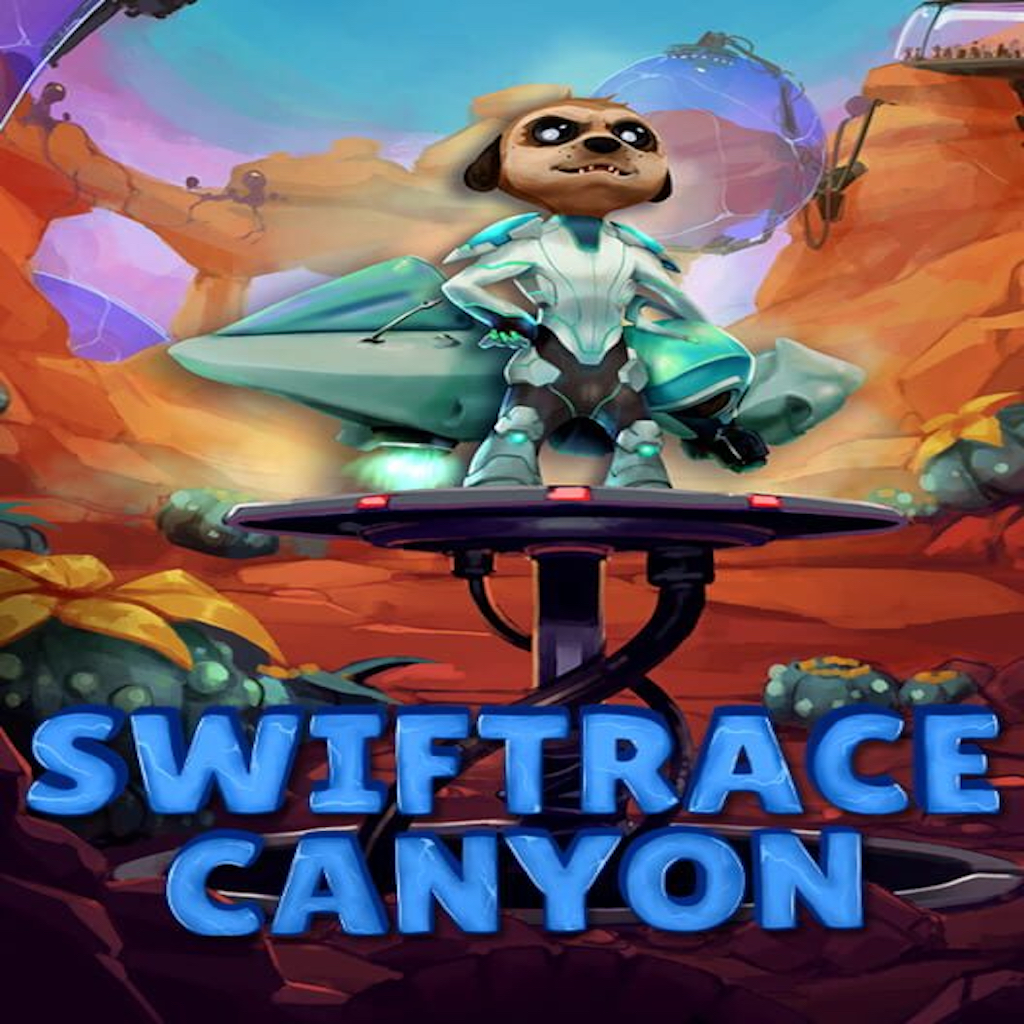
Every so often, a small indie project appears that feels less like a traditional game release and more like a proof-of-concept for an entirely new genre hybrid. Swiftrace Canyon, developed by Lucerne-based studio Optimotter and released February 20, 2026 on PC, fits squarely into that category.
Originally conceived as a graduation thesis at the Lucerne University of Applied Sciences and Arts, the game has rapidly grown beyond its academic origins into a cult hit among speedrunning and time-attack communities. Its pitch sounds simple — ride a hoverbike through desert canyons collecting flags — but the execution blends 3D platforming, physics experimentation, and racing design into something refreshingly original.
Rather than asking players to follow tracks, Swiftrace Canyon asks them to invent routes, master momentum, and push movement systems to their absolute limits. The result is a deceptively small game with an enormous skill ceiling.
Concept & Setting
Set within a stylized canyon world inhabited by a technologically advanced meerkat tribe, Swiftrace Canyon immediately establishes a playful tone. You play as one of these tiny racers piloting a customizable hoverbike across sprawling rocky arenas, caves, and desert structures.
The premise remains intentionally lighthearted. There’s no grand narrative or dramatic stakes — only competition, mastery, and exploration. The world exists primarily as a playground for movement experimentation.
This minimalist storytelling works well because the game’s identity revolves around mechanical expression rather than progression drama. The charming meerkat aesthetic softens what could otherwise feel like a sterile physics simulator, giving personality to repeated runs.
Unlockable skins and accessories add light customization, reinforcing the sense that this is a sport practiced by a quirky community rather than a serious sci-fi universe.
Gameplay — Racing Without Roads
The defining feature of Swiftrace Canyon is its non-linear arena racing.
Instead of fixed tracks, each level functions as an open sandbox filled with flags that must be collected before reaching the finish line. The order is entirely up to you.
This design fundamentally changes racing psychology.
Rather than memorizing corners, players ask:
- Which flags should I grab first?
- Can I reach that cliff early?
- Is an aerial shortcut faster than ground travel?
- Can momentum skip half the course?
Every run becomes a routing puzzle layered on top of a high-speed platformer.
Initially, players will take obvious paths. Over time, however, hidden shortcuts emerge — vertical routes through canyon ceilings, glide chains across ravines, or risky jumps that shave seconds off completion times.
Watching your own improvement feels tangible as routes evolve from cautious driving into fluid aerial choreography.
Force Mechanics — The Heart of Movement
Optimotter calls the core system “force mechanics,” and it’s where Swiftrace Canyon truly distinguishes itself.
Players can manipulate push and pull forces to influence movement momentum:
- Pull forces slingshot you toward surfaces.
- Push forces launch you away at high speed.
- Combining both enables rapid directional changes mid-air.
Mastery turns movement into a physics dance. Skilled players chain boosts, jumps, and glides into continuous motion that barely touches the ground.
The comparison to “schmoovement” platformers is accurate — success depends on understanding momentum rather than simply pressing accelerate.
Early hours may feel awkward as players wrestle with inertia, but once the mechanics click, traversal becomes deeply satisfying. Few racing games reward mechanical creativity this strongly.
Rewind & Retry — Learning Through Experimentation
One of the smartest design decisions is the integrated rewind system.
Instead of restarting a race after failure, players can instantly rewind a few seconds and retry a specific maneuver. Miss a jump? Rewind. Overshoot a flag? Try again immediately.
This feature dramatically lowers frustration while encouraging experimentation. Players feel safe attempting risky shortcuts because mistakes become learning opportunities rather than punishments.
It transforms difficult sections into practice tools — almost like editing a performance in real time.
For a game built around mastery, this system is invaluable.
Ghost Racing & Community Competition
Swiftrace Canyon embraces asynchronous multiplayer through its ghost system.
Players can select up to three ghosts from leaderboards and race alongside them, observing optimal routes and movement techniques in real time.
This serves multiple purposes:
- Competitive motivation
- Learning tool for advanced techniques
- Community engagement without matchmaking pressure
Watching elite players glide through seemingly impossible shortcuts becomes both inspiring and humbling — often revealing entirely new ways to approach levels.
It’s a subtle but powerful social layer that extends longevity far beyond solo play.
Level Design & Biomes
The game features four unlockable biomes, each introducing new environmental mechanics and traversal challenges.
Canyons evolve into cave systems, vertical arenas, and environments featuring air currents that dramatically alter movement possibilities. These swirling wind zones enable massive aerial shortcuts for players willing to experiment.
Level design emphasizes verticality as much as horizontal speed, reinforcing the hybrid platformer-racer identity.
Challenges are divided into three categories:
- Mechanical mastery trials
- Linear time attacks
- Non-linear arena races
This variety keeps progression engaging while reinforcing different skill sets.
Graphics & Art Direction
Visually, Swiftrace Canyon adopts a stylized low-poly aesthetic that prioritizes readability at high speeds.
Bright color contrasts ensure flags and traversal cues remain visible even during rapid movement. Environmental simplicity prevents visual clutter, allowing players to focus on route planning.
The desert palette, combined with playful character animation, gives the game a clean, cohesive identity that suits its indie roots.
While not graphically demanding, the presentation feels polished and intentional.
Sound & Music
The drum-and-bass soundtrack deserves special mention.
Fast-paced electronic tracks perfectly complement the sense of velocity, subtly encouraging players to maintain flow. Music rarely distracts but enhances rhythm during successful runs.
Audio feedback for boosts, glides, and impacts reinforces momentum awareness — an essential element for a physics-driven game.
The soundtrack becomes part of the gameplay cadence, almost functioning like a metronome for movement mastery.
Performance & Technical State
Performance on PC is excellent. Frame rates remain stable even during complex aerial sequences, and load times are nearly instantaneous — ideal for rapid retries.
Controls feel tight and responsive, though keyboard players may prefer switching to controller for smoother analog movement control.
Technical issues are minimal, an impressive achievement for a project originating as a student thesis.
Replay Value & Longevity
Replayability is where Swiftrace Canyon shines brightest.
The game thrives on self-improvement:
- Beating personal bests
- Discovering faster routes
- Competing against ghosts
- Mastering advanced mechanics
Completionists will chase medals, while competitive players may spend dozens of hours refining runs for leaderboard dominance.
Its small scope hides enormous depth — a hallmark of great time-attack games.
Pros & Cons
Pros
- ✔ Brilliant non-linear racing design
- ✔ Deep physics-based movement with huge skill ceiling
- ✔ Rewind system encourages experimentation
- ✔ Addictive ghost racing and leaderboard integration
- ✔ Excellent value for price
Cons
- ✘ Steep learning curve for new players
- ✘ Minimal narrative or progression structure
- ✘ Limited biome count at launch
- ✘ Some players may prefer traditional track racing
Final Verdict
Swiftrace Canyon is a reminder that innovation often comes from small teams willing to rethink genre assumptions. By merging platforming physics with racing structure, Optimotter creates an experience that feels fresh without being complicated for its own sake.
Its genius lies in freedom. There is no single correct route, no prescribed racing line — only possibilities waiting to be discovered through experimentation and skill. The game rewards curiosity, persistence, and creativity in equal measure.
It may lack the content breadth of larger racers, and newcomers may initially struggle with its momentum-heavy controls, but those willing to invest time will uncover one of the most satisfying mastery-driven experiences of the year.
What began as a student project has evolved into something far more impressive: a speedrunner’s playground disguised as a charming indie racer.