
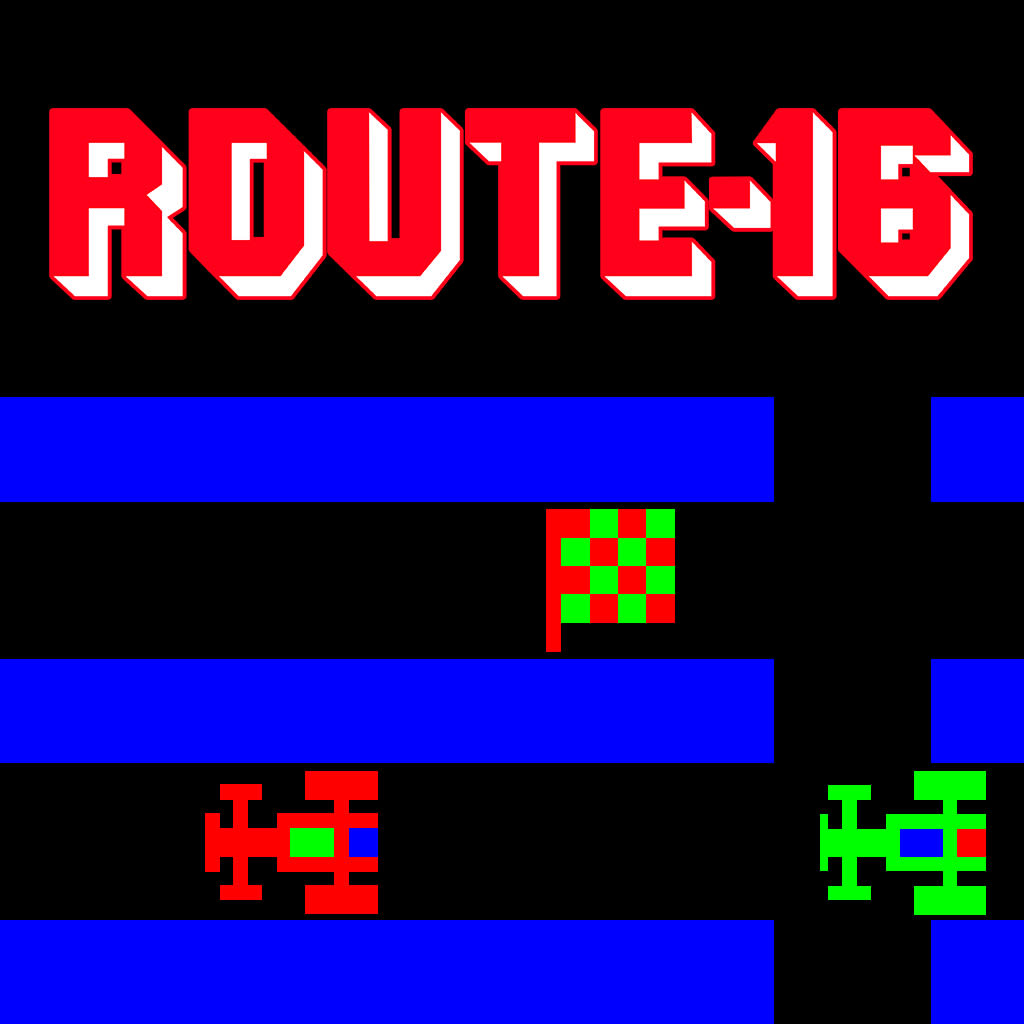
Before open-world driving games, before massive racing franchises, and before developers had the technology to create enormous digital landscapes, arcade designers were already experimenting with the idea of freedom behind the wheel. ROUTE16 may look simple by modern standards, but beneath its basic presentation lies an ambitious concept that helped shape the future of maze-based action games. Released in 1981 by SUNSOFT, the game challenged players to navigate a sprawling network of interconnected areas while keeping one eye on the road and another on the enemy vehicles hunting them down.
At first glance, ROUTE16 appears to be a straightforward arcade chase. You control MAD X, a small but nimble car tasked with recovering stolen money bags hidden throughout a dangerous maze. The objective is clear: collect everything, avoid the enemy cars, and escape safely. Yet the genius of ROUTE16 lies in how it presents its world, switching between two distinct perspectives that force players to think both tactically and instinctively.
Returning to ROUTE16 today is an interesting experience, as it highlights just how creative early arcade developers had to be. Without the ability to create enormous environments, SUNSOFT made a small maze feel much larger by allowing players to shift between a close-up view and a wider strategic map. The result is a game that feels like a product of its time while still showing flashes of design ideas that would become common decades later.
The Road Less Travelled
The defining feature of ROUTE16 is its dual-perspective system. The game splits between Maze Mode and Radar Mode, and knowing when to use each view is essential to survival. Maze Mode places players directly within the level’s individual sections, offering a more detailed view of the immediate surroundings. Here, the focus is on careful driving, avoiding tight corners, collecting items, and escaping enemies that can appear with little warning.
Radar Mode dramatically expands the view, revealing the entire stage layout and all 16 maze sections. This perspective changes how players approach the game by revealing the bigger picture. Instead of blindly rushing ahead, players can plan routes, monitor enemy movements, and decide when it is safer to move between areas.
For 1981, this was an incredibly forward-thinking concept. Many arcade games of the era were built around a single fixed viewpoint, but ROUTE16 created a sense of scale by giving players two ways to interact with the same environment. The transition between these perspectives remains the game’s greatest achievement, turning a simple maze into something that feels alive and constantly changing.
The challenge lies in balancing these two views effectively. Spending too much time focused on the smaller maze sections can leave players vulnerable, as they may lose track of approaching enemies. Relying too heavily on Radar Mode can make navigation more difficult, as smaller details disappear. Finding the right balance between awareness and precision is where the real skill of ROUTE16 lies.
Survival Behind the Wheel
The basic gameplay loop centres on collection and survival. MAD X must traverse the maze network, gathering all available items while evading enemy vehicles that relentlessly pursue the player. Unlike many modern games with numerous tools and abilities, ROUTE16 keeps things tightly focused. Your greatest weapon is your ability to read the maze, anticipate danger, and make quick decisions.
Enemy cars constantly apply pressure, turning every journey into a tense escape. Their movement patterns create moments of panic as they close in from different directions, forcing players to change plans at a moment’s notice. There is genuine satisfaction in narrowly avoiding a collision or finding a perfect route through the maze while an enemy car is right behind you.
However, the simplicity that makes ROUTE16 appealing can also feel limiting. The gameplay is built around repetition, and after several attempts the structure becomes familiar. Players who enjoy the pure arcade challenge will appreciate the focus, but those expecting more variety may find the experience a little too bare compared with modern action games.
Collecting flags offers one of the few opportunities to turn the tables. When collected, these special items temporarily empower MAD X, allowing players to challenge the enemy cars rather than simply avoid them. These moments create a satisfying shift in momentum and provide a brief sense of control in a game designed around vulnerability.
A Piece of Arcade History
Playing ROUTE16 today is less about uncovering a complex adventure and more about appreciating its historical significance. This is a game that helped pioneer ideas that would later become standard in gaming. The concept of switching between detailed exploration and a strategic overview feels surprisingly familiar when compared with modern games that constantly shift between close action and wider planning.
SUNSOFT’s design philosophy is clear throughout the experience. Every mechanic serves a purpose, and there is very little wasted space. The game does not overwhelm players with unnecessary systems or distractions. Instead, it delivers a pure arcade challenge centred on movement, observation, and survival.
The modern release also benefits from features that make revisiting older games easier. Quality-of-life improvements such as save options and display enhancements help remove some of the barriers that come with playing an early 80s arcade title. These additions allow players to appreciate the original design without being constrained by the limitations of the hardware it was created for.
The presentation naturally shows its age. The visuals are simple, the audio is minimal, and the overall experience lacks the depth players might expect today. However, judging ROUTE16 purely by modern standards would miss the point. This is a snapshot of an era when developers were experimenting with new ways to make players feel immersed, within limited technical boundaries.
Final Thoughts
ROUTE16 is a fascinating piece of arcade history that deserves recognition for its creativity and influence. While its straightforward structure and repetitive gameplay may not appeal to everyone, the innovative dual-perspective system remains genuinely impressive. SUNSOFT managed to create tension, strategy, and a sense of exploration from a surprisingly simple concept.
It is not a game that will keep every modern player entertained for dozens of hours, but it does not need to be. ROUTE16 succeeds as a reminder of the imagination and experimentation that defined early arcade gaming. For fans of retro titles or anyone interested in seeing where modern maze and driving concepts began, this classic journey with MAD X is still worth taking.
Want to experience the complete history of MAD X? Read our full review of ROUTE16 COLLECTION, bringing together the original arcade classic, ROUTE16TURBO and the modern reimagining ROUTE16R in one complete retro package.











[…] ROUTE16 ReviewThe original 1981 arcade classic that introduced the series’ innovative dual perspective gameplay and established MAD X as one of SUNSOFT’s earliest arcade icons. […]