History has a funny habit of making you think you know more than you do. We all leave school remembering certain dates, famous names and major events, but ask a slightly unexpected question and that confidence can disappear quickly. That is where Kids’ World History: Which Side Are You On!? comes in, taking a huge subject and reducing it to a collection of quick, accessible questions designed to test what you know while hopefully teaching you a few things along the way.
Developed and published by MASK, Kids’ World History: Which Side Are You On!? is an educational quiz aimed primarily at children and families, although there is nothing stopping adults from joining in. The concept is straightforward. You are presented with a statement or historical situation and asked to choose between two possible answers. Sometimes it is a matter of deciding whether something is true or false, while other questions frame historical situations as a choice between two opposing sides or perspectives.
That simplicity is important because history can be an intimidating subject for younger players. There are thousands of years of events, countless important figures and enough names and dates to make even the keenest student reach for a textbook. Kids’ World History: Which Side Are You On!? wisely avoids trying to teach everything at once and instead concentrates on small pieces of information that can be absorbed one question at a time.
Two Answers, One Decision
The basic gameplay loop could hardly be easier to understand. Read the statement, decide which answer you believe is correct, then see whether your historical knowledge has served you well. There is something pleasingly immediate about the format, with no elaborate tutorial or complicated system standing between you and the questions.
Getting an answer right provides that little flash of satisfaction that makes quiz games so addictive. Getting one wrong can be just as valuable, because suddenly you have learned something you did not know a few seconds earlier. That is arguably where the educational side of the experience works best. Rather than making mistakes feel like failure, the game can turn them into opportunities to discover an interesting fact that might stick in your mind.
The true-or-false structure also makes the game incredibly approachable. You do not need to understand a complicated set of rules before you can begin, and the questions are presented in bite-sized pieces that can be tackled at your own pace. This is very much an experience designed around curiosity rather than pressure, which should make it particularly suitable for younger players who might otherwise find traditional history lessons a little dry.
A Trip Through the Past
One of the most appealing aspects of history is its sheer variety, and Kids’ World History: Which Side Are You On!? takes advantage of that by covering different eras, cultures, famous figures and historical events. That allows the quiz to jump from one part of the world to another, reminding players that history is not simply a list of British kings, European wars and dates to be memorised for an exam.
There is a certain charm in never quite knowing what the next question will ask. One moment you might be thinking about an ancient civilisation, while the next takes you towards a famous historical figure or an event that changed the course of a culture. The questions are brief, but they can open the door to much bigger conversations, particularly when played by a child and parent together.
That family element is arguably one of the game’s strongest qualities. A question can easily prompt someone to say, “I didn’t know that,” followed by a quick discussion about why something happened or who a particular historical figure was. For an educational title, encouraging that kind of curiosity is far more valuable than simply throwing facts at the player and expecting them to memorise them.
More Quiz Than History Lesson
There is a distinction worth making, though. Kids’ World History: Which Side Are You On!? is a history quiz rather than a comprehensive history course, and that becomes increasingly obvious the longer you play. The information is delivered in short snippets, leaving little opportunity to explore the background behind the questions in any real depth.
This can occasionally leave you wanting more. A particularly interesting question might introduce an event or person you know very little about, only for the game to move on to the next challenge. It is enough to spark curiosity, but you will often need to look elsewhere if you want the full story. In that sense, the game works rather nicely as a gateway into history, but it should not be regarded as a replacement for books, documentaries or a more comprehensive educational programme.
The lack of branching scenarios is another missed opportunity. The “which side are you on?” idea could have been developed into something much more ambitious, perhaps allowing players to explore historical decisions and see how different choices might have changed events. Instead, the format remains primarily a straightforward quiz. It works, but there is a sense that the concept could have been pushed further.
Friendly Presentation
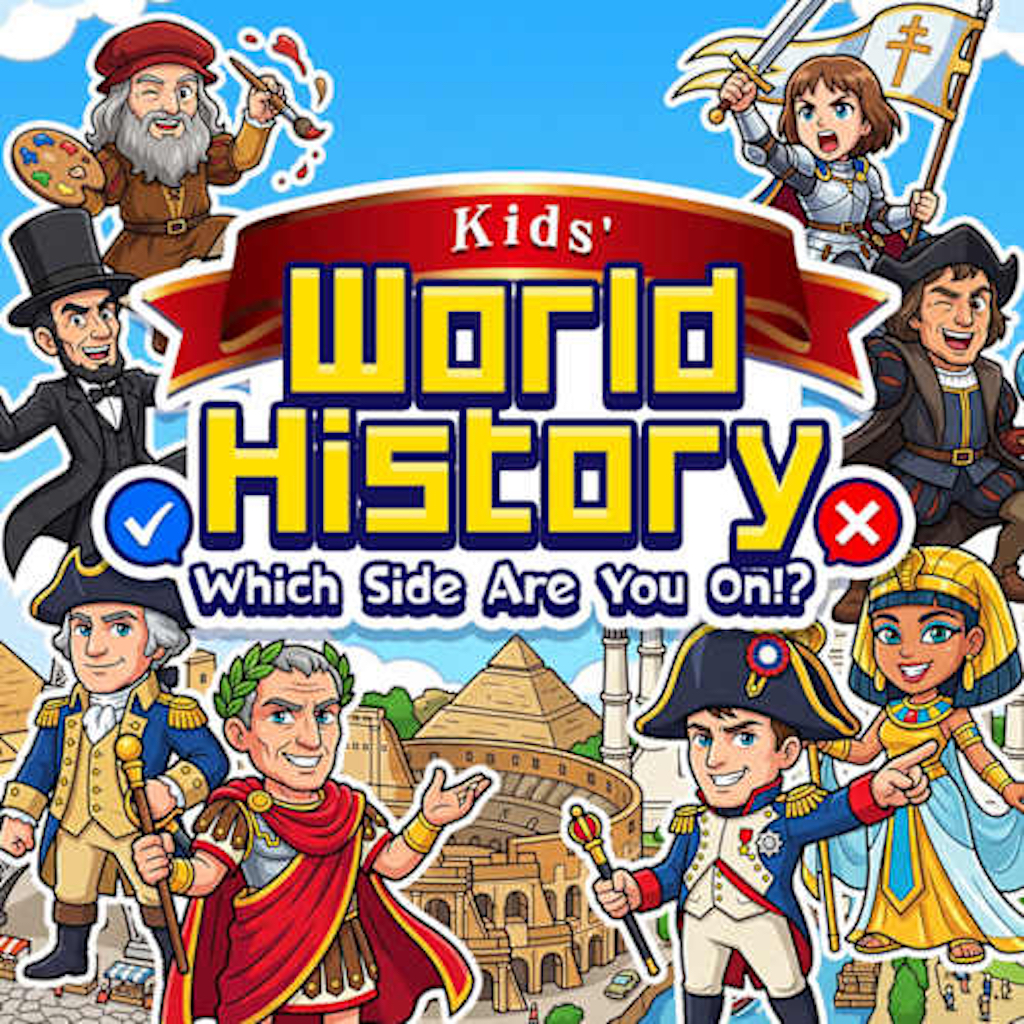
Visually, the game adopts a colourful, cartoon-based approach that suits its younger audience. Historical subjects can sometimes be presented in a rather serious or intimidating manner, so it is refreshing to see them delivered in a friendlier format. The illustrations help break up the text and give the experience a more welcoming feel.
The simplicity of the presentation also means players are unlikely to be distracted by unnecessary visual clutter. Everything is designed to get you to the question and the answer as quickly as possible. Whether you are using touch controls in handheld mode or playing with buttons, the basic interactions are straightforward enough that even younger players should be able to pick them up quickly.
It is not a visually spectacular game, and it does not need to be. The important thing is that the presentation supports the educational purpose rather than getting in the way. The cartoon artwork gives it some character, while the simple interface makes it easy to understand what you are supposed to do.
The Switch Makes a Good Quiz Machine
The Nintendo Switch is a particularly natural home for this sort of experience. You can play it on the television with the family gathered around, or pick it up in handheld mode and answer a few questions while sitting somewhere comfortable. There is no need to commit to a lengthy gaming session, which makes it ideal for those moments when you simply want something quick and uncomplicated.
That flexibility also works well for parents. It is easy to imagine a child asking a parent to join in, only for the parent to realise their own historical knowledge is not quite as impressive as they remembered from school. There is a nice opportunity here for the game to become a shared experience rather than something that simply sits on the console as another educational application.
It is also the kind of game that can be returned to periodically. You might remember an answer from a previous session, recognise a historical name that has appeared before, or discover that a fact you previously got wrong has somehow lodged itself in your memory. The repetition can therefore have an educational benefit, even if the underlying gameplay remains very simple.
Where It Falls Short
The biggest issue is also the most obvious. Once you are familiar with the basic question-and-answer format, there is very little mechanical variety to keep things fresh. There are no substantial strategy systems, no meaningful progression mechanics, and no elaborate historical simulations hidden beneath the quiz format.
That is not necessarily a problem for the audience it targets, but it does limit the game’s appeal to older players who might want something more substantial. Adults seeking a serious history challenge could find the experience a little lightweight, while younger players may eventually wish for more ways to interact with the historical subjects introduced.
I also found myself wishing the game did more with the information it presents. When a question concerns an interesting event or a fascinating figure, it would be great to have the option to tap for additional information, perhaps with a short explanation, a timeline, or a collection of related facts. That extra layer could have turned the game from a simple quiz into something that genuinely encourages deeper exploration.
Final Verdict
Kids’ World History: Which Side Are You On!? is a modest educational quiz that understands one important thing about learning: sometimes the best way to get somebody interested in a subject is simply to spark curiosity. Its questions are easy to understand, the two-answer format is accessible, and the colourful presentation gives history a friendly face. Most importantly, getting an answer wrong does not feel like a punishment. Instead, it can be the moment when you discover something you never knew.
There is certainly room for more. The game would benefit enormously from additional modes, deeper explanations, historical timelines, and perhaps some genuine branching scenarios that allow players to explore the consequences of historical decisions. As it stands, it is much closer to a digital trivia book than a fully developed educational adventure.
Nevertheless, there is something rather likeable about that modest ambition. Kids’ World History: Which Side Are You On!? does not try to turn history into a complicated strategy game or bury young players beneath pages of information. It asks a question, gives you two choices, and lets you discover whether you were right. Sometimes that is enough to spark the most important question of all: “What happened next?”
For children, families, and anyone who enjoys a quick trivia challenge, there is genuine educational fun to be found here. Just do not expect it to teach you everything about world history. Think of it instead as a colourful little doorway into a subject that is far bigger, stranger, and more fascinating than any quiz could possibly contain.