Pool is one of those rare sports that translates surprisingly well into video games. Unlike football, racing, or basketball, its fundamentals remain largely unchanged whether you’re holding a cue in a crowded pool hall or a controller on your sofa. Precision, patience, and a little nerve are all that matter. Konami understood this back in 1987 when it released RACK’EM UP, and nearly forty years later, that understanding still shines through.
Thanks to Hamster Corporation’s latest preservation effort, Arcade Archives 2: RACK’EM UP arrives on modern platforms with all the conveniences expected of contemporary retro collections, while maintaining complete respect for the original arcade experience. It may not have the immediate spectacle of a classic shooter or beat ’em up, but beneath its modest presentation lies an arcade sports title that remains remarkably engaging.
For long-time arcade enthusiasts, this release serves as another reminder that some of gaming’s most enduring ideas were established decades ago. For newcomers, it offers a fascinating glimpse into an era when developers were still discovering how to recreate real-world activities through digital systems.
A Surprisingly Advanced Arcade Pool Game
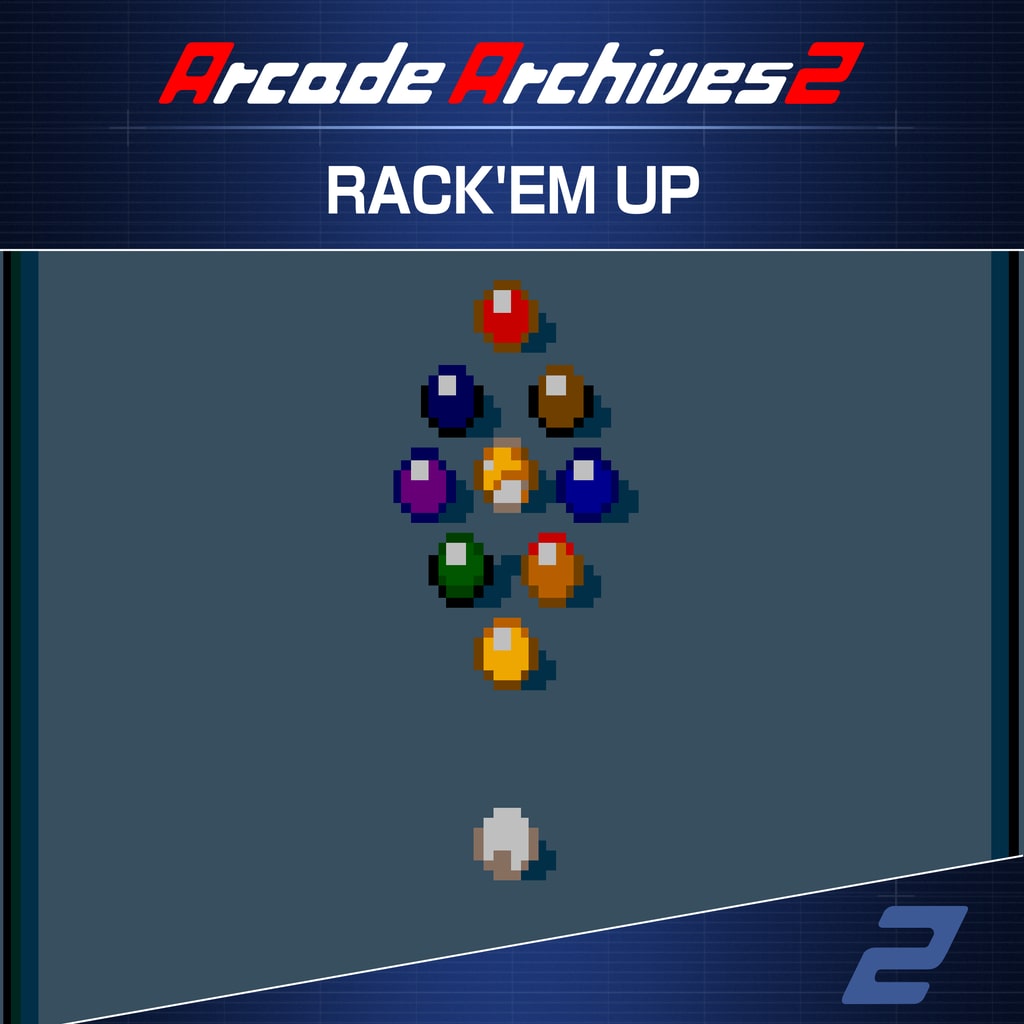
At first glance, RACK’EM UP appears straightforward. The table sits in front of you, the balls are racked, and your objective is simple: sink them before your opponent does. Yet within minutes it becomes clear that Konami was aiming for something more ambitious than a basic cue-and-ball simulation.
The game features both Nine-Ball and Rotation rule sets, each with its own strategic considerations. Nine-Ball is immediately accessible and easy to understand, while Rotation introduces stricter requirements that demand careful planning and precise shot execution. The latter mode in particular reveals how much depth lies beneath the surface.
What made RACK’EM UP stand out in arcades during the late 1980s was its innovative use of perspective. Rather than relying entirely on a flat overhead view, players could switch to a dedicated 3D display to better assess angles, distances, and ball positioning. It sounds commonplace today, but at the time it was genuinely impressive technology.
Even now, that feature remains useful. Pool is a game of geometry, and being able to examine the table from multiple viewpoints makes lining up difficult shots feel considerably more intuitive.
The Satisfaction of the Perfect Shot
The heart of RACK’EM UP lies in its shot mechanics. Every strike feels deliberate, and each successful pot delivers a small but satisfying rush of accomplishment.
What elevates the game beyond simple arcade entertainment is its treatment of spin. Players can precisely control where the cue strikes the ball, applying topspin, backspin, or side spin to influence the cue ball’s movement after impact. This transforms routine shots into miniature puzzles, where positioning is as important as scoring.
There is a wonderful sense of progression as these systems are learned. Early matches may involve little more than basic potting, but as confidence grows, you’ll begin experimenting with bank shots, clever rebounds, and positional play that feels remarkably authentic.
The game never overwhelms players with complexity, yet it constantly rewards those willing to improve. That balance between accessibility and mastery remains one of its greatest strengths.
Arcade Simplicity at Its Finest
Modern sports simulations often bury players beneath menus, statistics, and endless options. RACK’EM UP belongs to a very different philosophy.
You insert your virtual coin, choose a mode, and start playing. Within seconds, you are lining up your first shot. There are no lengthy tutorials, progression trees, or unlock systems demanding attention.
That simplicity creates an immediacy that remains refreshing. It is the sort of game you can enjoy for ten minutes during a short break or lose yourself in for an hour while chasing increasingly efficient clears.
The newly added Time Attack Mode in the Arcade Archives 2 release complements this philosophy beautifully. Rather than focusing purely on score, it challenges players to clear tables as quickly as possible. The result is a surprisingly addictive mode that encourages optimisation and precision without fundamentally altering the original experience.
Combined with the existing Original Mode, Hi Score Mode, and Caravan Mode, there is more variety here than one might initially expect from a vintage pool game.
Hamster’s Preservation Work Continues to Impress
One of the most remarkable aspects of the Arcade Archives line is the consistency of its quality. Hamster understands that preservation is about more than simply making old software playable.
Arcade Archives 2: RACK’EM UP includes an excellent suite of modern conveniences. Save states let players preserve progress at any moment. Rewind functionality provides a safety net for newcomers learning the mechanics. Screen customisation options help tailor the visual presentation to personal preferences, whether that means crisp modern pixels or CRT-inspired nostalgia.
The addition of Variable Refresh Rate support further enhances the package. While casual players may never consciously notice the difference, the result is a smoother, more faithful recreation of the original arcade hardware.
These features never compromise the integrity of the game itself. Instead, they make an already approachable title even easier to enjoy in 2026.
Where Age Begins to Show
For all its strengths, RACK’EM UP cannot entirely escape its age. The presentation is understandably basic by modern standards. Menus are sparse, visual flourishes are minimal, and there is little sense of spectacle around matches. Players accustomed to contemporary sports titles packed with commentary, camera angles, and dramatic presentation may find the experience somewhat bare.
The limited scope of the original arcade design also becomes apparent during extended sessions. While mastering the mechanics remains rewarding, there is only so much variety. Once you’ve experienced both rule sets and explored the available modes, the core gameplay loop changes very little.
Online functionality is another area where some players may feel disappointed. Global leaderboards are excellent for competitive score chasing, but there is no online head-to-head multiplayer. Friends can compete locally, but those hoping to challenge opponents online will need to look elsewhere. These limitations are understandable given Hamster’s commitment to preserving arcade authenticity, but they are still worth acknowledging.
A Snapshot of Arcade History
What makes Arcade Archives 2: RACK’EM UP particularly interesting is how clearly it captures a specific moment in gaming history. This was a period when developers were experimenting with ways to simulate real-world activities on relatively limited hardware. Every innovation mattered. Every clever solution was a meaningful step forward.
Playing RACK’EM UP today offers a glimpse into that creative process. Its 3D viewing system, spin mechanics, and accessible design all demonstrate a studio seeking to make virtual pool feel convincing. The fact that so many of those ideas still work decades later speaks volumes about the quality of the original design.
Not every arcade classic deserves modern attention. Some are interesting historical curiosities and little more. RACK’EM UP earns its place because it remains genuinely fun.
Final Verdict
Arcade Archives 2: RACK’EM UP is another excellent preservation effort from Hamster Corporation and a reminder that strong fundamentals never go out of style. Its blend of accessible controls, satisfying shot mechanics, and surprisingly deep strategy ensures that this 1987 arcade release remains entertaining nearly forty years later.
The presentation is undeniably dated, and the lack of online multiplayer limits its long-term appeal for some players. Yet these shortcomings are outweighed by the quality of the underlying game and the care taken in bringing it to modern hardware.
Whether you’re a retro enthusiast, a pool fan, or simply curious about arcade history, RACK’EM UP delivers a polished and enjoyable experience that stands the test of time far better than many of its contemporaries.