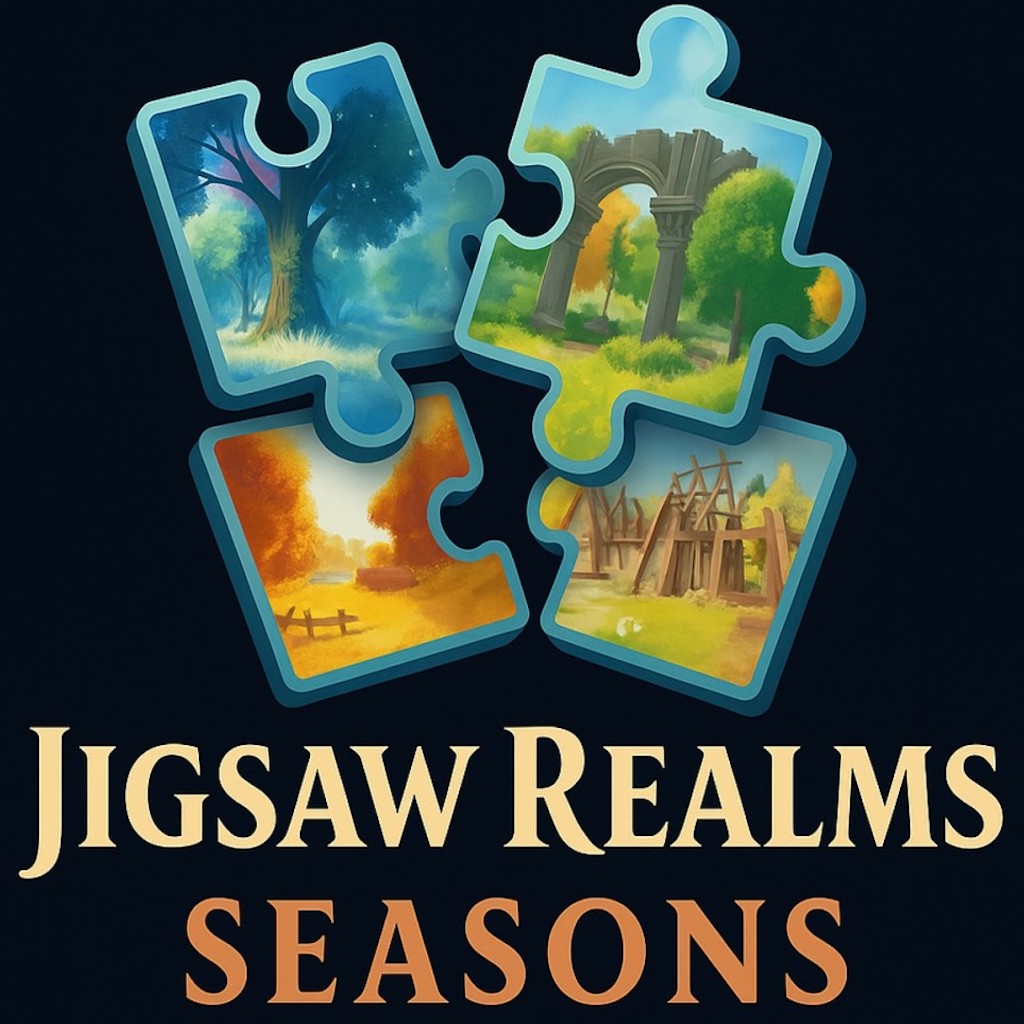
There’s a quiet confidence required to release a pure jigsaw puzzle game in 2026. No roguelike hooks. No competitive leaderboards. No meta-progression trees. Just puzzles — pieces scattered across a digital table, waiting patiently to be assembled.
Jigsaw Realms: Seasons doesn’t try to disguise what it is. It leans fully into the appeal of calm, tactile satisfaction, offering 30 handcrafted puzzles divided across four seasonal themes: Blooming Spring, Sunlit Summer, Colorful Autumn, and Peaceful Winter. It’s a deliberately low-pressure experience built for short, cozy sessions and longer reflective evenings alike.
The real question isn’t whether it reinvents the genre. It doesn’t. The question is whether it captures the meditative joy that makes jigsaw puzzles timeless.
For the most part, it does.
A Year in Thirty Puzzles
The game’s structure is simple but effective. Thirty puzzles are split across the four seasons, with each realm offering a distinct visual and tonal identity.
- Blooming Spring focuses on soft pastels, flowering fields, and renewal.
- Sunlit Summer brings vibrant skies, golden sunlight, and lush landscapes.
- Colorful Autumn leans into warm oranges and reds, with falling leaves and harvest imagery.
- Peaceful Winter shifts toward cool blues and snowy serenity.
Each puzzle celebrates a moment within its season rather than repeating generic imagery. There’s a noticeable attention to composition — scenes feel intentionally framed, not procedurally generated.
The stylized fantasy art style gives the game a cohesive identity. These aren’t hyper-realistic photographs but illustrated vistas with gentle lighting and painterly textures. The aesthetic supports the game’s “Zen” philosophy: soothing rather than stimulating.
Progressive Difficulty Without Pressure
One of the smartest design decisions in Jigsaw Realms: Seasons is its progressive difficulty curve. Early puzzles feature a relatively low piece count, making them ideal for quick pick-up-and-play sessions. As you unlock more realms, complexity gradually increases.
Importantly, this progression never feels punishing. There are no timers. No score multipliers. No penalty for stepping away mid-puzzle. The game allows you to save and resume freely at any time — a small but crucial quality-of-life feature for a genre built around patience.
The absence of high-score pressure is refreshing. In an era where nearly every game demands optimization, this one invites you to slow down. The only goal is completion.
That design philosophy won’t appeal to players who crave challenge spikes or competitive metrics. But for those seeking a decompression tool rather than a test of skill, it’s exactly the right call.
Dual Control Schemes: A Thoughtful Touch
Perhaps the most practical feature is the inclusion of dual control schemes. Players can seamlessly switch between standard controller input and touchscreen controls, with the latter feeling especially natural in handheld mode.
Touch controls elevate the experience considerably. Dragging pieces with your finger, rotating them intuitively, and hearing the satisfying “click” upon correct placement creates a tactile illusion that controller inputs can’t fully replicate.
That said, controller support is clean and functional. Cursor movement is responsive, and snapping mechanics are forgiving without being overly automatic. There’s no sense of fighting the interface — a vital requirement for a puzzle game built around precision placement.
The flexibility to swap between inputs at any time makes the game adaptable to different play styles and environments.
Atmosphere Over Gimmicks
The game’s Zen identity is reinforced by its lo-fi, atmospheric soundtrack. Music is subtle, ambient, and unobtrusive. It complements the seasonal themes without drawing attention away from the puzzles themselves.
Sound design is minimal but effective. The gentle click when a piece locks into place is oddly satisfying — a small auditory reward that reinforces progress.
Visually, the interface avoids clutter. Pieces are clearly outlined, edges are easy to identify, and the board layout is clean. There are no unnecessary UI distractions competing for your attention.
The cumulative effect is a calm, meditative space. It feels less like a game demanding engagement and more like a digital tabletop waiting for you to sit down.
Where It Holds Back
The purity of Jigsaw Realms: Seasons is both its strength and its limitation.
There are no alternative modes — no randomized piece rotations, no puzzle remix options, no dynamic piece shapes. What you see is what you get: handcrafted puzzles presented as intended.
For some players, that consistency will feel satisfying. For others, it may limit replay value once all 30 puzzles are completed.
The piece counts, while progressively increasing, never reach extreme complexity. Hardcore jigsaw enthusiasts accustomed to massive 1000+ piece challenges may find the difficulty curve gentle.
Additionally, while the art is cohesive and charming, it stays within a narrow stylistic lane. There are no dramatic shifts in perspective or experimental layouts.
The game is cozy — perhaps almost too comfortable.
Designed for Cozy Sessions
The pacing of Jigsaw Realms: Seasons makes it ideal for short sessions. Completing an early puzzle might take just a few minutes. Later ones stretch comfortably into longer sittings without feeling overwhelming.
Because you can save and resume anytime, the game adapts well to real-life interruptions. It’s particularly well-suited for handheld play before bed, during travel, or as a calming buffer between more intense titles.
In that sense, it succeeds as a companion game rather than a centerpiece release.
Who Will Love It?
This game is perfect for:
- Players seeking stress-free, cozy puzzle experiences
- Families looking for accessible, all-ages content
- Handheld users who prefer touchscreen interaction
- Anyone wanting a digital alternative to physical jigsaw puzzles
It’s less suited for:
- Competitive players seeking leaderboards
- Puzzle veterans craving high piece counts and complexity spikes
- Players expecting deep progression systems or unlockable mechanics
Understanding that target audience is essential. This isn’t a puzzle battleground — it’s a seasonal retreat.
Where It Shines — and Where It Settles
Strengths:
- Beautiful seasonal art direction
- Progressive but gentle difficulty curve
- Seamless controller and touchscreen support
- Relaxing soundtrack and satisfying sound design
- Save-and-resume flexibility
Weaknesses:
- Limited long-term replayability
- No alternative modes or modifiers
- Piece counts may feel modest to hardcore fans
The game’s biggest achievement is consistency. It delivers exactly what it promises: a calm, seasonal jigsaw journey.
Final Verdict
Jigsaw Realms: Seasons doesn’t attempt to revolutionize digital puzzling. Instead, it focuses on delivering a polished, cozy experience built around handcrafted art, thoughtful pacing, and accessible controls.
Its 30 puzzles provide enough content for multiple relaxed evenings, and the seasonal structure gives the experience a satisfying arc. The inclusion of touchscreen support enhances immersion, particularly in handheld mode, while the lack of timers and score pressures preserves its tranquil identity.
Its limitations — modest piece counts and minimal feature variety — keep it from reaching genre-defining heights. But as a budget-friendly, atmosphere-driven jigsaw experience, it accomplishes its goals with quiet confidence.
Sometimes, a game doesn’t need to surprise you. Sometimes, it just needs to offer a peaceful space to slow down and focus on one piece at a time.
And in that regard, Jigsaw Realms: Seasons fits together beautifully.